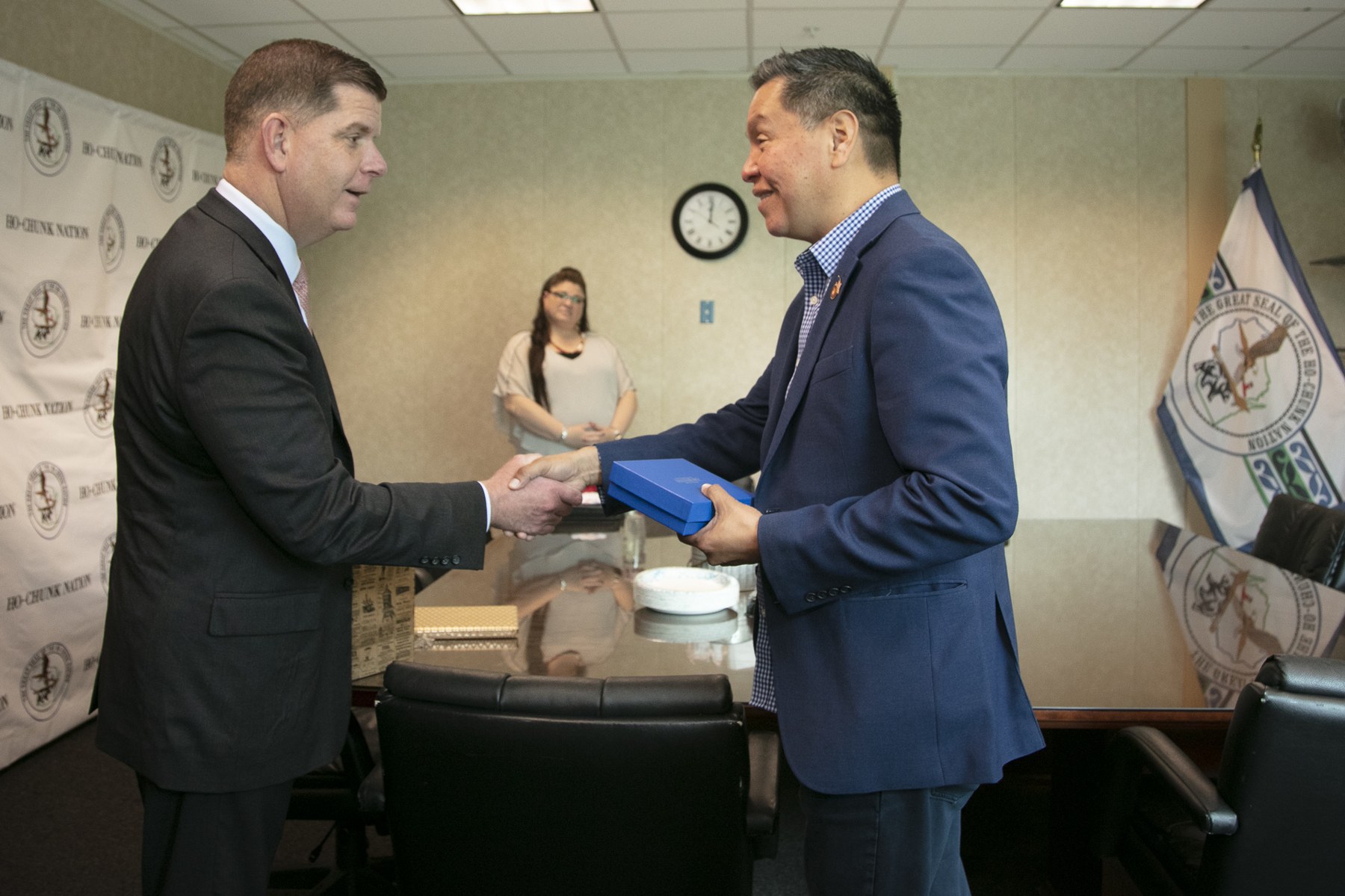
Marlon WhiteEagle and Marty Walsh at Ho-Chunk tribal offices, May25,2021Ariana Lindquist / U.S. Department of Labor,May25,2021,L-21-05-25-B-0730. Existing crop by MarginalCost via Wikimedia Commons. CC BY 2.0. No affiliation or endorsement implied.
Ho-Chunk is a broader people-name reading route. The starting sources here focus on the Ho-Chunk Nation in Wisconsin, whose own accounts explain its governmental and heritage-preservation work. The Nation’s separate directory entry remains available; this route does not merge it with the Winnebago Tribe of Nebraska or turn one institution’s account into every Ho-Chunk person’s experience.
See each region’s evidence for historical or present-day scope.
Homeland / region
Great Lakes / Wisconsin / Nebraska
Research depth
Source guide
Source collection
4 annotated resources · 4 Indigenous-led
Inspected sources
2 substantive works · selected content reviewed
Initial adequacy
Still unfinished
Source review
October 27, 2026
A source guide for a deeper dive.This entry provides a brief orientation and an organized reading path. A comprehensive deep dive has not yet been completed. Follow the annotated sources and distinguish primary community accounts from outside reference material.
Still unfinished
A small, purposefully selected actual-content starting path and specifically scoped credited image are now available. Fuller history, source comparison and community review remain open; quantity does not establish completion.
Assessment recorded October 27, 2026. This is separate from research completion and community review.
Add independently scoped Winnebago Tribe of Nebraska history and other Ho-Chunk community accounts.
Inspect further community-authored history, language publications and original records beyond the selected institutional passages.
Government names, historical people names and older uses of Winnebago require context; this guide does not settle every historical label.
Backdrop photographs & credits
These photographs have individual, documented connections to this entry. Their captions and source records define the people, place, object, and period shown; no one photograph represents every community within a broader label.
Marlon WhiteEagle and Marty Walsh at Ho-Chunk tribal offices, May25,2021 Ariana Lindquist / U.S. Department of Labor,May25,2021,L-21-05-25-B-0730. Existing crop by MarginalCost via Wikimedia Commons. CC BY 2.0. No affiliation or endorsement implied.
An individually scoped Wisconsin Ho-Chunk Nation meeting illustrates one government within this broader people-name route. It is not every Ho-Chunk community or present leadership. Actual Commons file-description body read, including date/place/subject, official USDOL credit and reused federal-work statement, explicit CC BY 2.0 image licence and crop history. CC BY 2.0 deed read. Exact1917×1277 image downloaded and visually inspected: Walsh at left, WhiteEagle at right, Ho-Chunk Nation wall/flag context visible. Dated historical officeholder attribution only; no present presidency, policy outcome or endorsement inferred. This image already carries a lossless crop20% horizontally and20% vertically recorded by Commons; the supplied file adds no alteration. Original linked USDOL Flickr page403ed in web tool, so original Flickr metadata is not claimed independently inspected; Commons image/credit/licence and EXIF attribution were inspected. Complete available 1917×1277 source frame proportionally resized to 1800×1199 and JPEG recompressed; no pixel crop or retouching. Original source copy retained privately. CSS crops/overlays affect display only.
Image, association, and reuse record reviewed 2026-10-27.
Full photographs are displayed proportionally above. A translucent background copy may be cropped by the viewport; it does not replace the complete image or its record.
The visual treatment does not change the research status, evidence, or remaining gaps recorded in this profile.
Start reading here
A short starting path through selected actual-content works. Read each annotation for the specific community, period and inspection limits; this is not a complete history or community endorsement.
Continue with the public heritage-preservation and language account.
These are selected starting points. The full annotated collection, source perspectives, inspection limits and remaining research questions follow below. A starting guide is not an exhaustive history or community endorsement.
01
Identity and context
Ho-Chunk people continue through distinct communities and governments in Wisconsin and Nebraska.
Focus the next stage of research on: Ho-Chunk-authored history, language, removal and the meaning of Winnebago in historical sources. The sources below are selected reading paths; their authorship, dates and community scope should guide how they are used.
The Ho-Chunk Nation’s institutional account distinguishes its government and traditional-government relationship. It gives one specific contemporary point of entry into the broader Ho-Chunk story. Readers should retain the publisher’s scope: a particular Nation’s organization is not automatically the institutional arrangement of every Ho-Chunk community. The source’s linked constitutional texts and present legal rules were not independently examined.
The Nation’s Heritage Preservation account describes work involving cultural stewardship, archives and language continuity. These are institutional responsibilities and stated aims, rather than a measurement of results or a claim that all public or private cultural material is open for reuse. The selected public passages offer a useful starting route; internal records, personal services and sensitive locations remain outside this guide.
Add independently scoped Winnebago Tribe of Nebraska history and other Ho-Chunk community accounts.
Inspect further community-authored history, language publications and original records beyond the selected institutional passages.
Government names, historical people names and older uses of Winnebago require context; this guide does not settle every historical label.
Cohort06: selected actual-content sources and specifically scoped credited imagery form a bounded starting guide. Reused publications/photos are not new global works. Comprehensive history and community review remain open.
Follow the reading path
Sources & further reading
Open any title to read the original source. Annotations explain what each link can help you explore.
No Indigenous-led source is identified in this entry yet. This is a gap in this collection, and does not imply an absence of community knowledge or organization.
Community or Indigenous-organization perspective linked for this entry. Use “HO-CHUNK NATION” to begin with the publisher’s own account; check whether its scope is one community or a wider people.
Community or Indigenous-organization perspective linked for this entry. Use “Ho-Chunk Nation - Wisconsin First Nations” to begin with the publisher’s own account; check whether its scope is one community or a wider people.
Publication: Undated; site footer and crawl dates are not publication dates
The Nation’s explanation of governmental organization and traditional homeland. Read as institutional description; linked constitutions, exact present rules and ancient chronology are unverified.
Inspection: Content reviewed for the stated scope
Scope: Actual complete main body29–34 read. Synthesis uses the four named branches, constitutional reference and traditional-government distinction29, with the homeland statement34. Term lengths, district totals, court staffing, developing courts and speculative ancient dates are not adopted as independently current or established facts. Linked constitutions and law were not inspected.
Review recorded: October 27, 2026
Access note: Public HTML actual selected body text read; linked documents and media are outside this inspection.
Publication: Undated; site footer and crawl dates are not publication dates
Departmental account of preservation responsibilities and language continuity. Service aims are distinguished from evaluated outcomes; restricted materials and personal enrollment services are outside scope.
Inspection: Content reviewed for the stated scope
Scope: Actual Department of Heritage Preservation mission98–109, public services137–153 and Language Division statement275–279 read. Personal enrollment instructions, private information, named staff/contact details, burial locations and operational/eligibility advice excluded. Linked language site, internal records, surveys and reports not reviewed.
Review recorded: October 27, 2026
Access note: Public HTML actual selected body text read; linked documents and media are outside this inspection.
Related entries may represent alternate names, constituent communities, wider groupings, or historical connections. Read the naming notes before treating entries as equivalent.
Robey’s Atlas of Indigenous North America · Compiled October 19, 2026 · Ho-Chunk