Fort William First Nation is an Anishinaabe community connected to the western end of Lake Superior and Anemki-Wajiw. These starting sources pair historical treaty interpretation with a named Elder’s account of family, land-based learning and education.
See each region’s evidence for historical or present-day scope.
Homeland / region
Ontario, Canada — listing address only
Research depth
Source guide
Source collection
2 annotated resources · 1 Indigenous-led
Inspected sources
2 substantive works · selected content reviewed
Initial adequacy
Still unfinished
Source review
October 27, 2026
Names & relationshipsListed as an Anishinabek Nation member First Nation. This is an organizational relationship; membership alone does not establish ethnicity, language, ancestry, citizenship, jurisdiction or representation of another named community.
A source guide for a deeper dive.This entry provides a brief orientation and an organized reading path. A comprehensive deep dive has not yet been completed. Follow the annotated sources and distinguish primary community accounts from outside reference material.
Still unfinished
A small, purposefully selected actual-content starting path and specifically scoped credited image are now available. Fuller history, source comparison and community review remain open; quantity does not establish completion.
Assessment recorded October 27, 2026. This is separate from research completion and community review.
Add further community-authorized histories and public language/education resources.
Inspect underlying treaty and annuity records rather than relying only on museum interpretation.
Review fresh community publications independently; one live governance page displayed unrelated injected sports links and was excluded from current-authority use.
Backdrop photographs & credits
These photographs have individual, documented connections to this entry. Their captions and source records define the people, place, object, and period shown; no one photograph represents every community within a broader label.
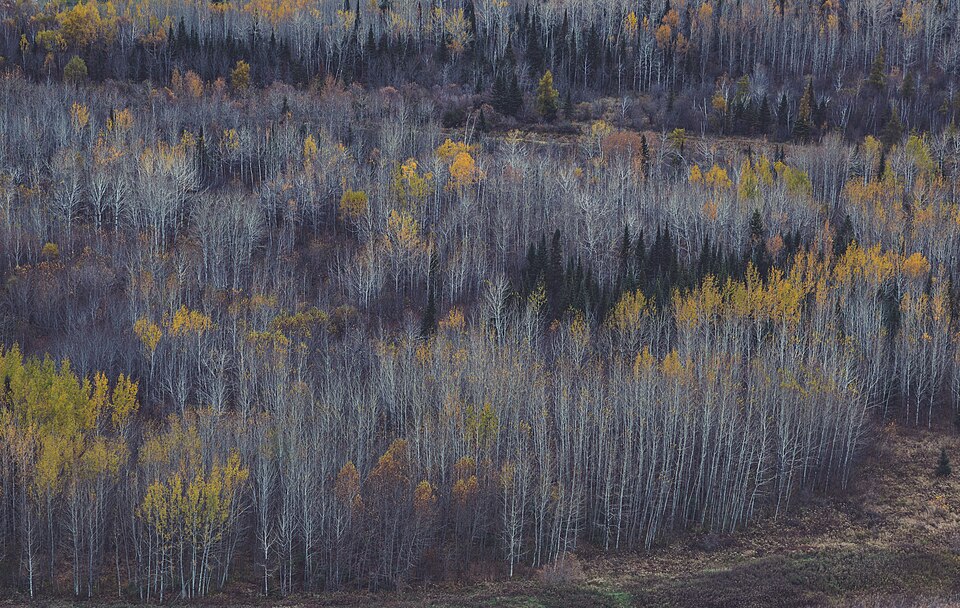
Autumn trees at Mount McKay, Fort William First Nation Tony Webster / Wikimedia Commons · CC BY-SA 2.0
Photographer’s exact record identifies Fort William First Nation and Mount McKay; the museum account independently pairs Mount McKay/Anemki-Wajiw with the community. A specific public landscape, not all territory, members, cultural objects or proof of ownership. No sacred practice or detailed ceremonial site is depicted. Unchanged complete record-linked960px full-frame preview. The larger original was not inspected or copied. CSS crops/overlays affect display only. The photographic image remains available under CC BY-SA 2.0; creator/source/license credit retained. Parent imported the supplied complete JPEG unchanged; the recorded original/preview/earlier-derivative limits remain. CSS crops/overlays affect display only.
Image, association, and reuse record reviewed 2026-10-27.
Full photographs are displayed proportionally above. A translucent background copy may be cropped by the viewport; it does not replace the complete image or its record.
The visual treatment does not change the research status, evidence, or remaining gaps recorded in this profile.
Start reading here
A short starting path through selected actual-content works. Read each annotation for the specific community, period and inspection limits; this is not a complete history or community endorsement.
Then read one Elder’s attributed account of land-based upbringing and later learning.
These are selected starting points. The full annotated collection, source perspectives, inspection limits and remaining research questions follow below. A starting guide is not an exhaustive history or community endorsement.
01
Treaty history in a particular community
Thunder Bay Museum’s Robinson-Superior account connects Fort William First Nation with the1850 treaty and identifies Anemki-Wajiw as Mount McKay. Its archival caption describes an annuity gathering there in1933. These records offer a way to study the treaty relationship through a named community and documented event, rather than treating every north-shore First Nation as interchangeable. The museum’s interpretation does not settle present legal rights or establish that treaty commitments were fulfilled.
In Rick Garrick’s2021 report, Fort William Elder Rita Fenton recalls a childhood in which her family hunted, fished and gathered from the land. She also describes later education and renewed learning about Indigenous histories. Her public storytelling connects personal experience with responsibilities to younger generations. This is an attributed individual life account; it should not stand in for every Fort William family or authorize reproducing cultural teachings beyond their public context.
Develop a community-directed history and annotated reading collection.
Review community-specific imagery and reuse terms before substantive profile publication.
Review detailed relationships, naming changes and historical regional connections.
Add further community-authorized histories and public language/education resources.
Inspect underlying treaty and annuity records rather than relying only on museum interpretation.
Review fresh community publications independently; one live governance page displayed unrelated injected sports links and was excluded from current-authority use.
Cohort06: selected actual-content sources and specifically scoped credited imagery form a bounded starting guide. Reused publications/photos are not new global works. Comprehensive history and community review remain open.
Follow the reading path
Sources & further reading
Open any title to read the original source. Annotations explain what each link can help you explore.
No Indigenous-led source is identified in this entry yet. This is a gap in this collection, and does not imply an absence of community knowledge or organization.
Read the introduction, complete Robinson Superior subsection and its photograph captions; other treaty sections are outside this selected review. Connects Fort William/Anemki-Wajiw with the 1850 treaty and a specifically dated 1933 annuity gathering. Museum interpretation and archival captions, not a current legal ruling or a review of original treaty papers. No museum images reproduced.
Inspection: Content reviewed for the stated scope
Scope: Read the introduction, complete Robinson Superior subsection and its photograph captions; other treaty sections are outside this selected review. Connects Fort William/Anemki-Wajiw with the 1850 treaty and a specifically dated 1933 annuity gathering. Museum interpretation and archival captions, not a current legal ruling or a review of original treaty papers. No museum images reproduced.
Review recorded: October 27, 2026
Access note: Substantial actual public article body read through the web reader; this is not an inspection of linked publications, photographs or underlying records. No login or reader paywall was encountered for the inspected text.
Read the complete main article, including Rita Fenton’s own recollections of land-based childhood, identity and later education. Reporting about a December virtual presentation; the underlying recording was not inspected. One named person’s account, not every family’s experience or a current service directory. Images and detailed personal/health experiences are not reproduced.
Inspection: Content reviewed for the stated scope
Scope: Read the complete main article, including Rita Fenton’s own recollections of land-based childhood, identity and later education. Reporting about a December virtual presentation; the underlying recording was not inspected. One named person’s account, not every family’s experience or a current service directory. Images and detailed personal/health experiences are not reproduced.
Review recorded: October 27, 2026
Access note: Substantial actual public article body read through the web reader; this is not an inspection of linked publications, photographs or underlying records. No login or reader paywall was encountered for the inspected text.