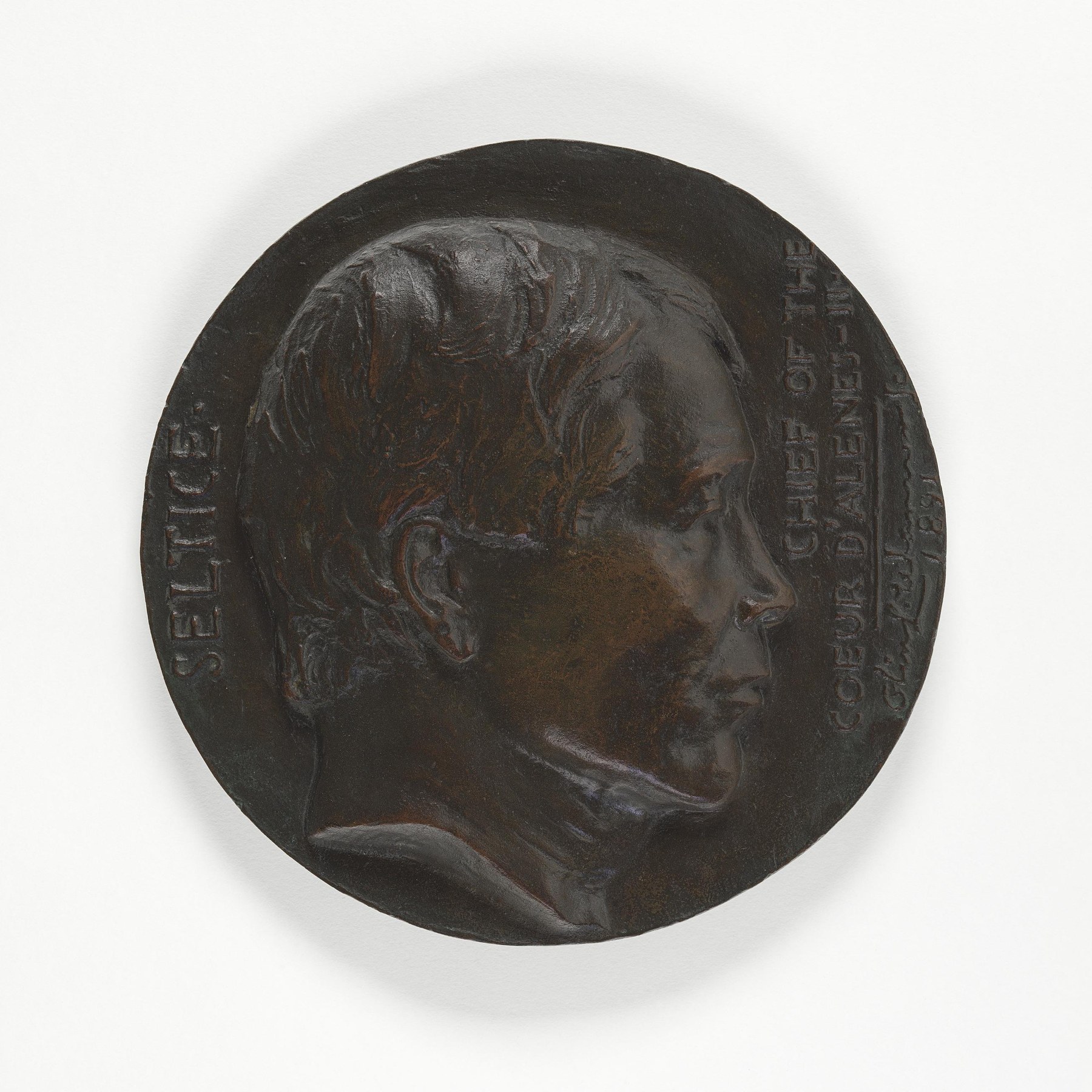
Seltice, Chief of the Coeur D’Alênes, 1891Olin Levi Warner, 1891. Smithsonian American Art Museum, A Gift of Alison Warner Waterman in memory of her mother, Frances D. Warner, 1985.76.3. Public domain.
Tribal government / contemporary community · Added to the original list
Coeur d'Alene Tribe
The Coeur d'Alene Tribe is an Idaho tribal government whose public histories connect community, land and water. This starting guide follows the Tribe's own accounts of historical change, language documentation and care for the lake. The wider Coeur d'Alene reading profile supplies additional context without replacing this named government route.
See each region’s evidence for historical or present-day scope.
Homeland / region
Idaho
Research depth
Source guide
Source collection
3 annotated resources · 3 Indigenous-led
Inspected sources
3 substantive works · selected content reviewed
Initial adequacy
Still unfinished
Source review
October 27, 2026
Names & relationshipsThis is an individually named government and community route. Its own publications and the selected institutional sources provide the scoped context below. Broader people-level reading routes are related context, not interchangeable governments, an individual citizenship determination or a boundary claim.
A source guide for a deeper dive.This entry provides a brief orientation and an organized reading path. A comprehensive deep dive has not yet been completed. Follow the annotated sources and distinguish primary community accounts from outside reference material.
Still unfinished
A compact source-led introduction to this named government. Selected public sources provide useful orientation, with limited voices, historical coverage and outcome evaluation; no comprehensive completion or community endorsement is claimed.
Assessment recorded October 27, 2026. This is separate from research completion and community review.
Compare selected community chronology with dated agreements and land records; current legal rules are not established.
Update environmental implementation through newer records before describing present cleanup conditions.
Broaden family, arts and foodways voices; no community review or language-outcomes assessment is recorded.
Backdrop images & credits
These images have individual, documented connections to this entry. Their captions and source records define the people, place, object, and period shown; no one image represents every community within a broader label.
Seltice, Chief of the Coeur D’Alênes, 1891 Olin Levi Warner, 1891. Smithsonian American Art Museum, A Gift of Alison Warner Waterman in memory of her mother, Frances D. Warner, 1985.76.3. Public domain.
Museum photograph of Olin Levi Warner’s 1891 bronze portrait relief of the specifically identified Coeur d’Alene leader Seltice. This is an outside sculptor’s historical portrait, not Coeur d’Alene-made art, a photograph of the living sitter, or a present government representation. The museum’s curators place Warner’s portraits in the context of racial classification and an erroneous expectation that Native peoples would disappear, and note that the sitters’ perspectives are poorly documented. That context is retained; no essential cultural or physical trait is inferred from the portrait. No traditional design meanings or community endorsement are claimed. Complete delivered 2600x2600 source frame preserved. Web JPEG resized proportionally to 1800x1800 and recompressed at quality 88; no pixel crop, generated material, retouching or added detail. Cards and opened-page backgrounds may use disclosed CSS crops/overlays. Visual review does not add substantive research counts or community endorsement. The original download endpoint returned a short Request Rejected HTML page instead of an image. No retry or challenge bypass was attempted. The separate public display URL returned directly by the same item API worked and supplied the inspected complete display frame. No claim that the original full-resolution file was inspected. Exact-government route uses this as a specifically identified historical leader portrait object. The visible caption must name Seltice and Warner and explain that this is a museum photograph of a bronze relief; it is not a photograph of a present citizen or council. This new mapping does not enlarge the original artwork attribution or establish present governmental representation. No fresh successful source-page inspection is asserted: the museum record request timed out on October 27, so the prior reviewed source/rights record is preserved. Complete delivered 2600x2600 source frame preserved. Web JPEG resized proportionally to 1800x1800 and recompressed at quality 88; no pixel crop, generated material, retouching or added detail. Cards and opened-page backgrounds may use disclosed CSS crops/overlays. Visual review does not add substantive research counts or community endorsement.
Image, association, and reuse record reviewed 2026-10-27.
Full images are displayed proportionally above. A translucent background copy may be cropped by the viewport; it does not replace the complete image or its record.
The visual treatment does not change the research status, evidence, or remaining gaps recorded in this profile.
Start reading here
Named government route; nearby people-level profiles remain related reading rather than interchangeable identities. Review dates and selected-content limits are preserved.
Read the Tribe's lake perspective with its explicit historical dates.
These are selected starting points. The full annotated collection, source perspectives, inspection limits and remaining research questions follow below. A starting guide is not an exhaustive history or community endorsement.
01
Community history and land
The Tribe's history introduces place, naming, government and changes in land ownership through a community-published account. It provides an opening perspective on relationships disrupted by settlement and land loss. Its acreage and chronology need comparison with the underlying agreements and records before making detailed legal claims. This narrative belongs to the Tribe; it does not summarize every neighboring Salish community.
The Culture Department describes a 1973 documentation effort and credits Lawrence G. Nicodemus and Joseph N. Bitar with work on writing and documenting the Coeur d'Alene language. Its reading-and-writing article combines a community history of that work with alphabet and lesson material. These public resources offer a concrete way into language learning while leaving present fluency and teaching outcomes unmeasured.
The Tribe's lake-management account links water with spiritual and material life, and discusses mining pollution, management planning and hydropower licensing. Several conditions and procedural details are explicitly dated to 2005. Read it as the Tribe's environmental history and perspective, then seek newer records for current cleanup conditions.
Compare selected community chronology with dated agreements and land records; current legal rules are not established.
Update environmental implementation through newer records before describing present cleanup conditions.
Broaden family, arts and foodways voices; no community review or language-outcomes assessment is recorded.
A community-specific starting guide reuses selected earlier actual-content reviews with their original dates/scopes. It does not add new global works merely because a URL appears on this route. Picture identification/rights are separate from historical adequacy or community endorsement.
Follow the reading path
Sources & further reading
Open any title to read the original source. Annotations explain what each link can help you explore.
No Indigenous-led source is identified in this entry yet. This is a gap in this collection, and does not imply an absence of community knowledge or organization.
Community historical overview covering place, naming, government and changes in land ownership. Its acreage and timeline statements are attributed to the Tribe’s page and should be compared with dated treaties, court records and planning documents; no old population estimate is reused as current.
Read the complete public article and its alphabet/lesson material. The Tribe recounts a 1973 documentation effort and credits Lawrence G. Nicodemus and Joseph N. Bitar with language documentation and orthography work. This community narrative and teaching resource describes a particular language project, not a fluency survey.
Read the complete public page, including its discussion of the lake’s spiritual and material importance, mining pollution, the 1991–95 management plan and hydropower licensing. The page explicitly dates several conditions and procedural details to 2005; use it as historical context, not a current status report.
Related entries may represent alternate names, constituent communities, wider groupings, or historical connections. Read the naming notes before treating entries as equivalent.
Robey’s Atlas of Indigenous North America · Compiled October 19, 2026 · Coeur d'Alene Tribe