“Coahuiltecan” is a later umbrella label used for many distinct Indigenous groups of South Texas and northeastern Mexico. It does not identify one uniform historical nation, language, government, or present-day community. The surviving colonial record is uneven, and scholars disagree about terminology and relationships. This page distinguishes group-specific evidence from the separate public accounts of Tāp Pīlam Coahuiltecan Nation and the Miakan/Garza Band.
See each region’s evidence for historical or present-day scope.
Homeland / region
Texas / Northeastern Mexico
Research depth
Expanded profile
Source collection
15 annotated resources · 4 Indigenous-led
Inspected sources
12 substantive works · selected content reviewed
Initial adequacy
Still unfinished
Source review
October 26, 2026
An expanded introduction, with sources reviewed.This profile develops several themes through identified sources. Citations connect each section to its evidence; remaining gaps appear below. It has not been reviewed or endorsed by the community.
Still unfinished
Twelve substantive resources have actual-content inspection records, including first-party Tāp Pīlam and Miakan/Garza materials, a peer-reviewed study of one Miakan-Band program, scholarly and educational syntheses, and targeted mission research. They support a careful introductory profile and document major disagreements. The source target is a quantity measure, not a finding that the broad umbrella entry is complete or that these communities endorse the synthesis. The previously unread INAH lead now has an explicit selected-content inspection record, but remains excluded from substantive quantity. No new excellent work or independent identity/continuity claim is established by this bounded pass.
Assessment recorded October 26, 2026. This is separate from research completion and community review.
The entry covers a broad historical umbrella; the evidence cannot stand in for separate research on the many named peoples and contemporary communities placed under it.
The origin and scope of the term “Coahuiltecan” conflict across sources: the 2014 CHAPS chapter describes later scholarly usage while the current NPS visitor page attributes it to Spanish geography. The reviewed material does not settle this disagreement.
Mission registers and language records are incomplete; group-to-language and group-to-place identifications require more primary-source and specialist review.
No community review or endorsement is recorded. Tāp Pīlam Coahuiltecan Nation and Miakan/Garza Band / Indigenous Cultures Institute are distinct sources and should not be treated as interchangeable or exhaustive.
The Institute language page contains an internally inconsistent speaker-status statement; no current speaker count or language-vitality conclusion is made.
The 2001 NPS report and 1985 mission study are dated. Their consultation recommendations and legal discussion do not establish current status.
Selected methodological and final-comment pages of the INAH language-history article have now been inspected. Its vocabulary tables and cited originals remain unevaluated, its broad disappearance assertions are not adopted, and its publication dates conflict internally. More focused community-directed and specialist language evidence remains needed.
No current population, exhaustive descendant list, legal recognition status, or specific map association is asserted.
Backdrop photographs & credits
These photographs have individual, documented connections to this entry. Their captions and source records define the people, place, object, and period shown; no one photograph represents every community within a broader label.
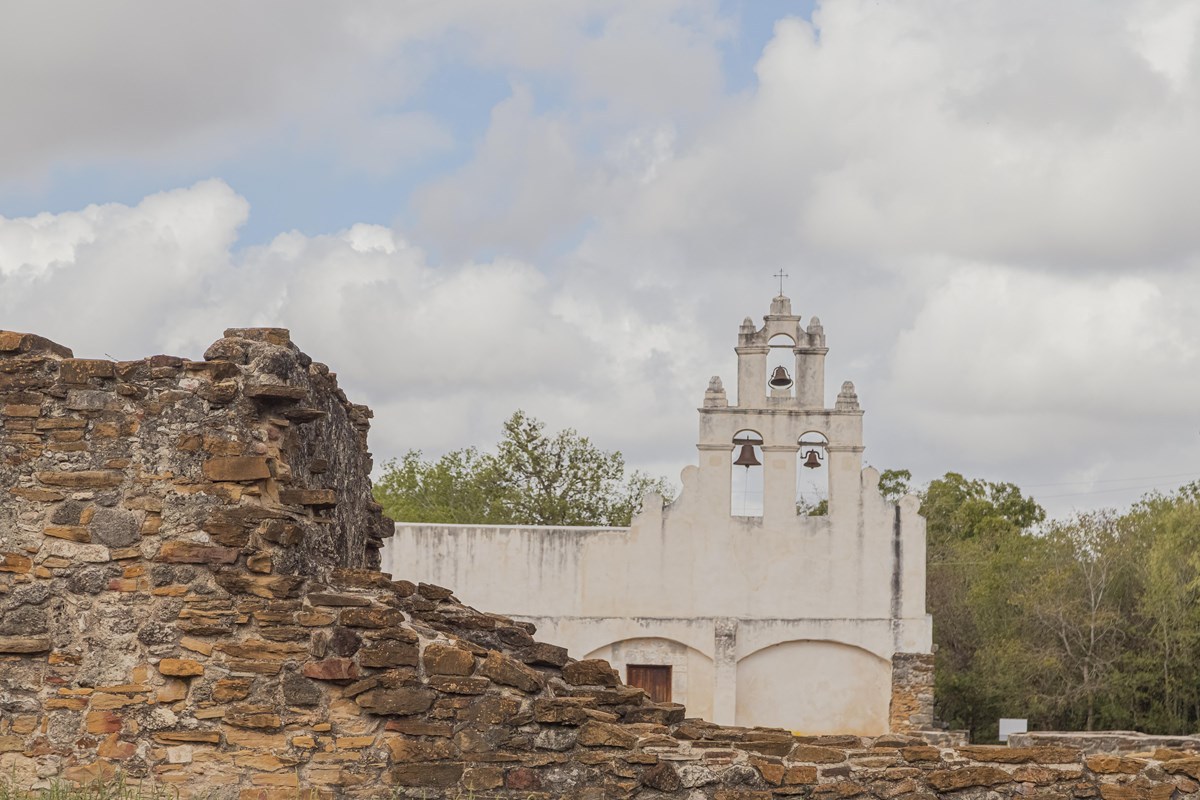
Mission San Juan church and stone ruins NPS Photo / Andrew Shirey, San Antonio Missions National Historical Park · U.S. government work
A modern photograph of the Spanish colonial Mission San Juan in San Antonio. The existing profile discusses this particular mission and records diverse peoples associated with the missions. This illustrates a documented colonial setting, not a universal Coahuiltecan building tradition, a single unified people, a present government's headquarters or territorial boundaries. Read the primary NPS gallery caption and creator credit, the Mission San Juan visitor description and existing park acknowledgement. Rechecked the current profile's mission-specific source scope. Visually inspected the complete 1200×800 gallery-delivered image. The exact linked URL and HTML source were used; no filename was guessed. No image content was generated, altered or cropped by this review. Complete available NPS gallery-delivered frame, not a claim to the photographer's highest-resolution camera original. The separate place-page image was rejected as the primary asset because its URL explicitly serves a cropped view. Web copies were proportionally compressed without upscaling, retouching or invented content. CSS crops/overlays apply to card/background displays; the opened-page banner preserves the complete delivered source view.
Image, association, and reuse record reviewed 2026-10-26.
Full photographs are displayed proportionally above. A translucent background copy may be cropped by the viewport; it does not replace the complete image or its record.
The visual treatment does not change the research status, evidence, or remaining gaps recorded in this profile.
Start reading here
Coahuiltecan is a broad historical umbrella, not one uniform nation, government or language. Tāp Pīlam and the Miakan/Garza Band/Indigenous Cultures Institute are distinct; neither is an exhaustive representative of South Texas or northeastern Mexico peoples.
The mission study shows why inconsistent registers and changing group names require careful local rather than universal conclusions.
These are selected starting points. The full annotated collection, source perspectives, inspection limits and remaining research questions follow below. A starting guide is not an exhaustive history or community endorsement.
01
A broad label, not one uniform people
Historical records name many autonomous communities, while later scholarship grouped some South Texas and northeastern Mexico peoples under “Coahuiltecan.” Authors disagree about whether the word began as a colonial regional label or a later scholarly classification. A 2014 CHAPS chapter describes a scholarly category; a current National Park Service page attributes the name to Spanish geography. The evidence reviewed here does not resolve that conflict, and neither account makes the label a universal self-name. The safest use is as a broad, contested umbrella—not a single polity or shared culture.
Educational and archival syntheses identify Payaya, Pacuache, Mariames, Aranama, Tamiques, Manos de Prieta and many other names, often from particular places or mission records. The sources describe varied languages, seasonal movements, resource use and relationships; some groups’ territories overlapped while others were distant or hostile. These reconstructions are uneven and often depend on Spanish accounts. A name appearing near a place or in a mission list is not by itself proof of a single people’s complete homeland or identity.
Language evidence and classification remain limited
The surviving language material is fragmentary. Researchers have debated which documented languages were related to Coahuilteco and whether a wider “Coahuiltecan” language family is supported. Mission lingua-franca use further complicates identifying who spoke which language. The Institute’s language-reclamation page documents its program history, but its statement that the language is extinct because fewer than 1,000 people speak it is internally contradictory and uncorroborated; this profile does not use that number or claim a current speaker count.
Mission records describe specific, changing communities
Spanish mission records are valuable but incomplete sources created for colonial administration and religious purposes. A 1985 San Antonio mission study documents conflicting registers and warns that names, languages and earlier locations are difficult to match consistently. A separate Espíritu Santo case study discusses Aranama, Tamiques and Manos de Prieta, and records disagreement over whether Aranama and Mariames were distinct. These findings apply to a specific mission setting, not to every community grouped under the umbrella.
Tāp Pīlam Coahuiltecan Nation publishes its own history and timeline; that account should be read as the Nation’s perspective on its community, not as a substitute for all South Texas peoples. Separately, the Indigenous Cultures Institute says it was founded by members of the Miakan/Garza Band and describes that Band’s history, public programs and repatriation priorities. A peer-reviewed 2023 article documents one Miakan-Band Elders’ educational program. These sources present distinct community and program scopes; they do not establish that either organization represents every community connected to the broad label.
Older sources sometimes describe groups as extinct or cultures as lost. Such statements reflect authors’ interpretations of a limited archive and their historical categories; they do not prove that descendants disappeared. A 2001 National Park Service report describes differing views about continuity and calls for further consultation in one mission context. The present sources do not establish an exhaustive list of descendant communities, current legal status, population figures, or one shared cultural account. Community review remains open. No individual historical map was examined in this batch, so no map association was added.
The entry covers a broad historical umbrella; the evidence cannot stand in for separate research on the many named peoples and contemporary communities placed under it.
The origin and scope of the term “Coahuiltecan” conflict across sources: the 2014 CHAPS chapter describes later scholarly usage while the current NPS visitor page attributes it to Spanish geography. The reviewed material does not settle this disagreement.
Mission registers and language records are incomplete; group-to-language and group-to-place identifications require more primary-source and specialist review.
No community review or endorsement is recorded. Tāp Pīlam Coahuiltecan Nation and Miakan/Garza Band / Indigenous Cultures Institute are distinct sources and should not be treated as interchangeable or exhaustive.
The Institute language page contains an internally inconsistent speaker-status statement; no current speaker count or language-vitality conclusion is made.
The 2001 NPS report and 1985 mission study are dated. Their consultation recommendations and legal discussion do not establish current status.
Selected methodological and final-comment pages of the INAH language-history article have now been inspected. Its vocabulary tables and cited originals remain unevaluated, its broad disappearance assertions are not adopted, and its publication dates conflict internally. More focused community-directed and specialist language evidence remains needed.
No current population, exhaustive descendant list, legal recognition status, or specific map association is asserted.
Follow the reading path
Sources & further reading
Open any title to read the original source. Annotations explain what each link can help you explore.
No Indigenous-led source is identified in this entry yet. This is a gap in this collection, and does not imply an absence of community knowledge or organization.
Publication: Undated community timeline; dates within page are attributed there
The Nation’s own public timeline is a first-party account of Tāp Pīlam history and community continuity. Its sweeping chronology and deep-time claims are presented as the Nation’s account, not as independently verified claims about every South Texas people. Read alongside group-specific historical research.
Inspection: Content reviewed for the stated scope
Scope: Read the complete visible History timeline, including its dated periods, mission-era entries and contemporary organizational chronology. The linked image and underlying archival or archaeological evidence were not independently examined.
A community site index linking public resolutions and proclamations. It is useful as a route to primary documents, not as a substantive historical work. The page also includes placeholder text and unverified membership figures; those are not used.
Inspection: Supporting or limited review; see scope
Scope: Inspected the full visible listing and linked document labels. The page’s placeholder copy and membership figures were excluded; the linked instruments are not counted as separately inspected here.
A substantial scholarly synthesis describing hundreds of separately named groups and the difficulty of reconstructing language, culture and political organization from uneven Spanish records. Its wording about “extinct” groups and its population estimates reflect the article’s interpretation and date; the conclusion does not establish that descendants disappeared.
Inspection: Content reviewed for the stated scope
Scope: Read the full visible article and bibliography, including its classification debate, mission-language discussion, regional overview and conclusion. Cited publications and original Spanish records were not independently reviewed.
An educational synthesis presenting Coahuiltecan as a geographic catch-all for diverse South Texas and northeastern Mexico peoples. It names Payaya, Pacuache and Mariames and describes seasonal movement, language diversity and overlapping relationships. Its deep-time continuity inference and other reconstructions are the exhibit authors’ interpretations, not demonstrated genealogies for every named people.
Inspection: Content reviewed for the stated scope
Scope: Read the complete substantive exhibit page, its historical and foodways passages, the ending and credits/source links. Embedded primary quotations were read as presented; cited works and archival records were not opened independently.
Named groups·Language diversity·Seasonal lifeways·Regional history
Scholarly / archaeological synthesisIn Native American Peoples of South Texas, Community Historical Archaeology Project with Schools (CHAPS), University of Texas–Pan AmericanSource 5
A chapter in a regional scholarly volume. The authors characterize “Coahuiltecan” as a later scholarly category and discuss its thin linguistic basis and internal diversity. They also make cultural-loss claims; these are dated author conclusions that should be weighed against community accounts and later work. The chapter is not a comprehensive account of all contemporary peoples.
Inspection: Content reviewed for the stated scope
Scope: Read chapter 2, printed pages 13–17 (PDF pages 20–24), including its terminology and summary passages. Other chapters, full references, original archaeological collections and the book’s map were not independently reviewed. The volume states all rights reserved; linked for reading, not reproduced.
A dated group-by-group study of communities recorded at the San Antonio missions. Its authors emphasize conflicting and incomplete mission registers and the uncertainty of identifying groups, languages and premission locations. The report is a regional historical analysis, not a present-day community or legal-status determination.
Inspection: Content reviewed for the stated scope
Scope: Read the report’s methods/limitations, conclusions and selected mission-by-mission discussions in the HTML edition. Other entries and underlying Spanish registers were not exhaustively checked; cited archival records were not independently opened.
A park-specific overview of San Antonio’s mission communities, archaeology, archives and descendant stories. It attributes a Spanish origin for the term Coahuiltecan; this conflicts with the 2014 CHAPS chapter’s account of a later scholarly label and with other treatments of the word. The page is useful for the park’s own public interpretation, not a definitive regional ethnography.
Inspection: Content reviewed for the stated scope
Scope: Read the complete substantive History & Culture page, including its mission-descendant section and archaeological interpretation. Linked family stories, archives and collections were not independently opened.
A focused case study of people associated with three locations of Mission Espíritu Santo, especially Aranama, Tamiques and Manos de Prieta. The exhibit records disagreement over possible Aranama/Mariame equivalence and notes sparse, ambiguous Spanish documentation. Its statements concern this mission setting, not every group placed under the broader label.
Inspection: Content reviewed for the stated scope
Scope: Read the complete visible Native Peoples page and its mission-specific discussion. Linked mission records and the exhibit’s archaeological sources were not independently opened.
The Institute’s own account says it was founded by Miakan/Garza Band members and describes the Band’s family continuity and 2013 Texas legislative recognition. This is a first-party institutional description of the Miakan-Garza Band, distinct from Tāp Pīlam; the Institute is not presented here as a tribal government or as representing every Coahuiltecan-descended community.
Inspection: Content reviewed for the stated scope
Scope: Read the full substantive About page and its founder/organization sections. Linked profiles, presentations and legislative documents were not independently reviewed.
A first-party description of the Institute’s language-reclamation program, including its 2022 launch and later course-development activity. The same page contradicts itself by calling the language extinct while claiming fewer than 1,000 speakers; that speaker figure and status statement are not repeated as facts. This page documents the organization’s program, not a linguists’ consensus or every community’s language.
Inspection: Content reviewed for the stated scope
Scope: Read the full visible program page, including its internally inconsistent language-status sentence and the stated 2022–2025 program chronology. Linked dictionary, course materials and future class application were not inspected.
A NPS baseline report that discusses differing interpretations of cultural extinction and survival in one San Antonio mission context and recommends further consultation. It records a 2001 research/consultation setting; its recommendations and legal discussion do not establish current NAGPRA status or speak for present communities.
Inspection: Content reviewed for the stated scope
Scope: Read the full 26-page PDF, including the summary, discussion of local descendant connections, contrasting interpretations and recommendations. Family-level details are not reproduced here; present legal status and underlying case files were not checked.
A peer-reviewed study of one Indigenous Summer Encounter for Latinx and Indigenous children led by Miakan-Band Elders. It offers a specific collaborative education example and the authors’ interpretation of climate pedagogy; it is not a general history or a survey of all South Texas peoples. Culturally specific content is not reproduced here.
Inspection: Content reviewed for the stated scope
Scope: Read the open-access full article, including abstract, author/context statements, research discussion and conclusions. No program materials, recordings or culturally restricted details were independently accessed or repeated.
Publication: Statement covers events through August 2022
A first-party Miakan-Garza account of a specific request to rebury three ancestors and the Band’s stated position. It documents that community’s own account of the dispute, not an independent legal determination, current case status, or shared position of all Coahuiltecan-descended peoples.
Inspection: Content reviewed for the stated scope
Scope: Read the full visible statement, including its dated chronology and quoted community position. The linked video, open letter, university correspondence and later developments were not inspected; no private family or sacred-site details are reproduced.
A present-day park acknowledgment that names multiple communities associated with San Antonio missions. It is contextual evidence of the park’s stated relationships, not an exhaustive list, a sovereignty determination, or proof that the named peoples share one identity.
Inspection: Supporting or limited review; see scope
Scope: Read the complete acknowledgment. It is retained as supporting context only and does not count as a substantive historical work.
Contemporary community relationships·Further reading
Scholarly / inspected supporting referenceNoroeste de México / Instituto Nacional de Antropología e HistoriaSource 15Supporting reference · outside substantive inspected count
Publication: Date unresolved: article received/accepted in 2024; PDF running header identifies January–June 2022
Selected methodological pages explain the author’s reorganization of earlier vocabulary lists and discuss disputed language classifications. This is a secondary reconstruction, not a new speaker survey. The article also makes sweeping disappearance claims; those are the author’s assertions and are not adopted as evidence that descendants ceased to exist. The vocabulary tables were not systematically evaluated.
Inspection: Supporting or limited review; see scope
Scope: Actual public 54-page publisher PDF: printed pp. 164–169 (PDF1–6); the ‘Lenguas y voces’ methodological passage on p.172 (PDF9); and final comments on p.206 (PDF43). References on pp.207 and215–217 inspected as locators only. Title page visually inspected. Full vocabulary tables and intervening sections were not content-reviewed; cited original works were not independently inspected.
Review recorded: October 26, 2026
Access note: Public Spanish PDF with English abstract downloaded normally through PowerShell; no reader account or paywall encountered. The article-record route returned a server error and web-tool PDF retrieval timed out, but actual PDF text was accessible and selected content read. Printed first page states received January13,2024 and accepted April15,2024; running headers say Noroeste de México, nueva época,no.5,January–June2022. Publication chronology is unresolved. No vocabulary, maps, ceremonial detail, archaeological locations or images reproduced; link-only use.
Counting note: Retained as inspected supporting criticism of a secondary reconstruction. Partial scope and unresolved broad claims do not warrant promoting the earlier lead into an excellent substantive work merely to increase the count.
Inspected material and access routes
Actual publisher PDF ↗ — Selected printed pp.164–169,172(methodological passage),206;54-page PDF not read in full.