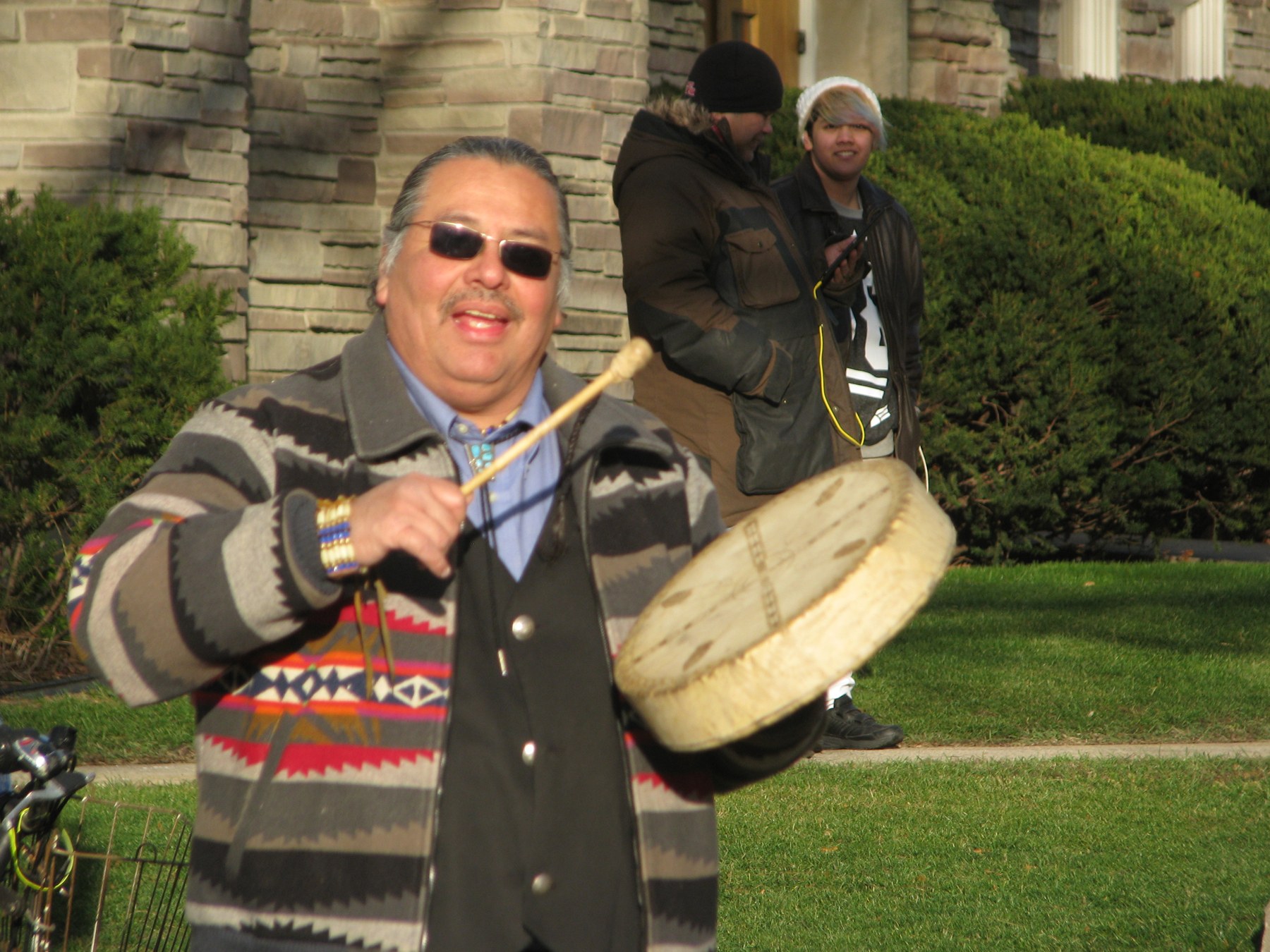
Myeengun Henry at a public climate march in Waterloo, 29 November 2015Laurel L. Russwurm / Wikimedia Commons (from Flickr) · CC BY 2.0 · resized and recompressed
The Nation’s history identifies Chippewas of the Thames as Deshkan Ziibiing Anishinaabeg and explains the Longwoods negotiations from its perspective. Emma Young’s conservation foreword connects stewardship with relationships and accountability.
See each region’s evidence for historical or present-day scope.
Homeland / region
Ontario, Canada — listing address only
Research depth
Source guide
Source collection
2 annotated resources · 0 Indigenous-led
Inspected sources
2 substantive works · selected content reviewed
Initial adequacy
Still unfinished
Source review
October 27, 2026
Names & relationshipsListed as an Anishinabek Nation member First Nation. This is an organizational relationship; membership alone does not establish ethnicity, language, ancestry, citizenship, jurisdiction or representation of another named community.
A source guide for a deeper dive.This entry provides a brief orientation and an organized reading path. A comprehensive deep dive has not yet been completed. Follow the annotated sources and distinguish primary community accounts from outside reference material.
Still unfinished
Two directly relevant works have been read for a bounded starting guide. The selected perspectives and periods leave substantial community history and later developments unreviewed.
Assessment recorded October 27, 2026. This is separate from research completion and community review.
Read the treaty texts and additional community-authored histories beyond this short institutional interpretation.
Review the conservation partnership’s later work and community assessments before making outcome claims.
Expand language, education and everyday history sources; selected front matter is not a review of the full conservation report.
Backdrop photographs & credits
These photographs have individual, documented connections to this entry. Their captions and source records define the people, place, object, and period shown; no one photograph represents every community within a broader label.
Myeengun Henry at a public climate march in Waterloo, 29 November 2015 Laurel L. Russwurm / Wikimedia Commons (from Flickr) · CC BY 2.0 · resized and recompressed
Exact photograph names Henry as from Chippewas of the Thames. Commons locates it in the 29 November 2015 Waterloo climate march. Waterloo’s official biography corroborates his former elected Chief role. This is one named person at a dated public event; no present office, ceremonial meaning or endorsement is asserted. Complete available 3264×2448 source frame proportionally resized to 1800×1350 and JPEG recompressed; no pixel crop or retouching. Original source copy retained privately. CSS crops/overlays affect display only.
Image, association, and reuse record reviewed 2026-10-27.
Full photographs are displayed proportionally above. A translucent background copy may be cropped by the viewport; it does not replace the complete image or its record.
The visual treatment does not change the research status, evidence, or remaining gaps recorded in this profile.
Read the Nation-attributed conservation foreword together with the report’s stated period and research limits.
These are selected starting points. The full annotated collection, source perspectives, inspection limits and remaining research questions follow below. A starting guide is not an exhaustive history or community endorsement.
01
The Nation’s account of Longwoods
Deshkan Ziibiing’s history describes the Longwoods negotiations as led by its own leadership. The account traces discussions beginning in 1818 and written versions in 1819, 1820 and 1822. It emphasizes leaders’ rejection of payment only in goods and their negotiation of an annuity. Reading these choices keeps the Nation’s account of the treaty’s spirit and intent visible alongside the written versions.
In the 2021 Deshkan Ziibi Conservation Impact Bond report, Emma Young’s Nation-attributed foreword describes the community’s involvement from the project’s early development. She presents lasting conservation as requiring repaired relationships with land and a recognition of humans within an interconnected environment. The accompanying preface identifies the report’s development period as January 2019–July 2021, so it provides a history of the partnership’s early aims.
Read the treaty texts and additional community-authored histories beyond this short institutional interpretation.
Review the conservation partnership’s later work and community assessments before making outcome claims.
Expand language, education and everyday history sources; selected front matter is not a review of the full conservation report.
Selected actual-content works support a bounded starting guide. Earlier source objects retain their original review dates and limits. Reused URLs, images and identity-only checks are not new global historical works. Full history and community review remain open.
Follow the reading path
Sources & further reading
Open any title to read the original source. Annotations explain what each link can help you explore.
No Indigenous-led source is identified in this entry yet. This is a gap in this collection, and does not imply an absence of community knowledge or organization.
Community public historyDeshkan Ziibiing / Chippewas of the Thames First NationSource 1
The Nation identifies itself and explains the Longwoods negotiations through its own account of leadership choices and treaty relationships. This public interpretation does not settle current legal questions.
Inspection: Content reviewed for the stated scope
Scope: Actual body under Who We Are, Our Treaty History, Why Three Versions and Other Treaty Relationships (web lines 87–112).
Emma Young’s Nation-attributed foreword presents conservation as restoring relationships with land. The report documents early partnership development; it does not demonstrate later ecological or financial outcomes.
Inspection: Content reviewed for the stated scope
Scope: Actual PDF citation page v, Emma Young foreword vi–viii and research lead preface xi–xii (PDF pages 6–9 and 12–13). Other chapters not claimed as read.