The Chippewas of Kettle and Stony Point First Nation’s community media account frames broadcasting as a way to share stories, language, local news and music.
See each region’s evidence for historical or present-day scope.
Homeland / region
Ontario, Canada — listing address only
Research depth
Source guide
Source collection
2 annotated resources · 0 Indigenous-led
Inspected sources
2 substantive works · selected content reviewed
Initial adequacy
Still unfinished
Source review
October 27, 2026
Names & relationshipsListed as an Anishinabek Nation member First Nation. This is an organizational relationship; membership alone does not establish ethnicity, language, ancestry, citizenship, jurisdiction or representation of another named community.
A source guide for a deeper dive.This entry provides a brief orientation and an organized reading path. A comprehensive deep dive has not yet been completed. Follow the annotated sources and distinguish primary community accounts from outside reference material.
Still unfinished
Two directly relevant works have been read for a bounded starting guide. The selected perspectives and periods leave substantial community history and later developments unreviewed.
Assessment recorded October 27, 2026. This is separate from research completion and community review.
Extend community-authored history beyond day schools and the selected broadcasting account.
Read underlying archival items and subsequent language-project work with community context; neither the live interface nor broadcasts were assessed.
Review Stony Point displacement and return through a separately bounded historical source collection; no present legal conclusion is supplied.
Backdrop photographs & credits
These photographs have individual, documented connections to this entry. Their captions and source records define the people, place, object, and period shown; no one photograph represents every community within a broader label.
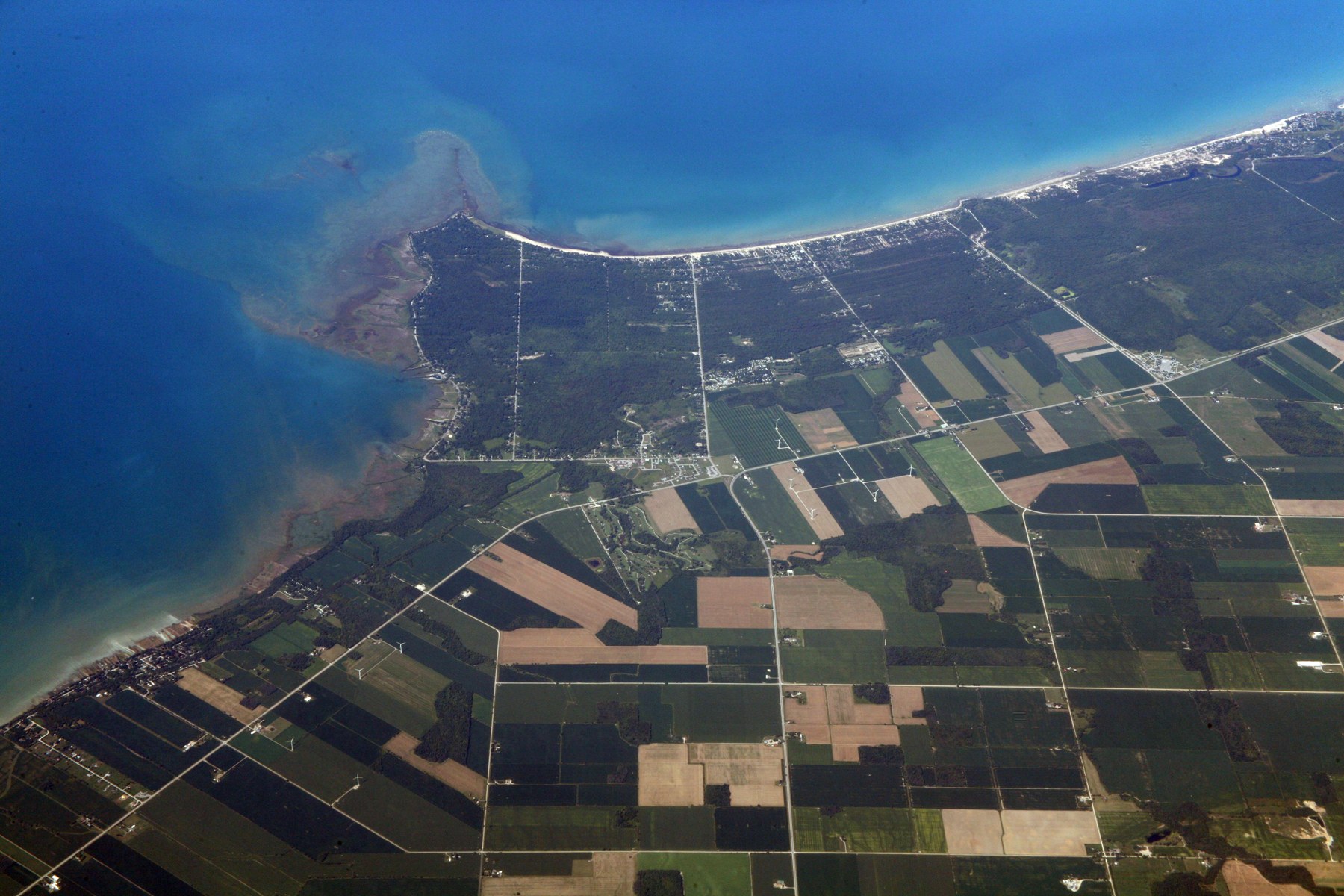
Kettle Point and the Lake Huron shoreline, 23 August 2013 Doc Searls / Wikimedia Commons (from Flickr) · CC BY 2.0 · resized and recompressed
Exact item identifies Kettle Point in Ontario projecting into Lake Huron. The Nation’s History & Culture page places Kettle Point on the lake’s south shore and links the place name to shoreline rocks. The full photo also includes surrounding agricultural land; no reserve boundary or Stony Point view is inferred. Complete available 4368×2912 source frame proportionally resized to 1800×1200 and JPEG recompressed; no pixel crop or retouching. Original source copy retained privately. CSS crops/overlays affect display only.
Image, association, and reuse record reviewed 2026-10-27.
Full photographs are displayed proportionally above. A translucent background copy may be cropped by the viewport; it does not replace the complete image or its record.
The visual treatment does not change the research status, evidence, or remaining gaps recorded in this profile.
Begin with a community-coauthored study that states its participants’ positions and the limits of digital archival access.
These are selected starting points. The full annotated collection, source perspectives, inspection limits and remaining research questions follow below. A starting guide is not an exhaustive history or community endorsement.
01
Reading day-school history with community participation
Jordan George, Jackson Pind and Benjamin Farmer Lacombe link the 1942 displacement at Stony Point to the day school’s closure and pupils’ relocation to Kettle Point. Their community-coauthored article also describes petitions and withheld attendance over teacher misconduct, bringing community responses into an archive largely produced by colonial officials.
The Eagle’s community-hosted description links radio with language, stories, local news and musicians; its anniversary statement refers to 2013. George and his collaborators separately describe translating a day-school website interface into Anishinaabemowin. They note that English-only records and uneven handwriting recognition continued to limit archival access.
Extend community-authored history beyond day schools and the selected broadcasting account.
Read underlying archival items and subsequent language-project work with community context; neither the live interface nor broadcasts were assessed.
Review Stony Point displacement and return through a separately bounded historical source collection; no present legal conclusion is supplied.
Selected actual-content works support a bounded starting guide. Earlier source objects retain their original review dates and limits. Reused URLs, images and identity-only checks are not new global historical works. Full history and community review remain open.
Follow the reading path
Sources & further reading
Open any title to read the original source. Annotations explain what each link can help you explore.
No Indigenous-led source is identified in this entry yet. This is a gap in this collection, and does not imply an absence of community knowledge or organization.
Community publication / broadcasting programChippewas of Kettle & Stony Point First NationSource 1
The station’s mission and service account connects local news, language, stories and musicians. Its anniversary statement explicitly refers to 2013, so operating details are not treated as a current schedule.
Inspection: Content reviewed for the stated scope
Scope: Actual Mission Statement, Services and About the Eagle text, web lines 11–22. Contact hours and linked station content excluded from substantive use.
Jordan George, Jackson Pind and Benjamin Farmer Lacombe link community school history with an Anishinaabemowin digital interface. Their account also exposes language and handwriting biases in colonial archives.
Inspection: Content reviewed for the stated scope
Scope: Actual PDF printed 69–79: author positionalities, school history, translation process and technical biases; title/abstract and bibliography inspected. Publisher landing page read for author and release metadata.