Biinjitiwaabik Zaaging Anishinaabek, also found in sources as Rocky Bay, is an Ojibway community connected with southeastern Lake Nipigon. These starting works focus on community participation in food research and a later Lake Nipigon Guardians program.
See each region’s evidence for historical or present-day scope.
Homeland / region
Ontario, Canada — listing address only
Research depth
Source guide
Source collection
2 annotated resources · 2 Indigenous-led
Inspected sources
2 substantive works · selected content reviewed
Initial adequacy
Still unfinished
Source review
October 27, 2026
Names & relationshipsListed as an Anishinabek Nation member First Nation. This is an organizational relationship; membership alone does not establish ethnicity, language, ancestry, citizenship, jurisdiction or representation of another named community.
A source guide for a deeper dive.This entry provides a brief orientation and an organized reading path. A comprehensive deep dive has not yet been completed. Follow the annotated sources and distinguish primary community accounts from outside reference material.
Still unfinished
A small, purposefully selected actual-content starting path and specifically scoped credited image are now available. Fuller history, source comparison and community review remain open; quantity does not establish completion.
Assessment recorded October 27, 2026. This is separate from research completion and community review.
Develop a fuller community-authorized historical and language reading path.
Inspect published monitoring results separately and retain dates; this guide gives no current food-consumption advice.
Review original records for treaty and administrative histories rather than adopting older report summaries as current legal determinations.
Backdrop photographs & credits
These photographs have individual, documented connections to this entry. Their captions and source records define the people, place, object, and period shown; no one photograph represents every community within a broader label.
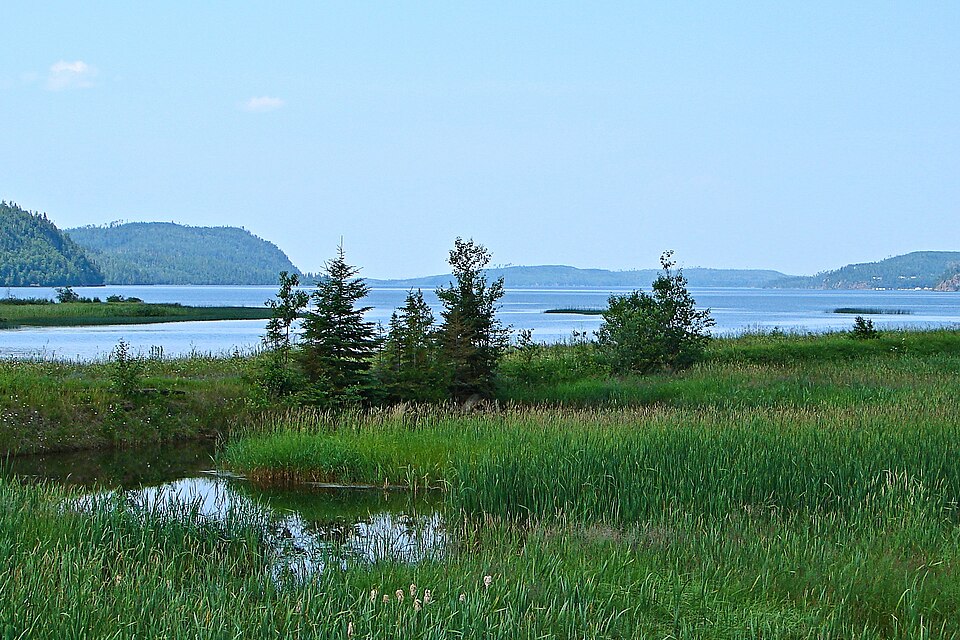
Lake Nipigon from Orient Bay,2012 P199 / Wikimedia Commons · CC BY-SA 3.0
The image record identifies Lake Nipigon from Orient Bay. BZA’s Guardian program is explicitly documented as monitoring Lake Nipigon and drawing research questions from community fishing concerns. This is waterbody/program context only, not a BZA settlement or reserve shoreline, membership portrait, surveyed boundary or picture of the program itself. Unchanged complete960px provider-listed preview, retrieved normally200 in coordinatedrootdownload and visuallyinspectedlocally. The2251×1500 original was not inspected orcopied. No pixelcrop/retouching/generation. CSSdisplaycrops/overlays only; image remainsCCBY-SA3.0 withcredit/source/licenselinks. Parent imported the supplied complete JPEG unchanged; the recorded original/preview/earlier-derivative limits remain. CSS crops/overlays affect display only.
Image, association, and reuse record reviewed 2026-10-27.
Full photographs are displayed proportionally above. A translucent background copy may be cropped by the viewport; it does not replace the complete image or its record.
The visual treatment does not change the research status, evidence, or remaining gaps recorded in this profile.
Start reading here
A short starting path through selected actual-content works. Read each annotation for the specific community, period and inspection limits; this is not a complete history or community endorsement.
Then read named participants explaining community-led monitoring and intergenerational fishing knowledge.
These are selected starting points. The full annotated collection, source perspectives, inspection limits and remaining research questions follow below. A starting guide is not an exhaustive history or community endorsement.
01
Community participation in food research
A2016 Nokiiwin Tribal Council and CanNorth study includes Biinjitiwaabik Zaaging Anishinaabek among four participating First Nations. Its selected methods pages explain how community questions and local knowledge shaped interviews and sampling choices. The BZA discussion connects fishing, hunting and gathering with Lake Nipigon and surrounding waters. This dated research-design account does not supply current food-safety advice, and its results or underlying private interviews have not been reviewed here.
In a2023 Anishinabek News report, BZA Guardian Brendon Hardy connects monitoring Lake Nipigon with memories of fishing alongside his grandfather and hopes for his own children. Researcher Tim Hollinger describes community concerns helping to shape questions about fish, water and sediment. These are named participants’ explanations of a particular program. The report does not independently establish current contaminant levels, safe fish consumption or the completion of every proposed outcome.
Develop a community-directed history and annotated reading collection.
Review community-specific imagery and reuse terms before substantive profile publication.
Review detailed relationships, naming changes and historical regional connections.
Develop a fuller community-authorized historical and language reading path.
Inspect published monitoring results separately and retain dates; this guide gives no current food-consumption advice.
Review original records for treaty and administrative histories rather than adopting older report summaries as current legal determinations.
Cohort06: selected actual-content sources and specifically scoped credited imagery form a bounded starting guide. Reused publications/photos are not new global works. Comprehensive history and community review remain open.
Follow the reading path
Sources & further reading
Open any title to read the original source. Annotations explain what each link can help you explore.
No Indigenous-led source is identified in this entry yet. This is a gap in this collection, and does not imply an absence of community knowledge or organization.
Indigenous-ledNokiiwin Tribal Council / Canada North Environmental Services (CanNorth)Source 1
Selected printed pp.1,3,9–10 (PDF pp.10,12,18–19) actually read, plus title/contents for context. June2016 community-based study includes BZA and describes interviews, local sampling choices and community participation. No full report, contaminant results, food-safety guidance, maps or private underlying interviews claimed. Its dated treaty/administrative assertions and old totals are not adopted as current determinations.
Inspection: Content reviewed for the stated scope
Scope: Selected printed pp.1,3,9–10 (PDF pp.10,12,18–19) actually read, plus title/contents for context. June2016 community-based study includes BZA and describes interviews, local sampling choices and community participation. No full report, contaminant results, food-safety guidance, maps or private underlying interviews claimed. Its dated treaty/administrative assertions and old totals are not adopted as current determinations.
Read the complete main article, selecting the BZA-specific presentation and interviews with Brendon Hardy and Lakehead researcher Tim Hollinger. Describes community questions guiding fish, water and sediment monitoring and Hardy’s memories of family fishing. Other conference speakers are outside this profile. Dated reporting, not the underlying datasets, current fish-consumption advice or proof of completed environmental outcomes.
Inspection: Content reviewed for the stated scope
Scope: Read the complete main article, selecting the BZA-specific presentation and interviews with Brendon Hardy and Lakehead researcher Tim Hollinger. Describes community questions guiding fish, water and sediment monitoring and Hardy’s memories of family fishing. Other conference speakers are outside this profile. Dated reporting, not the underlying datasets, current fish-consumption advice or proof of completed environmental outcomes.
Review recorded: October 27, 2026
Access note: Substantial actual public article body read through the web reader; this is not an inspection of linked publications, photographs or underlying records. No login or reader paywall was encountered for the inspected text.