Beothuk histories belong to Newfoundland’s coasts, islands, rivers, and interior. Archaeology, the testimony and drawings of named Beothuk women, and Mi’kmaw perspectives reveal skilled communities responding to colonial pressures. Their histories also require separating the destruction of communities from claims about ancestry, language, and the authority to tell their story.
See each region’s evidence for historical or present-day scope.
Homeland / region
Newfoundland
Research depth
Expanded profile
Source collection
14 annotated resources · 1 Indigenous-led
Inspected sources
14 substantive works · selected content reviewed
Initial adequacy
Not assessed
Source review
October 19, 2026
Names & relationshipsBeothuk, Innu, and Mi’kmaq remain distinct directory entries. Regional connections, oral histories, and shared or related maternal lineages do not make these names interchangeable. This profile does not adjudicate living people’s membership or ancestry claims.
An expanded introduction, with sources reviewed.This profile develops several themes through identified sources. Citations connect each section to its evidence; remaining gaps appear below. It has not been reviewed or endorsed by the community.
Backdrop photographs & credits
These photographs have individual, documented connections to this entry. Their captions and source records define the people, place, object, and period shown; no one photograph represents every community within a broader label.
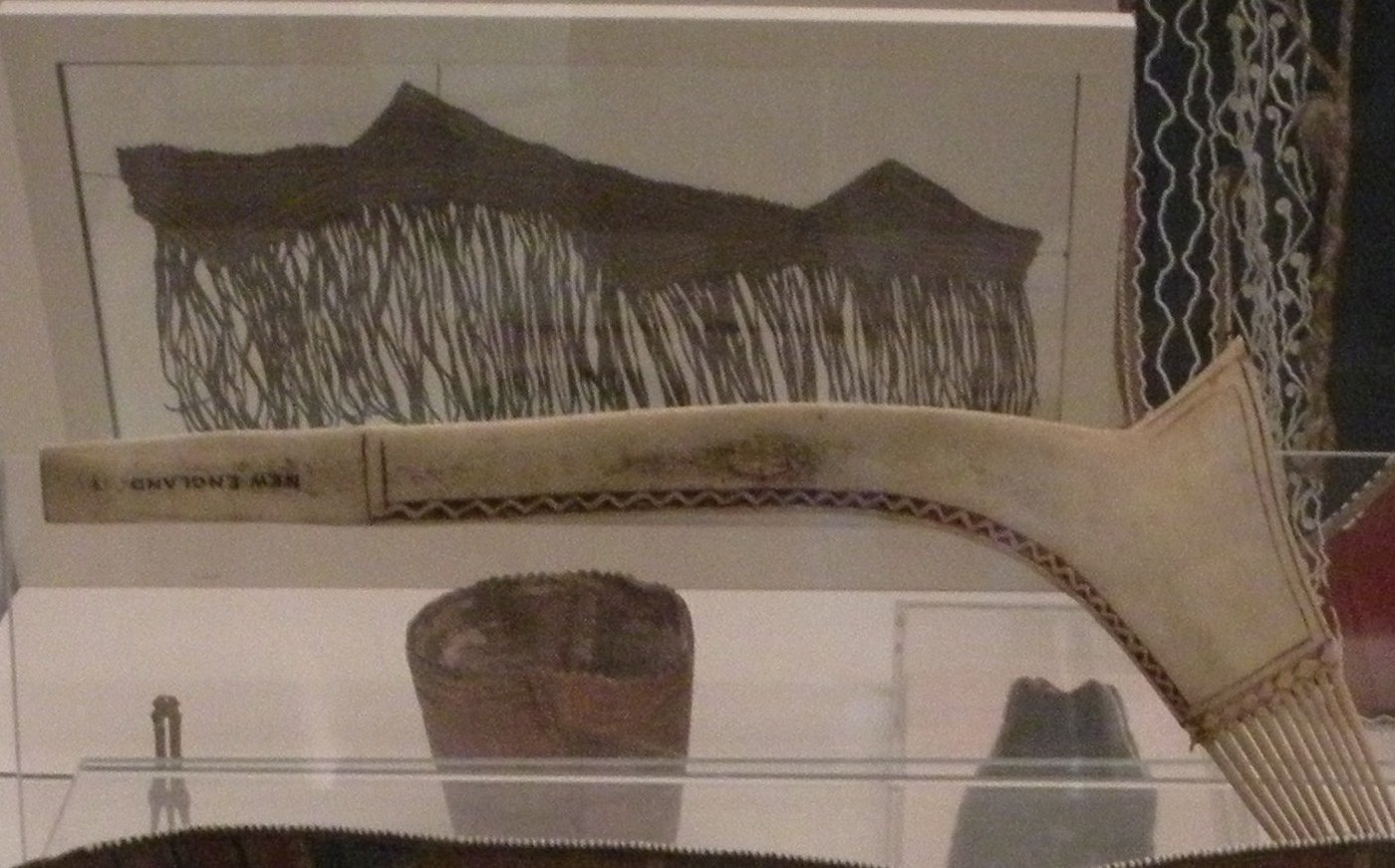
Beothuk objects displayed at the British Museum Dr Wilson / Wikimedia Commons; British Museum display
Museum display identified as Beothuk objects; not a depiction of contemporary people or evidence of cultural disappearance. Commons description, licensing and full original photograph visually inspected. Individual collection histories and object identifications not established; display label obscured. Image shows comb, paddle and containers; no human remains visible. Web copies proportionally resized/recompressed; display backgrounds may be cropped by CSS. Full image remains proportional in the page banner.
Image, association, and reuse record reviewed 2026-10-24.
Full photographs are displayed proportionally above. A translucent background copy may be cropped by the viewport; it does not replace the complete image or its record.
The visual treatment does not change the research status, evidence, or remaining gaps recorded in this profile.
01
Names, homelands, and the archaeological record
The name Beothuk appears in vocabularies recorded from Demasduit and Shanawdithit, although European writers used several spellings. Archaeologists commonly connect historically documented Beothuk with the island’s earlier Little Passage complex. These are analytical labels: they do not make every ancient Newfoundland site Beothuk. Donald Holly shows how older scholars mixed materials from different periods and peoples, then used the resulting collections to portray Beothuk as an isolated survival from a remote past. A more careful history distinguishes particular sites, dates, and communities while recognizing connections across the surrounding region.
Beothuk communities combined coastal and inland resources, with movements shaped by local opportunities rather than one island-wide timetable. Seals, salmon, seabirds, shellfish, caribou, and plant foods contributed to their livelihoods. At Boyd’s Cove in Notre Dame Bay, shell deposits helped preserve animal bones that Newfoundland’s acidic soils often destroy. These remains document a varied diet alongside house pits and other occupation evidence. Coastal and river access therefore mattered together: describing Beothuk simply as interior caribou hunters would mistake a later situation of displacement for the full range of their land use.
Birchbark canoes supported travel on inland waterways and at sea. Surviving models, drawings, and written descriptions preserve evidence about their distinctive construction, although no full-sized Beothuk canoe survives. At Boyd’s Cove, nails and other European metal were reshaped into projectile points, scrapers, awls, and ornaments. Acquiring material from fishing stations could provide useful iron without sustained participation in a European fur trade. Laurie McLean’s comparison of house pits further argues that settlement and architecture changed differently across places and periods. These findings show selective innovation and changing decisions, not an unchanging culture.
Colonial violence, competition for shorelines and food, and disease transformed Beothuk lives. Yet early contact should not be reconstructed by projecting later violence backward without evidence. William Gilbert’s reassessment finds that fragmentary sixteenth-century documents do not support a simple history of permanent hostility from first contact. Qalipu First Nation’s community plan also challenges the mercenary myth that blamed Mi’kmaq for Beothuk destruction and portrayed Mi’kmaq as outsiders brought to Newfoundland by the French. This matters because historical storytelling has affected living Indigenous peoples’ identities and claims to their homeland.
Oubee, Demasduit, and Shanawdithit supplied much of the surviving recorded vocabulary, under circumstances shaped by capture and coercion. Shanawdithit’s drawings document homes, foods, family relationships, travel, killings, and encounters with settlers. Her work offers a Beothuk account within an archive largely assembled and annotated by outsiders. Sarah Roberts’s 2024 study follows her capture in 1823, years in the Peyton household, transfer to St. John’s, and death in 1829. The Rooms reported revising the colonial descriptions attached to her drawings in 2023–24, showing that even catalogue labels carry interpretations requiring scrutiny.
The principal written word lists came from Oubee, Demasduit, and Shanawdithit through different recorders. Linguist John Hewson brought these materials together into a master list of 325 glosses, with numerals and month names. Their survival is significant, but the evidence is limited and filtered through inconsistent transcription. Scholars have disagreed about whether, and how closely, Beothuk belongs with Algonquian languages. The language guide summarizes both Hewson’s argument for a relationship and Ives Goddard’s skepticism. It is therefore preferable to present the affiliation as debated rather than confidently equating Beothuk with Innu-aimun or Mi’kmawi’simk.
Shanawdithit is often called the last Beothuk, but Mi’kmaw oral histories challenge the conclusion that nobody survived beyond her death. Historical community destruction, genealogical descent, genetic relationships, and present political identity are different questions. Duggan and colleagues’ 2017 ancient-DNA study distinguishes sampled Maritime Archaic and Beothuk maternal populations. Carr’s 2020 comparison finds some ancient maternal lineages identical or close to modern ones, while emphasizing sampling limits and warning against simplistic genetic identity assignments. Mitochondrial DNA follows one maternal line; it cannot by itself confirm or exclude all Beothuk ancestry, establish an unbroken genealogy, or decide community membership.
In March 2020, the remains of Demasduit and Nonosabasut returned from Scotland to Newfoundland and Labrador after advocacy led by Miawpukek Saqamaw Mi’sel Joe and cooperation among Indigenous leaders, museums, and governments. The provincial announcement records Indigenous leaders’ own statements about ancestors, responsibility, and the harm of colonial collecting. The Rooms’ 2024–25 report documents the Final Resting Place Circle’s continuing deliberations and a request for support to return associated spiritual belongings held in Britain. Those are dated reports of work in progress, not evidence that every repatriation or burial question has since been settled.
Add fuller Indigenous-authored oral-history material and inspect Chief Mi’sel Joe’s published interview and Santu Toney scholarship directly; neither is counted merely because other works cite it.
Obtain a specialist linguistic assessment of recent classification arguments and inspect original word-list manuscripts alongside their later transcriptions.
Verify developments after the 2024–25 museum reporting year concerning final resting places and spiritual belongings; do not infer completion from earlier announcements.
Extend site-specific archaeological coverage beyond northeast Newfoundland and keep competing interpretations of continuity, social organization, and colonial violence explicitly attributed.
Follow the reading path
Sources & further reading
Open any title to read the original source. Annotations explain what each link can help you explore.
No Indigenous-led source is identified in this entry yet. This is a gap in this collection, and does not imply an absence of community knowledge or organization.
Read the historical discussion around printed pages 17–18. This community-owned plan traces the unsupported mercenary story through colonial writers and explains its continuing consequences for Newfoundland Mi’kmaq. It supplies a living First Nation’s perspective, not a claim to speak for all Beothuk descendants.
Five-page study with reproduced drawings and source references. Pages 1–4 describe Shanawdithit’s knowledge, family, capture, testimony, death, and commemoration; the opening explicitly acknowledges Mi’kmaw challenges to the last-Beothuk narrative. Historical descriptions are retained with a language advisory.
Explains the three surviving vocabularies, their archival transmission, and disagreement about Algonquian affiliation. Identifies recorders and circumstances of collection; its classification should not be treated as settled consensus.
Detailed account of coastal and inland food resources, preservation, seasonal movement, and local variation. Sections on evidence explicitly distinguish archaeological findings from possibilities. The page now flags its 2009 scholarship as requiring updating; this profile uses it for documented resource relationships rather than speculative population totals.
The excavator explains site discovery, preservation of food remains, house pits, and iron refashioning; see Beothuk Diet and Reasons for Avoiding the Fur Trade. Its broader conclusions about extinction and other peoples reflect an older interpretive framework, explicitly flagged by the website, and require comparison with newer Indigenous perspectives.
Specialist account of canoe forms, bark construction, surviving models, snowshoes, and winter transport, based on Marshall’s historical research. It distinguishes observed objects and descriptions from reconstruction and inference. No surviving full-sized canoe is available to resolve every construction detail.
Archaeological synthesis comparing 22 coastal and 64 Exploits Valley house pits; see pp. 1–9 and 42–44. Differences in architecture and artifacts support varied responses to colonial pressures. Interpretations of household organization and motives remain archaeological arguments, not direct testimony from every community.
Peer-reviewed reassessment, pp. 24–44, of early captives, voyages, geographical names, and possible trade. Paragraphs 40–44 distinguish what fragmentary documents establish from assumptions repeated by later writers. Its challenge to perpetual early hostility does not deny well-documented later colonial violence.
Author-uploaded full text of the peer-reviewed article, DOI 10.1080/0275720032000107383. Pages 129–136 examine mixed artifact collections and assumptions about isolation, language, and inevitable disappearance. Valuable for reading older scholarship critically; its own discussion predates subsequent ancient-DNA work and current Indigenous-led debates.
Full open-access research article, DOI 10.1016/j.cub.2017.08.053. Results and Figure 3 analyze ancient maternal genomes alongside archaeological and isotope evidence. The study concerns sampled maternal populations and explicitly allows possible ancestry in living people; it is not a test of present community identity or every line of descent.
Read Discussion and Assignment of individuals, pp. 352–354. Compares ancient maternal lineages with modern database sequences, explains limited sampling and the Santu Toney inheritance example, and cautions against simplistic commercial ancestry claims. Miawpukek cooperation and approval are acknowledged. The afterword supersedes an earlier withdrawn manuscript.
Primary announcement of the transfer into The Rooms’ care, with attributed statements from Mi’sel Joe and other Indigenous leaders. Its backgrounder uses a categorical extinction account and describes the administrative recognition position in 2020; those passages should not settle contested historical or contemporary identity questions.
Printed pp. 76–77 (PDF pages 38–39) document the Final Resting Place Circle’s initial meeting and revision of colonial labels for Shanawdithit’s drawings and Demasduit portraits. This institutional self-report explains present cataloguing responsibilities and the influence of Cormack and Howley’s assumptions on collections.
Printed p. 66 (PDF page 69) describes the Circle’s June 2024 visits, deliberations about a resting place, and request for support to repatriate spiritual belongings held in Britain. This is a dated progress account; it does not establish a final burial decision or the outcome of later requests.
Related entries may represent alternate names, constituent communities, wider groupings, or historical connections. Read the naming notes before treating entries as equivalent.
Robey’s Atlas of Indigenous North America · Compiled October 19, 2026 · Beothuk