Also find this entry through: Lake Babine Nation (profile focus)
Babine histories connect lake and river communities, salmon fisheries, hereditary leadership, and relationships across north-central British Columbia. This introduction centers Lake Babine Nation’s own publications, alongside collaborative scholarship and public records. Its reading collection follows historical trade and colonial interference through language learning, community planning, stewardship, and work toward self-government.
See each region’s evidence for historical or present-day scope.
Homeland / region
British Columbia / Babine Lake and Babine River
Research depth
Expanded profile
Source collection
13 annotated resources · 10 Indigenous-led
Inspected sources
13 substantive works · selected content reviewed
Initial adequacy
Not assessed
Source review
October 19, 2026
Names & relationshipsThis profile centers Lake Babine Nation and its communities. Language labels such as Babine, Nedut’en, and Babine–Witsuwit’en require context; linguistic relationships do not make Lake Babine, Wet’suwet’en, or Dakelh governments interchangeable. The historical Barricade Treaty and the 2020 Foundation Agreement are different instruments.
An expanded introduction, with sources reviewed.This profile develops several themes through identified sources. Citations connect each section to its evidence; remaining gaps appear below. It has not been reviewed or endorsed by the community.
Backdrop photographs & credits
These photographs have individual, documented connections to this entry. Their captions and source records define the people, place, object, and period shown; no one photograph represents every community within a broader label.
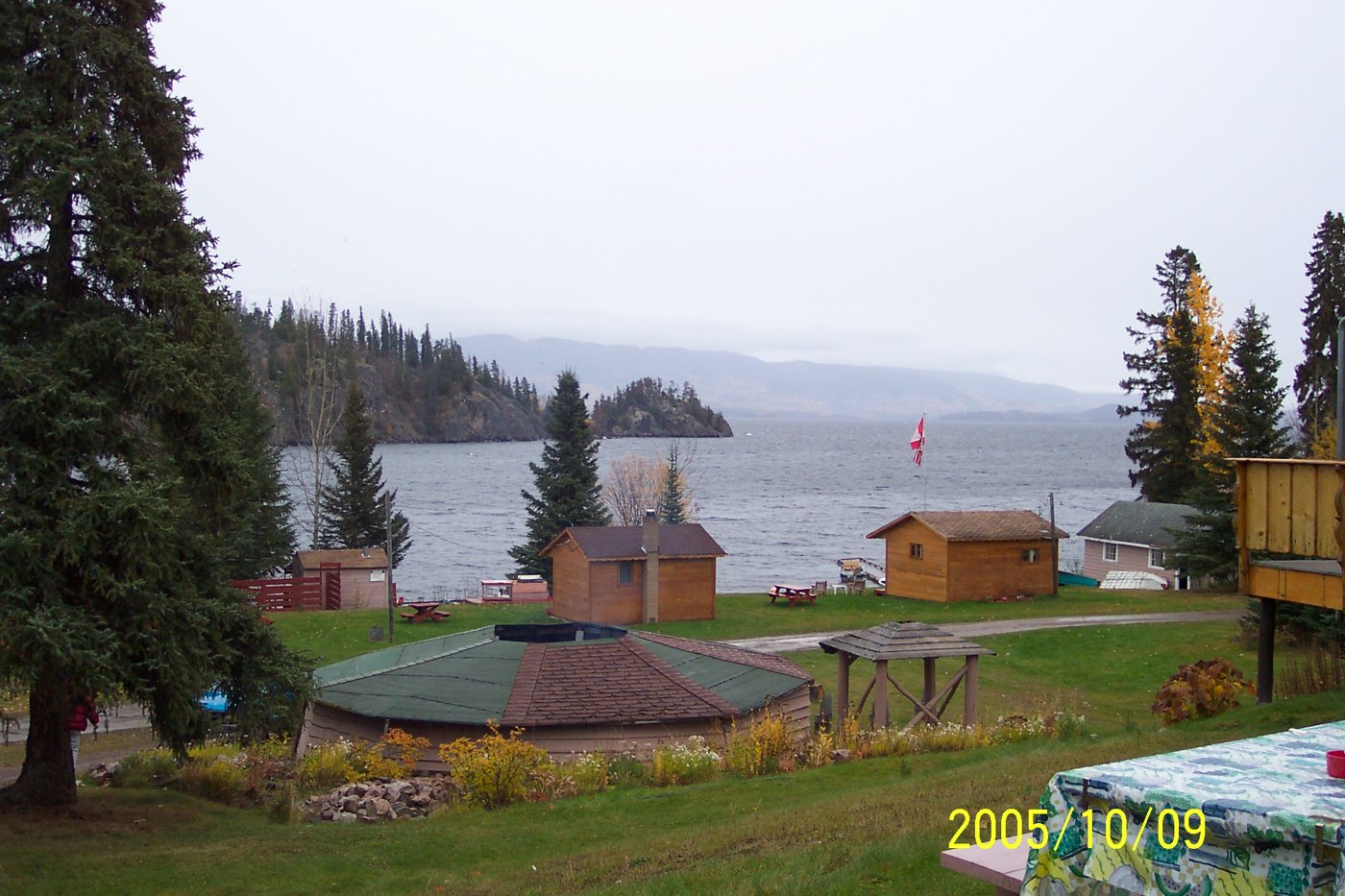
Babine Lake, British Columbia Christina from Canada / Wikimedia Commons (originally Flickr)
Contemporary landscape of Babine Lake. Cabins are not identified as Indigenous buildings or a particular First Nation community. Use only as geographic context, with existing profile evidence confirming regional association. Commons record, Flickr license-review record and full original photograph visually inspected. Photographer supplied location only; exact shore location and cabin ownership unverified. Web copies proportionally resized/recompressed; display backgrounds may be cropped by CSS. Full image remains proportional in the page banner. Regional connection is supported by the existing Babine profile, section A nation of connected communities, sources p27-s1/p27-s2. Cabins are not attributed to a First Nation.
Image, association, and reuse record reviewed 2026-10-24.
Full photographs are displayed proportionally above. A translucent background copy may be cropped by the viewport; it does not replace the complete image or its record.
The visual treatment does not change the research status, evidence, or remaining gaps recorded in this profile.
01
A nation of connected communities
Lake Babine Nation’s community plan organizes its discussion around Tachet, Fort Babine or Wit’at, Old Fort, Pinkut Lake/Donald’s Landing, and Woyenne, alongside members living away from home. This is a network of communities with shared and distinct priorities, rather than one village whose location captures the entire homeland. The treaty office’s public account places the traditional territory around Babine Lake and describes four clans and hereditary leaders with responsibilities toward land. Its institutional and treaty-stage descriptions are older material, however, and should not be taken as a current administrative directory.
The balhats, or feast system, belongs within an account of law, leadership, and responsibilities. In Cis dideen kat—When the Plumes Rise, Jo-Anne Fiske and Betty Patrick frame their study as a descriptive account of Lake Babine customary law and changing relations with the Canadian state. Their publicly available introductory chapter explains that research began in 1993 and that historical documents were examined alongside the knowledge of hereditary chiefs and elders. They explicitly acknowledge limits concerning narratives, territorial detail, and language. Their work offers an important sustained reading path without making one study a complete or timeless statement of Lake Babine law.
The treaty office reproduces Daniel Williams Harmon’s account of his January 1812 journey among Babine villages. It describes hospitality, salmon-based livelihoods, and trade connections reaching toward the coast through neighboring peoples. The office also warns that Harmon’s knowledge was limited by observation and interpretation. His writing is a record of a colonial visitor encountering an already connected society. It does not mark the beginning of Babine history, establish an exact population, or supply an objective description of every community. Reading the excerpt with the office’s commentary makes the source’s position visible.
In its account of 1906, the treaty office describes women defending a rebuilt fishing weir when fisheries officers attempted to dismantle it. It recounts arrests and negotiations in which chiefs sought provisions and services in exchange for removal of the weirs. The account calls the resulting agreement the Barricade Treaty. This history connects colonial control of fishing to food security, resistance, and political negotiation. A later UNBC report describes archaeological work conducted with Lake Babine Nation at a Babine River fishing village, where earlier work had established occupation extending back at least 1,300 years. The collaborative study concerns a particular site, not a date for the origins of the people.
Nedut’en is the name used by Lake Babine Nation’s FirstVoices collection. Its public pages offer an alphabet, recordings, words, phrases, and stories; individual records identify contributors. These are community-created learning resources, with their own access and reuse conditions. FPCC’s March 2025 account adds a specific example of intergenerational learning: Brian Lacerte learning from his mother, Rosalie MacDonald, through a mentor-apprentice program. It also describes MacDonald’s own learning and teaching work. Together, the collection and dated account show different forms of language transmission. Neither provides grounds for a current speaker census or a claim that one teaching method represents every family.
Planning, governance, and the Foundation Agreement
The 2017–2022 community plan records priorities in language, education, housing, access, health, and stewardship, developed through engagement with members. It is evidence of community priorities during a stated planning period; it is not a report that all goals were achieved. The Nation’s November 2020 update explains the Foundation Agreement as a twenty-year framework for implementing rights and developing self-government, rather than a finalized treaty settlement. Its governance page describes a proposed Nation-level and community-level model and steps toward ratification and implementation. A February 2024 federal announcement records a further funding agreement supporting governance capacity and infrastructure priorities for Wit’at and Tachet. That announcement documents commitments, not the completion of all funded facilities or a transition to the proposed government.
Lake Babine Nation’s environmental-assessment explanation identifies sustainability, benefits, socioeconomic effects, and respectful relationships as criteria for evaluating proposed development. It distinguishes an assessment collaboration agreement from work toward a further consent agreement. A different publication, issued in July 2023, announced closure of the recreational salmon fishery along part of the Babine River corridor in response to warm water and pressure on salmon. Read as a dated action, it shows how stewardship is expressed through decisions concerning food, water, and future generations. The notice should not be used as current fishing guidance. More recent regulations and Nation communications would need checking before a visit.
Read the full Fiske–Patrick volume and subsequent community scholarship; compare accounts of women’s leadership, law, colonial violence, relocation, and residential schooling.
Follow the Barricade Treaty account into the original instrument, archival correspondence, and community interpretations of unfulfilled obligations. Compare the community plan’s 1905 chronology with the treaty office’s 1906 narrative.
Add more histories authored by individual communities and clarify the wider scope of historical Babine and related language labels.
Check newer community reports for the outcomes of governance, infrastructure, environmental-assessment, and language initiatives. Source quantity does not establish completion.
Follow the reading path
Sources & further reading
Open any title to read the original source. Annotations explain what each link can help you explore.
No Indigenous-led source is identified in this entry yet. This is a gap in this collection, and does not imply an absence of community knowledge or organization.
Community account of territory, four clans, hereditary responsibilities, and the treaty office’s mandate. Its older treaty-stage and membership statements are not used as current facts.
Inspection: Content reviewed for the stated scope
Scope: Identity and mandate paragraphs; the page contains dated administrative context.
Nation-authored plan built through member engagement. See printed pp. 7–10, 20–26 and the community chapters for scope, shared priorities, and local differences. Goals are not completion reports.
Inspection: Content reviewed for the stated scope
Scope: Introduction, community structure, shared directions, and operational priorities; not every implementation action was independently checked.
Public sample of the coauthored book on Lake Babine legal order. The introduction, printed pp. 7–14, explains its research, historical context, and explicit limits. The entire book has not been reviewed here.
Inspection: Content reviewed for the stated scope
Scope: Publisher’s eight-page introductory sample; the full book is a further reading option.
Community commentary plus a reproduced fur-trader journal excerpt, useful for early trade and salmon livelihoods. The publisher identifies the visitor’s limited perspective; his estimates are not treated as a census.
Inspection: Content reviewed for the stated scope
Scope: Commentary and reproduced January 1812 journal passage.
Nation-published narrative of women’s defense of the weir, arrests, and negotiations. Distinguish this historical account from the legal text and later interpretation of the Barricade Treaty.
Inspection: Content reviewed for the stated scope
Scope: Full historical narrative; no claim that every treaty obligation or its legal status has been independently established.
October 18, 2012 account of archaeology undertaken with Lake Babine Nation, including earlier dating of a fishing-village site. A project report about one location, not a complete regional archaeological synthesis.
Inspection: Content reviewed for the stated scope
Scope: Full project news account; later technical publications remain a research task.
Community-created alphabet, dictionary, recordings, and stories. Public pages and a dictionary example were inspected; follow contributor credits and the collection’s usage conditions. Counts and audio transcriptions are not reproduced here.
Inspection: Content reviewed for the stated scope
Scope: Rendered public home/alphabet/collection and sample dictionary material; no restricted content accessed.
March 31, 2025 feature includes Brian Lacerte and Rosalie MacDonald’s Lake Babine learning and teaching experiences. Its other language-community examples are not assigned to Lake Babine.
Inspection: Content reviewed for the stated scope
Scope: Nedut’en section, including the named mentor-apprentice pair and teaching account.
Nation-published explanation of the September 2020 agreement and implementation work. See printed pp. 3 and 10–11, especially the distinction between a framework agreement and a treaty settlement.
Inspection: Content reviewed for the stated scope
Scope: Introductory account, timeline, and questions and answers; goals and early commitments kept distinct from later outcomes.
Sets out a proposed two-level governance model, community engagement, citizenship-rule development, ratification, and implementation steps. Its future-tense model is not described as already in force.
Inspection: Content reviewed for the stated scope
Scope: Governance vision and milestone sections; no current officeholder list used.
Explains the Nation’s criteria for proposed development and distinguishes collaboration from a further consent agreement. A public account of priorities, not a substitute for the signed instruments.
Inspection: Content reviewed for the stated scope
Scope: Assessment criteria, collaboration/consent distinction, and policy explanation.
July 28, 2023 announcement of protective action effective August 1, 2023, linking river temperature and pressure on salmon. Historical evidence of stewardship; not current fishing guidance.
Inspection: Content reviewed for the stated scope
Scope: Full public announcement and its stated 2023 effective date.
February 21, 2024 announcement, with a Lake Babine leadership statement, of support for capacity and community priorities. Funding commitments do not establish that every project or governance transition was completed.
Inspection: Content reviewed for the stated scope
Scope: News-release body and Lake Babine statement; demographic and reserve-count figures omitted.
Related entries may represent alternate names, constituent communities, wider groupings, or historical connections. Read the naming notes before treating entries as equivalent.
Robey’s Atlas of Indigenous North America · Compiled October 19, 2026 · Babine