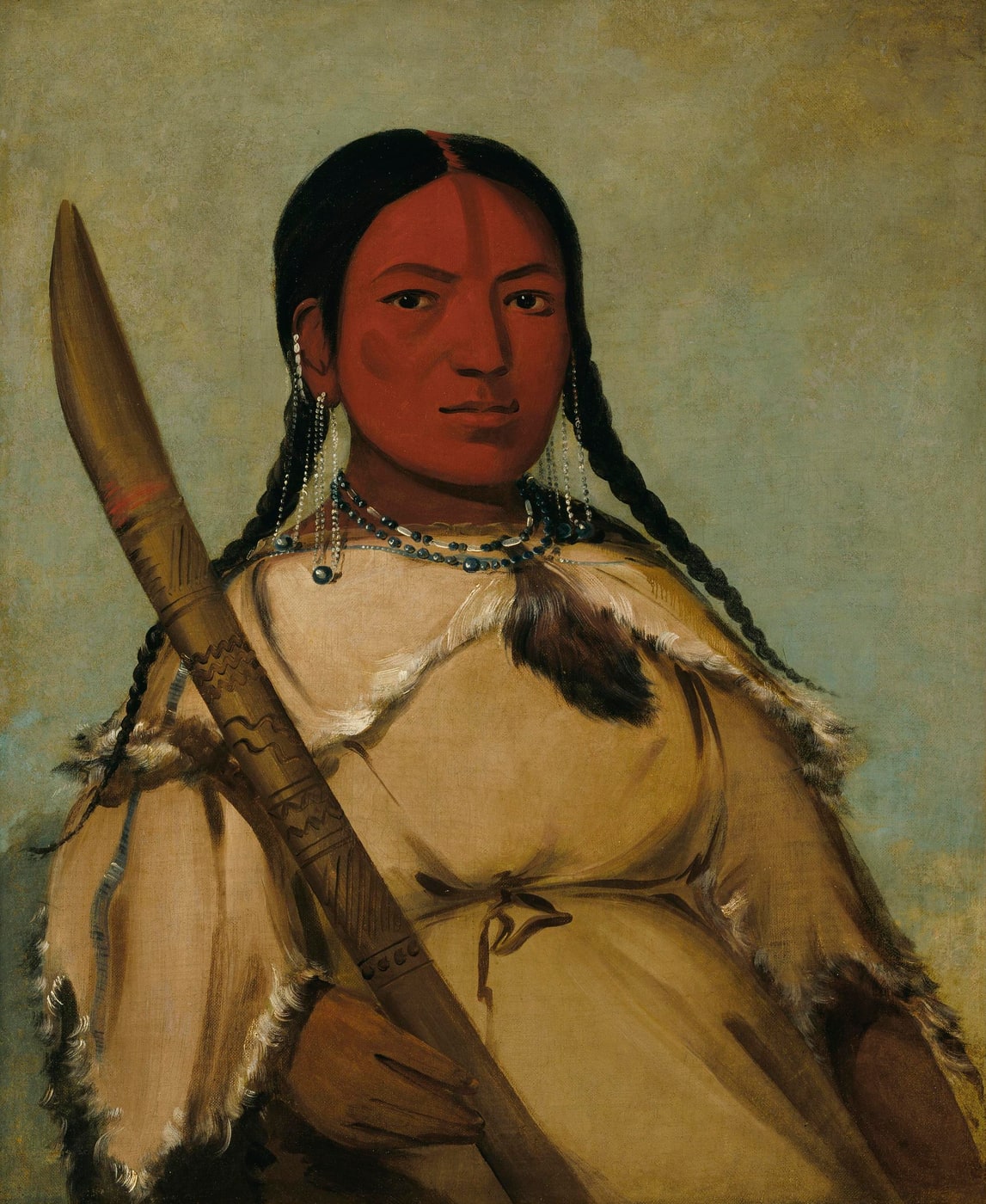
Chin-cha-pee, Fire Bug That Creeps, Wife of Pigeon’s Egg HeadGeorge Catlin, 1832. Smithsonian American Art Museum, Gift of Mrs. Joseph Harrison, Jr., 1985.66.180. Public domain.
Assiniboine is an outside name for northern Plains peoples who use names including Nakoda, Nakota and Nakona in community contexts. Their histories and kinship cross the Canada–United States border, while contemporary governments remain distinct. Fort Belknap, Fort Peck and Saskatchewan First Nations offer different perspectives on land, language and continuing political life.
See each region’s evidence for historical or present-day scope.
Homeland / region
Great Plains / Canada / United States
Research depth
Source inspection pending
Source collection
7 annotated resources · 4 Indigenous-led
Inspected sources
0 substantive works · selected content reviewed
Initial adequacy
Not assessed
Source review
October 19, 2026
Names & relationshipsAssiniboine/Nakoda is not one government. Aaniiih/Gros Ventre at Fort Belknap and Dakota at Fort Peck are distinct co-resident peoples. Stoney Nakoda has close historical and linguistic relationships, but a Nakoda spelling alone does not identify the same community, language variety or government.
An expanded guide awaiting inspection records.This earlier expanded guide does not yet retain substantive page-level inspection records. Its linked resources are starting points for further review. Image identification and reuse review are separate from historical-source inspection and adequacy assessment.
Backdrop images & credits
These images have individual, documented connections to this entry. Their captions and source records define the people, place, object, and period shown; no one image represents every community within a broader label.
Chin-cha-pee, Fire Bug That Creeps, Wife of Pigeon’s Egg Head George Catlin, 1832. Smithsonian American Art Museum, Gift of Mrs. Joseph Harrison, Jr., 1985.66.180. Public domain.
One Assiniboine woman as portrayed by George Catlin at Fort Union in 1832. Explicit historical outside representation; not present-day portrait, a traditional-design template, all-Assiniboine clothing claim, or a current-government identification. Use factual museum identification, artist, date and scope; museum historical title retained as catalogue wording, not claimed to be a community-verified name translation. No ceremonial content labelled in actual objectrecord. Portrait does not improve historical-research adequacy/counts. Original full painting frame retained. Proportional JPEG web maximum 1,400 pixels and card maximum 500 pixels, no cropping, retouching or generated content. Directory cards and page backdrops may use CSS crops and translucent overlays; the opened image preserves the complete delivered frame.
Image, association, and reuse record reviewed 2026-10-26.
Full images are displayed proportionally above. A translucent background copy may be cropped by the viewport; it does not replace the complete image or its record.
The visual treatment does not change the research status, evidence, or remaining gaps recorded in this profile.
01
Names, language and origin accounts
Fort Belknap’s history identifies Assiniboine people as Nakoda or Nakota. Assiniboine derives from an Ojibwe name associated with cooking with heated stones. These names should be read in their local contexts. Linguistically, Nakoda belongs to the Siouan family. Linda Cumberland’s grammar also cautions against an old classification that treated Nakoda simply as a minor variant of Dakota and Lakota. Linguistic relationships do not settle every question of historical origin: Fort Belknap preserves oral accounts that differ from familiar outsider migration narratives.
Bison supplied food, hides and materials for mobile Plains communities. Assiniboine people also traded meat and pelts with Missouri River agricultural communities for crops and other goods. Their relations with European trading companies built on Indigenous knowledge, diplomacy and exchange. At Fort Union, founded in 1828, Assiniboine permission enabled the post’s establishment, and Assiniboine traders became its principal partners. Women’s marriages and kinship relationships helped sustain those connections. This history places Indigenous communities at the center of the trading economy rather than at its margins.
Smallpox repeatedly devastated northern Plains communities, including Assiniboine people connected with the Upper Missouri trade. The University of Saskatchewan’s synthesis places these epidemics alongside changing commercial networks and the destruction of bison herds. It describes later reserve life as shaped by restricted mobility, hunger, residential schooling and prohibitions on cultural and political activities. These pressures differed across the international boundary and among local communities. Reservation settlement consequently cannot be explained as a simple voluntary abandonment of older lifeways or as the end of Indigenous collective identity.
FHQ Developments’ community account dates the Treaty 4 adhesion by ancestors of Carry the Kettle to September 25, 1877 at Fort Walsh. It identifies the western Cypress Hills, including the Head of the Mountain, as a homeland of enduring significance. The community-authored history Owóknage follows forced removal from those lands to the area south of Sintaluta, Saskatchewan. Its published contents bring together land use, treaty-era farming, language, sacred places, harvesting and environmental concerns, drawing on Elder interviews as well as documentary research.
Fort Belknap Indian Community in Montana unites Nakoda and Aaniiih, also called Gros Ventre, in a shared government. The reservation was established in 1888 and represents only part of the peoples’ wider ancestral territories. Fort Peck institutions separately serve Assiniboine and Sioux communities; their language department distinguishes Nakona/Nakoda from Dakota. Carry the Kettle is another particular First Nation rather than a name for all Assiniboine people in Canada. Shared institutions, broad peoplehood and individual governments therefore need to be kept distinct when tracing contemporary sovereignty.
Fort Peck’s language department describes revitalization through community curriculum, Elder stories, history, songs and daily cultural learning. Its stated vision includes developing immersion education, which should be distinguished from evidence that a particular new school has already opened. Cumberland’s 2025 grammar provides a complementary reference on Nakoda sounds, grammar, kinship and writing systems, with attention to different practical orthographies. Community teaching and scholarly documentation serve related purposes, but the authority of particular speakers, families and institutions remains essential to how knowledge is learned and shared.
Add further community-authored perspectives and specialist scholarship for a fuller account.
Seek community review and expand topics not yet covered in this introduction.
Follow the reading path
Sources & further reading
Open any title to read the original source. Annotations explain what each link can help you explore.
No Indigenous-led source is identified in this entry yet. This is a gap in this collection, and does not imply an absence of community knowledge or organization.
Indigenous-ledFort Belknap Indian CommunitySource 1
Community account of Nakoda and Aaniiih, reservation history, bison lifeways and oral histories. Contains differing origin narratives and older linguistic simplifications; this profile preserves that distinction and uses a recent grammar for classification.
Specific account of Assiniboine authority and partnerships at Fort Union, intertribal exchange and the 1837 epidemic. Older broad origin claims and exact demographic estimates are not adopted here.
First Nations economic organization’s community history of the 1877 Treaty 4 adhesion and Cypress Hills homeland. The page’s legal-case update is explicitly historical and is not used as a current litigation status.
Publisher-distributor description and detailed contents of a community-authored history arising from traditional land-use research. Provides a substantial reading route through Cypress Hills displacement, Elder testimony, harvesting and sacred places; full book access is separate.
Official department page states the Nakona/Nakoda and Dakota program’s mission and vision for curriculum and immersion education. Distinguish its goals from confirmation that every envisioned facility is operational.
Public description, contents and chapter introductions establish Siouan affiliation, critique older classification and describe grammatical and orthographic coverage. Full text requires library or other access; this profile uses publicly visible material.
Historical synthesis of cross-border territory, trading alliances, epidemics and coercive reserve policies. Includes community and further-reading links; used for context rather than as a substitute for each nation’s own history.
Related entries may represent alternate names, constituent communities, wider groupings, or historical connections. Read the naming notes before treating entries as equivalent.
Robey’s Atlas of Indigenous North America · Compiled October 19, 2026 · Assiniboine