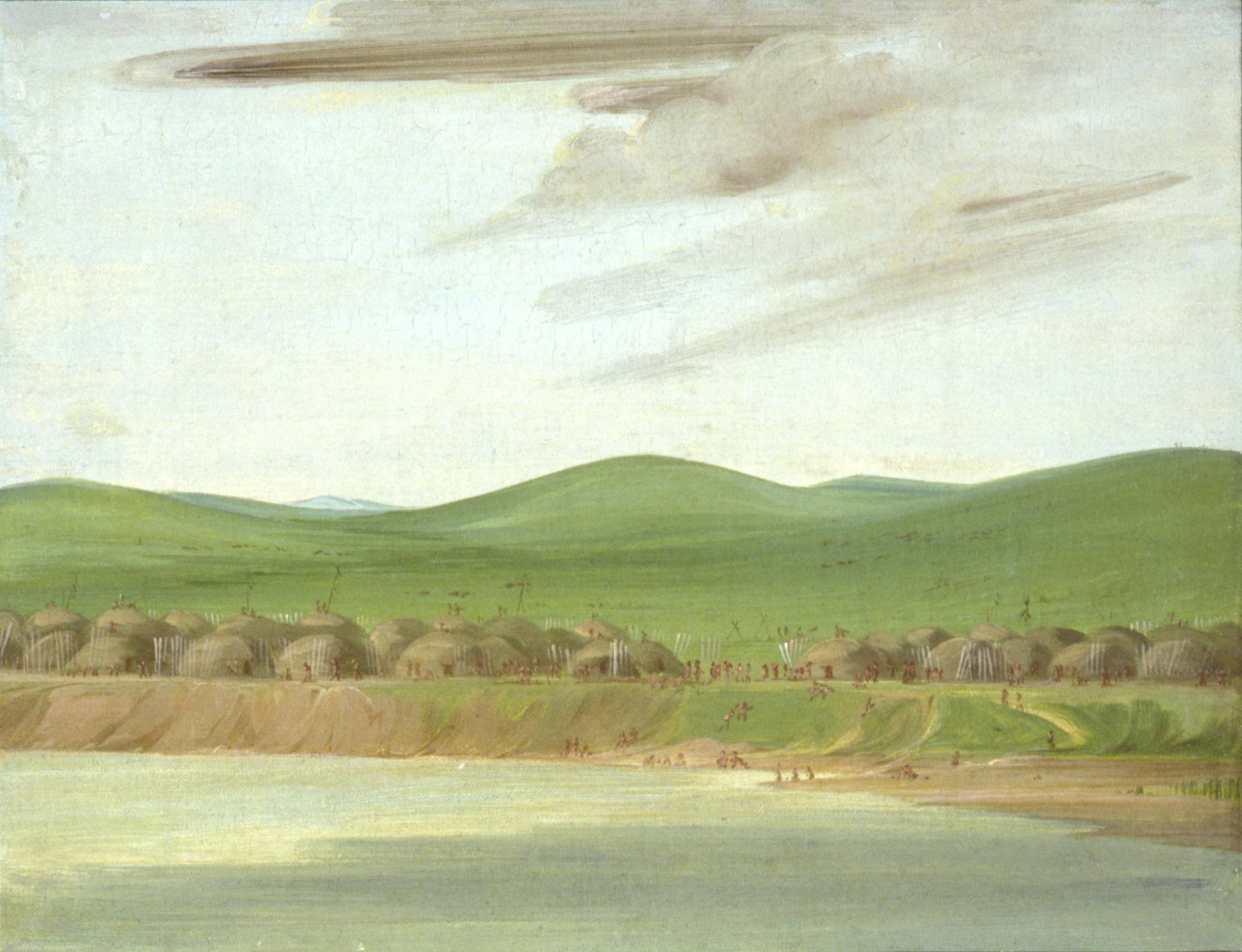
Arikara Village of Earth-Covered lodges, 1600 Miles above St. Louis, 1832George Catlin, 1832. Smithsonian American Art Museum, Gift of Mrs. Joseph Harrison, Jr., 1985.66.386. Public domain.
Arikara, or Sahnish, is a distinct people within the Mandan, Hidatsa and Arikara Nation. This reviewed starting guide covers village histories, river-community displacement and educational priorities. Deeper Arikara-specific research remains unfinished.
See each region’s evidence for historical or present-day scope.
Homeland / region
Great Plains / North Dakota
Research depth
Source guide
Source collection
6 annotated resources · 3 Indigenous-led
Inspected sources
3 substantive works · selected content reviewed
Initial adequacy
Still unfinished
Source review
October 21, 2026
Names & relationshipsArikara/Sahnish is a distinct people within the shared Mandan, Hidatsa and Arikara Nation. Mandan and Hidatsa are allied constituent peoples, not aliases for Arikara. Fort Berthold is a reservation and governmental context, not the entirety of historical homelands. The three languages and Arikara-specific educational work require separate attention.
A source guide for a deeper dive.This entry provides a brief orientation and an organized reading path. A comprehensive deep dive has not yet been completed. Follow the annotated sources and distinguish primary community accounts from outside reference material.
Still unfinished
This pass refreshes six original access points and supplies a carefully scoped orientation from three substantive explanatory works, with three short supporting references. Initial adequacy is not yet established. Direct Sahnish-authored scholarship, actual language-learning publications, fuller historical primary records and contemporary Arikara-specific perspectives remain insufficient. An index or short contextual introduction cannot fill those gaps.
Assessment recorded October 21, 2026. This is separate from research completion and community review.
The historical Nation page was inspected through its actual indexed body after direct timeouts; its selected interpretation and date disagreement require further corroboration.
The language portal explains educational priorities, but no linked textbook, handout, dictionary, class recording or language study was actually read.
The chapter and NPS introduction offer useful outside orientation, not a complete history or community review. The substantive target of twelve is not reached.
Backdrop images & credits
These images have individual, documented connections to this entry. Their captions and source records define the people, place, object, and period shown; no one image represents every community within a broader label.
Arikara Village of Earth-Covered lodges, 1600 Miles above St. Louis, 1832 George Catlin, 1832. Smithsonian American Art Museum, Gift of Mrs. Joseph Harrison, Jr., 1985.66.386. Public domain.
Smithsonian American Art Museum explicitly identifies this 1832 George Catlin oil painting as an Arikara village. Its description attributes to Catlin a view made from the deck of a steamer. This is an outside artist’s historical depiction, not Arikara-made art, a documentary photograph, an exact village survey, the modern MHA government or a view of all present Arikara communities. No more precise village identification, people’s names or territorial boundary is inferred. Museum attribution and date are retained, with Catlin’s viewpoint distinguished from independent archaeological evidence. Proportional resize/recompression from 1993x1528 to 1800x1380, JPEG quality 88; entire delivered frame retained, no pixel crop or generated material. CSS display crops/overlays must be disclosed with credits. CSS may crop or overlay directory/background copies; the opened-page image preserves the complete delivered source frame.
Image, association, and reuse record reviewed 2026-10-26.
Full images are displayed proportionally above. A translucent background copy may be cropped by the viewport; it does not replace the complete image or its record.
The visual treatment does not change the research status, evidence, or remaining gaps recorded in this profile.
01
A shared government and distinct peoples
MHA Nation’s official site identifies the Mandan, Hidatsa and Arikara Nation at Fort Berthold in North Dakota. It describes a Tribal Business Council with a chairman and representatives from six segments. This provides institutional orientation to a shared government; it does not make Mandan, Hidatsa and Arikara interchangeable names or turn the reservation into their entire historical homeland.
Village movements and river-community displacement
MHA Nation’s history distinguishes Sahnish village movements from Mandan and Hidatsa histories. Its narrative and timeline differ between 1862 and 1863, so the move into Like-a-Fishhook is described here as the early 1860 s. The page also recounts Garrison Dam relocation as a loss of fertile bottomlands and connected communities, with relocation completed by fall 1954.
Language priorities and community educational work
MHA Nation presents Mandan, Hidatsa and Arikara as separate languages and acknowledges Elders, teachers, Nueta Hidatsa Sahnish College and the MHA Language Project. Its portal identifies learning materials and past Arikara class recordings. This is an institutional account of educational priorities and collaboration; listing resources does not establish their contents, effectiveness or present class schedules as independently checked.
North Dakota Studies identifies Sahnish as the people’s own name and places Arikara village history along the Missouri River. Its educational account describes earthlodge homes, gardening of corn, beans and squash, food preservation and hunting. It also discusses epidemics and movement toward Like-a-Fishhook. These selected historical explanations do not describe every family or establish present practices.
The NPS introduction identifies Arikara as a Caddoan language and describes farming villages and regional trade. It explicitly warns that expedition observers’ accounts were not necessarily correct from Indigenous perspectives and that the displayed excerpts have been adapted. These limits matter: similar-looking homes do not establish common origins, and an edited excerpt is distinct from an original journal.
The NPS visitor entry identifies the Earthlodge Village near New Town as a reconstruction managed by MHA Nation. Its interpretation concerns Mandan, Hidatsa and Arikara peoples together. The listing offers an introduction to public historical interpretation, rather than an unchanged ancestral settlement or an exclusively Arikara village; present visitor arrangements require separate checking.
Read a substantial community-directed Arikara language textbook, dictionary introduction or documented educational study through legitimate public access, without reproducing narratives or audio.
Broaden direct Sahnish-authored accounts and historical scholarship; a shared-government overview cannot represent every constituent people’s experience.
Read actual primary records for village movement, colonial trade, treaties and dam displacement, preserving their period, authorship and community perspectives.
Corroborate the 1862/1863 movement chronology; do not resolve conflicting dates by pretending sources agree.
Verify present cultural/educational institutions separately, rather than converting undated descriptions or a 2021 visitor listing into current operations.
No community review, contemporary speaker census or assessment of learner outcomes has occurred.
Six original routes were rechecked; three substantive explanatory works and three supporting references are recorded. This is a reviewed starting guide, not an adequate deep-dive collection or a completion claim. The MHA history page was read through its actual indexed body after direct timeouts. Its internal 1862/1863 chronology difference is retained as uncertainty; page availability is not mislabeled a paywall. The language portal’s institutional explanation counts once. Underlying books, recordings, handouts and applications remain unread, and no audio was played. A linked Arikara Project access failure adds no work. The NPS expedition introduction is supporting; adapted excerpts are distinct from original journal editions. The short reconstructed-village listing concerns all three MHA peoples and is not an Arikara-specific architectural study.
Follow the reading path
Sources & further reading
Open any title to read the original source. Annotations explain what each link can help you explore.
No Indigenous-led source is identified in this entry yet. This is a gap in this collection, and does not imply an absence of community knowledge or organization.
Publication: Page undated in inspected body; search-index age is not assigned as publication date
A substantial Nation-published historical account differentiates constituent peoples and describes village changes and dam-related displacement. Selected public historical sections are used; conflicting dates and outdated extinction language elsewhere are not silently adopted.
Inspection: Content reviewed for the stated scope
Scope: Actual extended body rendered by exact-URL search: Arikara section, Historical overview, Village & Relocations, and Elbowoods/Fort Berthold relocation paragraphs. Direct opens timed out; no underlying manuscripts, origin narratives or linked books reviewed.
Publication: Undated page; 2015–2017 project and 2017 resource references date described work, not publication
The Nation’s explanatory account describes language priorities and acknowledges community educational work. Count this institutional publication once, not every library item. Its linked books, recordings and applications have not thereby been inspected or evaluated.
Inspection: Content reviewed for the stated scope
Scope: Actual explanatory body: language introduction, Carry Forward, community recognition, program descriptions and learning-resource explanation. Library categories and links reviewed as navigation; no recordings, lessons, books or applications opened.
Publication: Undated chapter; archival photograph dates are not publication dates
A substantial state educational chapter provides historical explanations of naming, homes, gardening and movement. Selected practical historical material is used, with broad role descriptions treated as historical interpretation. Spiritual, ceremonial and personal practices are excluded.
Inspection: Content reviewed for the stated scope
Scope: Actual selected explanatory paragraphs on naming, village movement, homes, gardening, food preservation, epidemics and concluding interpretation. Sacred passages and source photographs excluded; not independent review of underlying archaeology or oral histories.
Publication: Undated institutional page; dated notices and footer are not page publication dates
Official government orientation identifies the shared Nation, council structure and reservation context. Retained as supporting institutional context rather than a substantial Arikara history. Dynamic population figures, individual officials, schedules and service availability are excluded.
Inspection: Supporting or limited review; see scope
Scope: Actual homepage mission, council, Tribal Government and Our Land text read. Navigation and notices screened; no underlying codes, service documents or enrolment records inspected.
Review recorded: October 21, 2026
Counting note: Government entry point with short descriptive blocks and extensive navigation/notices; preserved without a substantive count.
Publication: Page publication/update date not established in this selected inspection; 1804 dates are historical records
The short contextual introduction warns that expedition accounts reflect outsider perspectives and that displayed excerpts are freely adapted. Preserved as supporting context. The longer journal compilation is not counted without full original-source review.
Inspection: Supporting or limited review; see scope
Scope: Actual introductory warning and contextual paragraphs, page lines 21–30, read. Journal excerpts encountered but not reviewed as a complete collection or original manuscripts; no ceremony or narrative reproduced.
Review recorded: October 21, 2026
Counting note: Only the short contextual introduction and editorial warning are substantively used; a long page does not establish a full journal-work inspection.
A short visitor listing identifies an MHA-managed reconstructed village and discusses shared earthlodge history. Useful supporting orientation, not a substantial Arikara-specific architectural study or evidence of current visitor services.
Inspection: Supporting or limited review; see scope
Scope: Actual location/management fields and explanatory visitor text read; reconstruction and three-peoples scope checked. Ceremonial characterization, dimensions, construction instructions, service offers and source photograph excluded.
Review recorded: October 21, 2026
Counting note: Short visitor-oriented overview concerning all three peoples; retained outside the substantive count.
Related entries may represent alternate names, constituent communities, wider groupings, or historical connections. Read the naming notes before treating entries as equivalent.
Robey’s Atlas of Indigenous North America · Compiled October 19, 2026 · Arikara