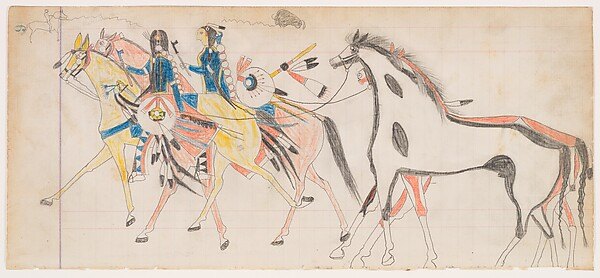
Two Riders Leading Horses (Henderson Ledger Artist B)Frank Henderson / The Metropolitan Museum of Art, Gift of Charles and Valerie Diker,1999,2000;1999.484.16
Arapaho histories include distinct Northern and Southern community experiences. This reading path connects historical change with particular governments, language education, community-authored research and collaborative public history, keeping regional perspectives separate.
See each region’s evidence for historical or present-day scope.
Homeland / region
Great Plains
Research depth
Expanded profile
Source collection
15 annotated resources · 6 Indigenous-led
Inspected sources
11 substantive works · selected content reviewed
Initial adequacy
Adequate initial introduction
Source review
October 21, 2026
Names & relationshipsNorthern Arapaho Tribe and the Cheyenne and Arapaho Tribes are separate governments. Cheyenne people are distinct from Arapaho people despite alliance and a shared Oklahoma government; Wind River is shared with the distinct Eastern Shoshone people.
An expanded introduction, with sources reviewed.This profile develops several themes through identified sources. Citations connect each section to its evidence; remaining gaps appear below. It has not been reviewed or endorsed by the community.
Adequate initial introduction
Eleven substantive works or conservative collections support an initial educational account of historical change, distinct governments, Northern and Southern educational work, language description, community-authored food research and collaborative public history. Four shorter navigation/overview cards remain supporting. Actual original texts and selected scholarly passages were inspected; older estimates and unread references were excluded. The twelve-source quantity target is not reached. The varied evidence supports continuing alphabetically while retaining explicit limits, not a completion or endorsement claim.
Assessment recorded October 21, 2026. This is separate from research completion and community review.
Historical treaty and removal records, additional Southern community voices and deeper chronological scholarship need further reading. No legal conclusions are drawn from introductory summaries.
Selected research and policy texts are not current program evaluations, speaker censuses, complete grammar reviews or permission to reproduce cultural materials.
Backdrop photographs & credits
These photographs have individual, documented connections to this entry. Their captions and source records define the people, place, object, and period shown; no one photograph represents every community within a broader label.
Two Riders Leading Horses (Henderson Ledger Artist B) Frank Henderson / The Metropolitan Museum of Art, Gift of Charles and Valerie Diker,1999,2000;1999.484.16
A specific Arapaho artist's drawing in pencil and colored pencil,ca.1882. Use the whole artwork or disclosed CSS cropping; do not imply contemporary photograph or a general tribal emblem. Met actual object page and Open Access API read;API isPublicDomain:true and official primaryImageSmall URL verified. Entire provided image visually inspected. No meaning of depicted clothing or marks inferred. Web copies proportionally resized/recompressed; display backgrounds may be cropped by CSS. Full image remains proportional in the page banner.
Image, association, and reuse record reviewed 2026-10-24.
Full photographs are displayed proportionally above. A translucent background copy may be cropped by the viewport; it does not replace the complete image or its record.
The visual treatment does not change the research status, evidence, or remaining gaps recorded in this profile.
01
Northern and southern historical trajectories
The Arapaho Project’s Northern Arapaho history distinguishes northern communities centered on the North Platte from southern communities associated with the Arkansas valley. It places the Northern Arapaho move to Wind River in 1878. Its account also connects boarding schools, allotment and pressures on language with later community-controlled education and cultural renewal. This is a Northern-focused historical synthesis; its undated descriptions of contemporary conditions require fresh corroboration.
Finding the Northern Arapaho government's own resources
The Northern Arapaho Tribe's website identifies Wind River as its location and links governmental and departmental resources. It offers a starting point for a particular tribal government's public information. Its brief homepage is a navigation source; the linked publications require their own reading and dates before supporting detailed historical or policy claims.
The Tribes' amended constitution identifies ratification on April 4, 2006. Its preamble links self-government with languages, education and protection of the natural environment. Article II establishes four branches, including the Tribal Council; Articles V–VI distinguish that adult membership body from a legislature representing four Cheyenne and four Arapaho districts. This describes the shared Oklahoma government's framework rather than a constitution for all Arapaho people.
The Tribe's 2006 Education Code presents education as part of Northern Arapaho self-determination. It prioritizes Arapaho language, history and culture alongside academic learning and parent and community participation. It expressly disclaims authority over Eastern Shoshone education policy. This dated publication documents the Northern Arapaho government's stated priorities; its presence online does not verify implementation, educational outcomes or unchanged current law.
Southern language teaching and public cultural work
The Cheyenne and Arapaho Tribes describe teaching both distinct languages through community classes, youth outreach, Elder partnerships and an adult apprenticeship program. These are the institution's stated approaches, without a measured fluency outcome. Its Culture Program also describes representatives working on repatriation and with the National Park Service on public interpretation of Sand Creek. These responsibilities concern the shared Oklahoma institution, rather than every Arapaho community's programs or cultural authority.
In Latoya Lonelodge's 2023 Tribal Tribune interviews, Arapaho apprentice Arianna Long describes progressing from isolated words toward conversation and learning with coworkers while attending college. Rachelle RomanNose discusses pronunciation, expressing herself and the continuing work of learning. Her interest in teaching is an aspiration, not evidence that certification was completed. Their accounts bring individual Southern Arapaho women's voices into a discussion that also includes separately identified Cheyenne learners.
The Arapaho Project explains that words can combine many meaningful elements. Verbs can express information that English distributes across several words, including participants, tense and aspect. Its animate/inanimate distinctions are grammatical, rather than a simple division between living and nonliving things. These introductory explanations offer a starting point for exploring language structure; the linked collection should be used with community teaching and does not certify proficiency.
Cowell and Arapaho coauthor Alonzo Moss, Sr. present their grammar through communicative use as well as forms and rules. Its introduction explains a corpus combining historical records, educational materials and more recent speech, with sources from Wyoming and Oklahoma. The authors identify revisions and corrections to earlier transcriptions. This makes the book useful for understanding how linguistic knowledge is documented, while its evidence remains distinct from a current speaker census.
Kelly and Cowell describe virtual-reality language documentation developed through iterative work with the Northern Arapaho Language and Culture Commission. Elders helped select contexts, and applications were checked for usability and cultural appropriateness. Sessions in 2019–2020 informed the study. The authors compare elicited language with other documentation methods; their findings concern recorded speech and research design, rather than proof that an application produces fluent learners.
In a 2019 study, Northern Arapaho researcher Melvin L. Arthur, with Christine M. Porter, relates food sovereignty to community control over historical storytelling. Interviews, talking circles, personal experience and historical research inform his account of disrupted food access and reclamation. He places these changes within colonial dispossession. This is a situated Northern Arapaho interpretation, without demonstrating current clinical outcomes or unanimity among community members.
Descendant knowledge and documentary investigation
The NPS overview describes descendant knowledge alongside archival research in locating and interpreting Sand Creek. Its short orientation provides a starting point for public history, rather than a complete account of the 1864 attack or its aftermath. The linked individual testimony and media were not inspected for this collection.
Alexa Roberts describes the Northern Arapaho Tribe choosing to conduct its part of the 1999 oral-history project internally. Her account explains why participation and control of research materials mattered, while describing different arrangements with Cheyenne communities. This is evidence about a particular collaborative process. The underlying recordings, interviews and photographs were not accessed or reproduced, and their permissions are not Atlas reuse rights.
A dated framework for collaborative public history
The December 2017 foundation document identifies tribal histories and consultation as important to interpreting the site. Its planning entries call for further community involvement and review of research. These are dated institutional priorities and identified needs, not proof that proposed projects were completed. They do not establish a single position shared by every Arapaho government or person.
The departmental directory lists an Ethete immersion entry alongside other public services. Such listings help readers find Northern Arapaho institutions. A directory alone does not establish current staffing, availability, teaching methods or results. Detailed claims about educational work need a dated publication that explains its purposes, practices and evidence.
Finding the Oklahoma government's public institutions
The Cheyenne and Arapaho Tribes' government overview links its executive, legislative, judicial and Tribal Council branches. This provides an institutional starting point for the shared Oklahoma government; its organization should be kept distinct from Northern Arapaho institutions at Wind River.
Read original treaties and additional historical scholarship before making precise territorial, ratification or legal conclusions. Older university wording is not independently verified legal history.
Broaden public Southern Arapaho and other community-authored perspectives beyond the shared Oklahoma government and two dated apprentice interviews. Northern and Southern institutions remain distinct.
Seek dated educational outcomes and contemporary community priorities without treating an undated program page, a 2006 code or a 2023 interview as current operations or measured success.
The grammar and documentation article were inspected in specified selected scopes. No audio was heard, underlying corpus independently reviewed or full grammar read. Public source access is not cultural reuse permission.
Sand Creek study methods and park planning contribute to public-history literacy; original recordings, individual narratives, casualty totals and sensitive locations remain outside this account. Community review remains open.
Fifteen cards represent eleven substantive works/collections and four short supporting orientations. Homepage, department directory, shared-government overview and brief NPS stories page stay outside the substantive target. Northern Arapaho and Eastern Shoshone are distinct peoples sharing Wind River. Cheyenne and Arapaho are distinct peoples within the shared Oklahoma government. Neither arrangement establishes one universal authority or identical historical experience. Northern education code enactment is May 4, 2006; the Oklahoma constitution was ratified April 4, 2006 and inspected through a later amended compilation. Neither is asserted to be unchanged current law. Reference grammar authorship includes Alonzo Moss Sr.; selected original introductory content counts once. Online grammar pages form one separate instructional collection, not a count for every lesson link. The 2019 food-sovereignty paper offers situated community-authored interpretation. The 2023 VR paper describes collaborative documentation, not demonstrated learner-fluency gains. Roberts’s 2000 methods paper and the 2017 NPS planning document are distinct works. Original recordings and source media were not accessed, and research permissions do not transfer to Atlas reuse.
Follow the reading path
Sources & further reading
Open any title to read the original source. Annotations explain what each link can help you explore.
No Indigenous-led source is identified in this entry yet. This is a gap in this collection, and does not imply an absence of community knowledge or organization.
Publication: Education Code version dated May 4, 2006; page 31 records enactment that day. Preface undated; 2026/07 upload paths are not publication dates
A dated primary policy text expresses Northern Arapaho educational priorities. Read as legislation and institutional intent, without assuming unchanged current law or successful implementation. The code preface and education title are conservatively grouped as one publication collection.
Inspection: Content reviewed for the stated scope
Scope: Actual 31-page title: selected pages 1–6, 10–11, 14–18 and final history note on 31. Claim uses policy on 2, 5–6 and enactment note; not the whole code.
Publication: Ratification identified as April 4, 2006; amended compilation includes 2021 election documentation and a January 12, 2023 BIA letter; PDF metadata dated September 2024 is not a ratification date
A primary constitutional framework for this shared government. The amended compilation must not be labeled an unchanged 2006 text or treated as independently verified current law. Citizenship rules, district boundaries and individual eligibility are not summarized.
Inspection: Content reviewed for the stated scope
Scope: Selected scan images: PDF 1–4 cover, ratification, contents and preamble; printed 4, 11 and 14 (PDF 8, 15, 18), Articles II, V and VI; printed 49–50 (PDF 53–54), amendment-related correspondence. Not the complete constitution.
Publication: Undated; footer copyright and dated application links do not establish the body's publication date
The Tribes describe distinct language programs and shared cultural institutions. Program aims are not measured outcomes. Cheyenne-specific history, precise migration dates, demographic claims and ceremonial applications are excluded; no media or restricted knowledge is reproduced.
Inspection: Content reviewed for the stated scope
Scope: Actual Culture Program and Language Program bodies, lines 5–29; historic-preservation introduction 48–50 and separate history headings/bodies 71–86 also read. Synthesis selects public institutional responsibilities and teaching descriptions only.
Publication: February 16, 2023 online posting; article links readers to the February 15, 2023 newspaper issue
A dated interview gives named Arapaho learners' perspectives alongside distinct Cheyenne participants. Individual experiences and aspirations are not universal fluency measures or completed certification outcomes. Old speaker estimates are excluded; no photographs, audio or instructional story texts are reused.
Inspection: Content reviewed for the stated scope
Scope: Actual complete article, lines 21–148, including byline and publication context. Synthesis selects Arianna Long's Arapaho experience in Part I and Rachelle RomanNose's Arapaho learning and teaching aspirations in Part II.
Publication: Published online November 11, 2019; Fall 2019, volume 9, supplement 2, pages 69–84. Later repository dates are not original publication
Arthur explicitly writes as a Northern Arapaho member. With Porter, he offers situated qualitative and historical research on food sovereignty. Neither a government statement, representative survey nor clinical-outcomes study; shared Wind River projects do not merge the two Nations.
Inspection: Content reviewed for the stated scope
Scope: Actual 16-page article: imprint and selected printed 69–73, 80–81 (PDF 1–5, 12–13), including authorship, methods and conclusion. Other history sections not fully reviewed.
Review recorded: October 21, 2026
Inspected material and access routes
Original journal article PDF ↗ — Actual selected article pages and original imprint read; same work as the landing page.
Publication: Undated page; copyright and crawl dates do not establish publication
A substantive Northern-focused history connects changing Plains relationships, dispossession and educational institutions. The undated page is useful for historical orientation; its contemporary assessments, estimates and broad generalizations are not current measurements or substitutes for tribal accounts.
Inspection: Content reviewed for the stated scope
Scope: Full actual narrative read: pre-contact, nineteenth-century, early reservation and contemporary-era sections. Synthesis selects river-valley distinctions, 1878 Wind River settlement, assimilation pressures and later educational renewal.
One learning collection offers a substantive grammar introduction alongside navigation to educational resources. Selected text explains word structure and grammatical categories. The undated landing page’s speaker estimates are excluded; linked media, dictionaries and narrative contents are not thereby inspected.
Inspection: Content reviewed for the stated scope
Scope: Actual language and grammar page bodies read; lesson page reviewed as navigation only. Count the related pages once. No audio listening, complete curriculum, dictionary or narrative review.
Review recorded: October 21, 2026
Inspected material and access routes
Grammar ↗ — Full explanatory body: verbs, categories, modifications, nouns and sentences.
Lessons ↗ — Topic list only; not inspected lesson contents.
Publication: 2008 original publication, verified in publisher metadata; later editions not separately counted
The published reference grammar’s substantive introduction explains its aims, analytical perspective and source corpus. This separate work is not the brief online grammar lesson. Its historical speaker estimates and judgments about learner commitment are not adopted as present community facts.
Inspection: Content reviewed for the stated scope
Scope: Actual 19-page publisher excerpt: selected printed 1–7 (PDF 8–14), especially aims and sources on 4–7. Contents inspected for orientation; later grammar chapters, underlying narratives and recordings not reviewed.
Publication: 2023-05-26 publication, confirmed by University of Virginia’s journal announcement; deposited copy identifies 2023
A research article describes an elicitation method developed with Northern Arapaho elders and educators. It concerns documentation, rather than demonstrated classroom effectiveness. The deposited reading copy has placeholder citation fields; the work’s publication date was independently checked through the journal’s university announcement.
Inspection: Content reviewed for the stated scope
Scope: Actual 13-page deposited PDF: title, selected introduction/background and method on 2–5, conclusion/acknowledgements on 10. No audio/video, application testing, underlying archive or detailed statistical reanalysis.
A substantial dated park-planning document identifies tribal participation and further research needs. It records institutional planning, without proving that proposed work was completed or describing current arrangements.
Inspection: Content reviewed for the stated scope
Scope: Actual 62-page PDF: cover, introduction on printed 2 and selected planning entries on printed 28–29 (PDF 32–33). Other encountered history and casualty totals are not adopted; no map or sensitive location is reproduced.
A public methodological account explains differing community arrangements in the site study. The Northern Arapaho project is distinguished from Cheyenne projects. One article counts once, not the entire issue or individual interviews.
Inspection: Content reviewed for the stated scope
Scope: Actual 56-page issue: cover and complete article on printed/PDF 43–46 read. No original recordings, photographs or interview transcripts accessed. Archive is an independent mirror explicitly linked by the current NPS bibliography.
Review recorded: October 21, 2026
Inspected material and access routes
NPS oral-history articles bibliography ↗ — Actual Roberts bibliographic entry read and archive link followed; bibliography is not an additional substantive work.
Publication: Undated; relative social-feed times do not date the institutional description
A brief institutional entry point links governmental and departmental resources. Retained for navigation and situated identity, outside the substantive count. Dynamic announcements, population displays and office details are not verified current facts.
Inspection: Supporting or limited review; see scope
Scope: Actual homepage body and navigation read, especially the Wind River location statement and links. Embedded social posts and linked videos not reviewed.
Review recorded: October 21, 2026
Counting note: Bare institutional orientation and navigation, not a substantial historical or governmental publication.
Publication: Directory and selected linked description undated
The directory identifies institutional access points, including immersion at Ethete. Its listings and brief linked description supply orientation, without establishing current operations, enrollment, methods or effectiveness. Conservatively retained as supporting context.
Inspection: Supporting or limited review; see scope
Scope: Actual displayed directory entries read; Load More not activated. Actual linked Immersion body also read; its undated assertions are not used as implementation evidence.
Review recorded: October 21, 2026
Counting note: A directory and short undated department description do not become an evaluated or substantial program publication.
Inspected material and access routes
Immersion (Ethete) ↗ — Brief undated program description read; no dated implementation or evaluation established, and no separate count.
Publication: Undated; site copyright is not a demonstrated article date
A brief four-branch overview retained as a useful original access route. Its short descriptions are supporting material, outside the substantive minimum. Linked departmental listings are not additional inspected works or evidence of program outcomes.
Inspection: Supporting or limited review; see scope
Scope: Actual introductory text and four branch descriptions, lines 2–36. Legislative and Tribal Council pages were followed to locate the constitutional publication; their directories are not separately counted.
Publication: Last updated April 24, 2025; first publication not established
A short public orientation describes descendant knowledge and documentary investigation. Useful supporting context, conservatively outside the substantive count. Its casualty figures and linked testimony are not adopted here.
Inspection: Supporting or limited review; see scope
Scope: Actual displayed narrative read. Last-updated date is not verified first publication. Linked letters, interviews and source media were not read or reused.
Review recorded: October 21, 2026
Inspected material and access routes
Original retained NPS access route ↗ — Original collection URL retained; recent request timed out. Actual content was read at the canonical www.nps.gov route.
Related entries may represent alternate names, constituent communities, wider groupings, or historical connections. Read the naming notes before treating entries as equivalent.
Robey’s Atlas of Indigenous North America · Compiled October 19, 2026 · Arapaho