Apalachee histories connect Florida communities, colonial missions and continuing descendant life in Louisiana. This collection pairs a community self-account and public-history participation with museum interpretation, scholarship and archaeological documentation.
See each region’s evidence for historical or present-day scope.
Homeland / region
Southeast / Florida / Louisiana
Research depth
Expanded profile
Source collection
6 annotated resources · 2 Indigenous-led
Inspected sources
5 substantive works · selected content reviewed
Initial adequacy
Adequate initial introduction
Source review
October 21, 2026
Names & relationshipsApalachee names an Indigenous people; San Luis de Talimali was a particular ancestral town and mission. The Talimali Band is a contemporary Louisiana descendant community, whose organization and recognition history should be distinguished from colonial population labels.
An expanded introduction, with sources reviewed.This profile develops several themes through identified sources. Citations connect each section to its evidence; remaining gaps appear below. It has not been reviewed or endorsed by the community.
Adequate initial introduction
Five substantive works or conservative collections support an accessible initial introduction through a descendant-community account, public-history participation, museum interpretation, a scholarly historical monograph and technical archaeological documentation. Related museum pages count once, and brief projects remain supporting context. Original article searches found further promising scholarship, but actual downloads failed and those works remain unread leads. This bounded coverage supports continuing alphabetically with explicit gaps; the twelve-source quantity target is not reached and fuller research remains open.
Assessment recorded October 21, 2026. This is separate from research completion and community review.
Modern community perspectives beyond the selected publishing Band and dated broadcast remain underrepresented. A recognition filing does not establish a recognition outcome.
Post-1704 archives, newer political scholarship, language history and everyday cultural life warrant further original-source reading; initial adequacy is not completeness or endorsement.
Backdrop photographs & credits
These photographs have individual, documented connections to this entry. Their captions and source records define the people, place, object, and period shown; no one photograph represents every community within a broader label.
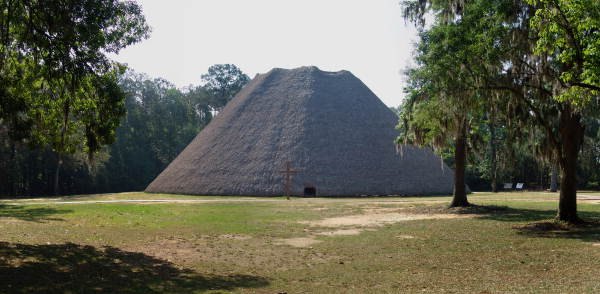
Reconstructed Apalachee council house at Mission San Luis Roy Lett / State Library and Archives of Florida, Florida Memory, PR30139
A modern reconstruction at a public living-history museum, not a surviving seventeenth-century structure. Visible caption must say reconstructed/replica. Institutional description reproduced on Commons, licensing and full 600px original photo visually inspected. Florida Memory original record https://www.floridamemory.com/items/show/16978 returned403 in this review; no bypass attempted. Web copies proportionally resized/recompressed; display backgrounds may be cropped by CSS. Full image remains proportional in the page banner.
Image, association, and reuse record reviewed 2026-10-24.
Full photographs are displayed proportionally above. A translucent background copy may be cropped by the viewport; it does not replace the complete image or its record.
The visual treatment does not change the research status, evidence, or remaining gaps recorded in this profile.
01
A community describing its own priorities
The Talimali Band presents itself as a Louisiana Apalachee descendant community and connects cultural preservation with educational outreach, research collaboration and higher-education assistance. Its public account dates nonprofit organization to 1995 and a federal recognition filing to 1996. These are the Band's own institutional statements. A filing is distinct from a recognition determination, and the pages' descriptions do not independently verify present scholarship eligibility, program outcomes or every person's ancestry.
Hann’s historical study describes major Apalachee villages with considerable autonomy during the seventeenth-century mission period. Ivitachuco and San Luis had prominent leaders, but prominence did not necessarily give them command over other villages. He also stresses uncertainty in earlier Spanish accounts. This helps readers approach Apalachee political history through relationships among communities, rather than assume a single centralized government persisted unchanged across periods.
A museum interpretation of mission history and its evidence
Mission San Luis’s museum collection portrays mission relations as shaped by Apalachee diplomacy, Spanish authority and coerced labor. It describes violent attacks, the mission’s 1704 end and different paths of displacement, while the timeline separates later routes toward Louisiana. The archaeology page explains the museum’s reliance on material remains and Spanish records. These are historical interpretations underpinning a modern reconstruction; the mission’s destruction must not be mistaken for the end of Apalachee people.
Hann describes a 1688 letter by Apalachee chiefs, preserved with a contemporary Spanish translation, as central evidence for studying the language. He cautions that Indigenous words recorded by Spaniards were not necessarily Apalachee.
McEwan’s 2003 documentation explains how survey and test excavations helped identify structures and activity areas at San Luis. She interprets the Apalachee council house and chiefly residence as evidence that important political institutions continued within a colonial settlement. This is an archaeologist’s interpretation of one community’s material record. It invites comparison with written accounts without assuming that mission life erased every Indigenous institution or affected every village identically.
A 2006 History Detectives transcript records Gilmer Bennett returning from Louisiana to Mission San Luis and discussing an ancestral connection with presenter Tukufu Zuberi. Bennett describes the visit as feeling like home and helps frame the investigation's question. This is direct participation in public history, rather than a community represented only through archaeological narration. The program's conclusions remain interpretations; the exchange does not independently establish every modern lineage or a shared religious position.
The Talimali project page brings together an undated village-expansion plan, museum-remodelling intentions and a September 2021 account of Hurricane Ida relief. The relief notice reports supply deliveries, while the museum text invites ideas for broader exhibits. These entries show what the Band proposed or reported at different times. They do not establish that planned construction or exhibits were completed, or that old requests and activities remain current.
Read newer scholarship on seventeenth-century conflict, including Lauersdorf’s full article, when legitimate access becomes available. Abstracts and 403 downloads were not counted.
Develop post-1704 displacement and Red River histories through actual original documents and community accounts. Never treat destruction of a mission or older extinction frameworks as disappearance of a people.
Broaden public community accounts of foodways, language, music and cultural life beyond one descendant institution and one dated broadcast, without reproducing restricted cultural or burial material.
Verify present recognition, leadership and program conditions separately before reporting current outcomes, eligibility or services. Undated plans and a 1996 filing are not completed actions.
Archaeological interpretation at San Luis is local and dated. Underlying excavation reports, Spanish manuscripts and the 1688 letter itself were not independently read through the reviewed summaries. Community review remains open.
Six cards represent five substantive works/collections and one short supporting projects page. The five original museum URLs remain visible within one conservative collection; multiple URLs are not separate works. Hann’s 1988 book is inspected through the 2017 university reissue. Selected political and language passages count once. Its obsolete extinction framing is excluded, and no translation of the original 1688 letter is claimed. McEwan’s form was prepared January 7, 2003, with later documentation context distinct. A technical nomination is not a current recognition ruling, unchanged surviving village or independent proof of every interpretation. PBS/OPB 2006 transcript was read, with direct community participation attributed. The 2011 directory is not the episode date, no video was viewed and participation is not relabeled a formal research partnership. Talimali institutional history, nonprofit organization, recognition filing and community identity are distinct. No lineage or sole representative authority is inferred from surnames, an artifact or one institutional claim.
Follow the reading path
Sources & further reading
Open any title to read the original source. Annotations explain what each link can help you explore.
No Indigenous-led source is identified in this entry yet. This is a gap in this collection, and does not imply an absence of community knowledge or organization.
Indigenous-ledTalimali Band of the Apalachee Indians of LouisianaSource 1
Publication: Both pages undated; dates of described events are not publication dates
The Band's public self-account and overlapping mission page are grouped once. They contribute its own perspective, without independently proving every historical claim, current program or legal status. Application, incorporation and community identity remain distinct.
Inspection: Content reviewed for the stated scope
Scope: Actual complete Today body, lines 62–69, and mission/activity/scholarship text 66–97 on What We Do. Current officeholders, eligibility and exclusivity claims excluded.
Review recorded: October 21, 2026
Inspected material and access routes
Our Mission, Our Vision, and What We Do ↗ — Actual mission, institutional history and scholarship description; overlapping community account, not another work-level count.
Publication: Undated pages; timeline ends with October 2022 entry. The 2026 footer is not a demonstrated article publication date.
Related uncredited museum history, chronology and archaeology pages are grouped once. Read as institutional interpretation, with coercion and survivor continuity visible. Disappearance claims and simplified cultural-origin narratives are not adopted.
Inspection: Content reviewed for the stated scope
Scope: Actual complete substantive bodies of all five pages read, excluding navigation. No underlying archival records, excavation reports, reconstruction manuals, linked resources or media reviewed.
Review recorded: October 21, 2026
Inspected material and access routes
Mission San Luis ↗ — Actual mission interpretation and colonial labor history.
End of the Mission System ↗ — Actual destruction, displacement and descendant passage; wording critically screened.
Timeline ↗ — Actual chronology; historical movement and museum-development entries distinguished.
Archaeology ↗ — Actual short evidentiary overview; not an excavation-report review.
Publication: 1988 original; 2017 LibraryPress@UF open reissue
A substantial documentary study examines relationships among Apalachee villages and leaders. Read its historical arguments with the stated limits of colonial records. Its obsolete extinction framing is not adopted, and this selected reading does not review the whole book.
Inspection: Content reviewed for the stated scope
Scope: Actual 470-page university PDF: title/licence, preface xi–xiii, introduction 1–4, political history 96–100 (PDF 116–120) and language documentation 118–121 (PDF 138–141). Selected pages only; ceremonial appendices and later extinction chapter are not used.
Publication: Prepared 2003-01-07; later asset/index dates are not publication dates
The archaeologist’s technical nomination explains how survey, testing and documentary research informed interpretations at San Luis. It is a distinct research account beyond a museum summary. Its dated interpretations concern this settlement, not all Apalachee experience or present recognition.
Inspection: Content reviewed for the stated scope
Scope: Actual 23-page PDF: identification, selected history/methods on 4–7 and 12–13, and preparer/date on 21. Synthesis uses survey methodology and political-architecture interpretation only; no burial, ceremony, mapped-location or present-status claims.
Publication: 2006 episode and transcript copyright; exact air day not established; 2011 PDF directory is an upload signal
A distinct public-history work records Bennett asking questions and responding to research. Interview participation is documented; a formal community research partnership is not claimed. Program inferences about an artifact are not genealogical proof or an all-community religious interpretation.
Inspection: Content reviewed for the stated scope
Scope: Actual complete four-page transcript read, plus PBS episode description. Synthesis selects Bennett/Zuberi exchanges on pages 1 and 4. No video viewed; burial/ritual details excluded.
Review recorded: October 21, 2026
Inspected material and access routes
Actual episode transcript ↗ — Four-page 2006 transcript, including direct community statements; one work with the episode page.
Publication: Page undated; Hurricane Ida notice explicitly September 2021; other project dates unestablished
Three brief project notices combine undated plans with dated relief reporting. Useful primary context but retained outside the substantive count. Photographs and present-tense wording do not establish completion, current availability or results.
Inspection: Supporting or limited review; see scope
Scope: Actual complete project text, lines 65–110: village expansion, September 2021 Hurricane Ida relief and museum intentions. Images and proposed family/clan exhibits not republished.
Review recorded: October 21, 2026
Counting note: Short notices and proposed work, not an independently evaluated or substantial project-history publication. Preserved without quota padding.