Alderville First Nation’s public history identifies its people as Mississauga Anishinabeg and follows their movement from the Bay of Quinte to Alderville. A separate account by its native-plant nursery coordinator introduces community-based ecological restoration and education.
See each region’s evidence for historical or present-day scope.
Homeland / region
Ontario, Canada — listing address only
Research depth
Source guide
Source collection
2 annotated resources · 1 Indigenous-led
Inspected sources
2 substantive works · selected content reviewed
Initial adequacy
Still unfinished
Source review
October 27, 2026
Names & relationshipsListed as an Anishinabek Nation member First Nation. This is an organizational relationship; membership alone does not establish ethnicity, language, ancestry, citizenship, jurisdiction or representation of another named community.
A source guide for a deeper dive.This entry provides a brief orientation and an organized reading path. A comprehensive deep dive has not yet been completed. Follow the annotated sources and distinguish primary community accounts from outside reference material.
Still unfinished
A small, purposefully selected actual-content starting path and specifically scoped credited image are now available. Fuller history, source comparison and community review remain open; quantity does not establish completion.
Assessment recorded October 27, 2026. This is separate from research completion and community review.
Review community-directed family, language and governance histories beyond these two introductory accounts.
Inspect original land and mission records with community guidance; no current legal or boundary determination is made.
Follow restoration and nursery work through later community assessments; no current ecological totals are asserted.
Backdrop photographs & credits
These photographs have individual, documented connections to this entry. Their captions and source records define the people, place, object, and period shown; no one photograph represents every community within a broader label.
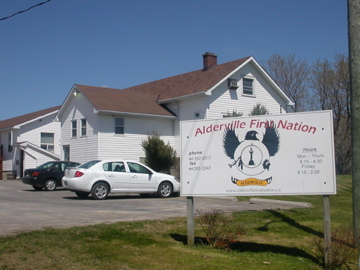
Alderville First Nation administration office, May 2007 Casey.sabawi / Wikimedia Commons · CC BY-SA 3.0
The exact identified administration-office exterior is a dated view of Alderville’s public institutional setting, not a current-service assurance or a complete representation of its people. The source is low resolution at360×270. The public sign/emblem is part of the scene and is not adopted as Atlas branding. Parent imported the supplied complete JPEG unchanged; the recorded original/preview/earlier-derivative limits remain. CSS crops/overlays affect display only.
Image, association, and reuse record reviewed 2026-10-27.
Full photographs are displayed proportionally above. A translucent background copy may be cropped by the viewport; it does not replace the complete image or its record.
The visual treatment does not change the research status, evidence, or remaining gaps recorded in this profile.
Start reading here
A short starting path through selected actual-content works. Read each annotation for the specific community, period and inspection limits; this is not a complete history or community endorsement.
Follow a different aspect of community life, keeping its date and evidence limits in view.
These are selected starting points. The full annotated collection, source perspectives, inspection limits and remaining research questions follow below. A starting guide is not an exhaustive history or community endorsement.
01
A community account of relocation and continuity
Alderville’s own history begins with its Mississauga Anishinabeg community at the Bay of Quinte and describes settlement at Alderville in the mid-1830s. It places mission schooling and economic change within wider colonial pressures. The account emphasizes that learning new skills did not erase language and cultural identity. This is a community interpretation to read alongside original records, rather than a complete history of every family.
Writing in 2021 as the Mitigomin Native Plant Nursery coordinator, Gillian di Petta describes Alderville’s work to restore tallgrass prairie and black oak savanna. Her account connects nursery production with ecological restoration, research and public education. It records a project’s development and ambitions, rather than proving that every planned activity or later environmental outcome was achieved.
Develop a community-directed history and annotated reading collection.
Review community-specific imagery and reuse terms before substantive profile publication.
Review detailed relationships, naming changes and historical regional connections.
Review community-directed family, language and governance histories beyond these two introductory accounts.
Inspect original land and mission records with community guidance; no current legal or boundary determination is made.
Follow restoration and nursery work through later community assessments; no current ecological totals are asserted.
Cohort06: selected actual-content sources and specifically scoped credited imagery form a bounded starting guide. Reused publications/photos are not new global works. Comprehensive history and community review remain open.
Follow the reading path
Sources & further reading
Open any title to read the original source. Annotations explain what each link can help you explore.
No Indigenous-led source is identified in this entry yet. This is a gap in this collection, and does not imply an absence of community knowledge or organization.
Complete public history body read. A community account of relocation, missions, assimilation pressures and cultural continuity; the linked treaty and family records were not independently inspected.
Inspection: Content reviewed for the stated scope
Scope: Complete public main body, web lines24–30; no author/date stated. Perspective: First Nation public historical interpretation.
Review recorded: October 27, 2026
Access note: Actual substantial indexed public body read without an account or challenge. Treaty/mission/family originals uninspected.
Complete June 2021 participant essay read. The nursery coordinator describes restoration work and project goals from her own role. Published by the funder; her ancestry is not inferred. Plans and ecological claims are dated; later outcomes and underlying measurements were not checked.
Inspection: Content reviewed for the stated scope
Scope: Complete body and author/date, web lines50–75. Perspective: First-person2021nursery coordinator account hosted by project funder.
Review recorded: October 27, 2026
Access note: Actual substantial indexed public body read without an account or challenge. Plans and claimed ecological measurements not independently verified; future completion not inferred.