Explore Ahtna homelands and community life through named voices, village planning, language teaching, historical studies and stewardship research. Distinguish village tribal governments, Native corporations and regional organizations while following each source’s perspective and date.
See each region’s evidence for historical or present-day scope.
Homeland / region
Alaska / Copper River Basin and neighboring Interior Alaska drainages
Research depth
Expanded profile
Source collection
21 annotated resources · 12 Indigenous-led
Inspected sources
16 substantive works · selected content reviewed
Initial adequacy
Not assessed
Source review
October 20, 2026
Names & relationshipsAhtna is a Northern Dene people and language name. Ahtna, Incorporated and Chitina Native Corporation are Native landholding corporations; village tribal governments and AITRC have different roles. The eight regional member tribes form an institutional partnership, not a statement that every resident has one language or identical affiliation. The Dene entry supplies wider context and is not a single government encompassing these institutions.
An expanded introduction, with sources reviewed.This profile develops several themes through identified sources. Citations connect each section to its evidence; remaining gaps appear below. It has not been reviewed or endorsed by the community.
Backdrop photographs & credits
These photographs have individual, documented connections to this entry. Their captions and source records define the people, place, object, and period shown; no one photograph represents every community within a broader label.
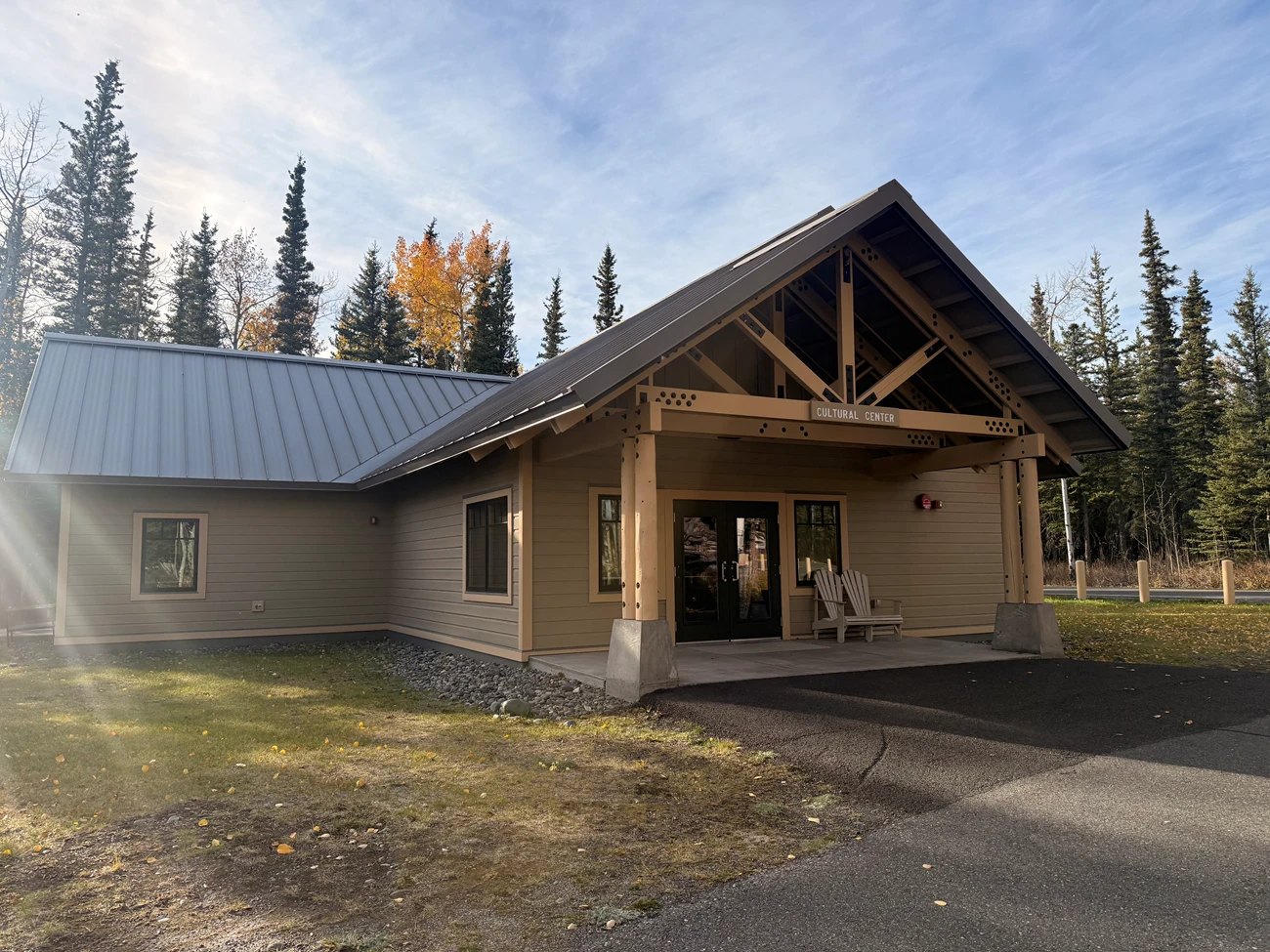
Ahtna Cultural Center, C'ek'aedi Hwnax (Legacy House) National Park Service (NPS)
Exterior of Ahtna Cultural Center at Copper Center, Alaska; source explicitly names the Ahtna-operated cultural center. A place image, not a claim that architecture represents all Ahtna culture. Actual NPS page, photo caption and NPS ownership policy read. Official 1300x975 web image downloaded and visually inspected. Individual photographer and exact photo date are not supplied; do not guess. Web copies proportionally resized/recompressed; display backgrounds may be cropped by CSS. Full image remains proportional in the page banner.
Image, association, and reuse record reviewed 2026-10-24.
Full photographs are displayed proportionally above. A translucent background copy may be cropped by the viewport; it does not replace the complete image or its record.
The visual treatment does not change the research status, evidence, or remaining gaps recorded in this profile.
01
Copper River homelands and living relationships
Ahtna people’s histories center on the Copper River region and connections extending into neighboring Interior Alaska drainages. The Alaska Native Language Center identifies Ahtna as an Athabascan language of the Copper River and upper Susitna and Nenana areas. Ahtna, Incorporated’s cultural overview places family fishing, hunting, gathering and other food work within seasonal relationships that continue amid changing lives. A cultural homeland, a language’s described distribution and the property owned by particular corporations are different kinds of geography. Neither a park boundary nor a corporate shareholder total describes the whole people.
AITRC identifies eight member tribes and the landholding corporations Ahtna, Incorporated and Chitina Native Corporation. It describes coordinating resource work rather than replacing village governments. Ahtna’s short village history also explains that seven village corporations merged with the regional corporation in 1980 while Chitina’s remained separate. That corporate reorganization should not be confused with a merger of tribal governments. Gakona’s own page separately describes its government and community services.
The community-coauthored 2019 study The Ahtna Homeland describes nineteenth-century land relationships through regional bands, matrilineal clans and particular leaders. Winter villages were connected with fishing camps, hunting areas and trails. Rights to use places were recognized, while kinship also carried obligations to share resources, particularly during shortages. This was an organized inhabited landscape before colonial authorities classified land through public and private property. The study follows pressures toward permanent road-connected settlements, including schooling requirements, restricted livelihoods and opportunities for paid work. Its account of movement toward Cantwell shows a gradual process with continued seasonal travel. These historical relationships should be distinguished from today’s tribal governments and Native corporations; none of those categories automatically substitutes for the others.
Simeone and Miller’s 2024 assessment combines historical records with elders’ accounts of colonial change. It distinguishes earlier Russian encounters from the expanding American presence after the 1898 gold rush, including mining, roads, schooling and pressures on livelihoods. Its wartime history describes forced removal from Dry Creek in 1942–43: homes were burned or dismantled to make way for an airfield. At Gulkana in 1943, bridge and road construction divided the village and forced resettlement across the river. These were local displacements within a homeland where Ahtna connections continued. The assessment also documents subsequent political organizing. Reading remembered experiences alongside government records matters, especially where official files omit removals. The authors’ synthesis preserves named narrators and differing perspectives; it does not speak for every family.
In his 2022 chapter, Simeone treats maps as historical arguments shaped by their makers’ purposes. He contrasts the sparse Indigenous information on Colton’s 1868 map with later surveys and development maps. A 1918 map used in advocacy over the Copper River fishery instead emphasized Ahtna villages and estimated populations. His discussion also considers a map produced by Ahtna, Incorporated that places corporate landholdings within a larger traditional homeland. Together these examples show why an apparently blank map cannot establish an uninhabited country, and why settlement dots do not capture a whole land relationship. Historical homeland representations, corporate parcels and present legal boundaries answer different questions. The chapter’s interpretations are useful reading guides, rather than authority to draw a precise territorial boundary.
Chitina Native Corporation dates its incorporation to 1973 and describes shareholders as primarily residents or descendants of the Native Village of Chitina, which it identifies as a separate tribe. Its public history recalls named leaders including Nicolai, Hanagita and Goodlataw, and Doc Billum’s river transport and knowledge of copper deposits. These attributed biographies place particular people and family relationships within exploration, transport and mining histories; their approximate dates should remain qualified.
Ahtna, Incorporated’s land FAQ distinguishes the property it owns from a much larger traditional-use landscape. It also identifies Chitina Native Corporation as a separate landholder. The FAQ describes different arrangements for recreation, research, filming and reserved public routes. These distinctions matter when reading a map: cultural relationships, corporate ownership and particular access rights describe different things. The corporation’s general account does not determine every parcel or route’s legal status.
Chitina’s distinct land statement connects cultural history and food resources with responsibilities to future generations. It gives shareholders and descendants priority in cultural, subsistence and recreational use while describing conditions for public access. This is the corporation’s account of managing its property. It should be read alongside current permissions and the status of particular land, rather than treating a broad Ahtna regional label as either public access or one uniform ownership.
In her 2007 interview, Kathryn Martin describes time spent traveling with her grandmother Katie John as a central part of her education. Watching relatives and listening over time connected knowledge with responsibilities to land and people. Martin also discusses the choices facing younger generations and her hopes for schooling that makes room for Ahtna language and culture alongside other educational opportunities. Her account resists reducing education to a textbook or a short list of cultural facts. She explicitly considers the consequences of sharing knowledge outside the community. This is one person’s public reflection at a particular moment, and its examples should retain her attribution and date.
Kari’s 1990 dictionary makes its Ahtna contributors visible, including Katie and Fred John Sr., Chief Jim McKinley, Mildred Buck, Ruth Johns, and speakers from several regions. Its historical introduction credits Buck, Jeff Leer, Michael Krauss, and Kari with establishing the writing system in 1973, and describes Buck’s work training other Ahtna writers. The dictionary combines roots, affixes, and examples with an English index. Its regional labels help readers recognize variation; they should be read within that work’s framework. Kari also acknowledges missing words and possible errors. The book is therefore a substantial learning and research tool whose own introduction invites correction and continuing community knowledge.
The Mentasta lessons feature Katie John’s recorded Upper Ahtna speech, with transcription by John T. Ritter and James Kari and editing by Cynthea L. Ainsworth. Their monthly sequence connects conversation with seasonal activities, then develops vocabulary and grammatical patterns through questions and answers. The inspected units cover weather, food, family, everyday activities, and learning to understand the language. The introduction also credits intergenerational teaching work in Mentasta. Readers should approach this as a resource grounded in a particular speaker and variety, rather than assume that every pronunciation or expression represents every Ahtna community. The 2018 web version preserves a teaching work published in 2009.
Berez’s 2013 study shows how the Ahtna Heritage Foundation’s C’ek’aedi Hwnax connected preservation with active learning. Its account of an August 2013 workshop brings learners, elders, and linguists together to work with archived recordings, transcription, grammar, and dictionary use. The study also documents local control over access: staff consulted families about legacy recordings whose original permissions could be unclear. These are historical descriptions of the archive’s decisions, rather than confirmation of today’s procedures. The wider lesson is practical: a recording’s survival and a researcher’s ability to describe it do not by themselves settle who may hear it, copy it, or publish it.
Gulkana’s January 2024 public review draft master plan connects cultural life with housing, training, community facilities and environmental resilience. A small 2023 survey, open to Tribal and non-Tribal respondents, records local concerns and aspirations; it is not a census of Ahtna opinion. Proposed actions include protecting cultural places, improving housing and providing additional subsistence-skills learning. The draft shows a particular community considering its future, without establishing final adoption or completed construction.
A Fall 2018 Kanas article describes Tazlina’s effort to address contamination around the former Copper Valley School, including work on land the Village did not then own. It connects environmental programs with community access, recycling and energy needs, reporting a heating project completed that September. A pedestrian route remained in planning. The account shows village initiative across institutional and property constraints at that date; it is not a current ownership record or contamination clearance.
A 2016 agreement between the Interior Department and AITRC identifies a shared purpose: sustaining wildlife and opportunities to continue customary subsistence practices. It provides a framework for rulemaking, cooperative research and an advisory process, with Ahtna knowledge contributing to management decisions. The document also retains federal responsibilities, makes proposed actions conditional on applicable procedures, and states that it creates no enforceable obligations or rights. Reading those provisions together shows a negotiated process whose implementation must be traced through later decisions, rather than assuming that signing the agreement transferred land or complete wildlife authority.
Kosbruk and Simon’s January 2026 report follows the Community Harvest System through administration, registration, hunting effort and participants’ feedback. It describes pooled harvest opportunities under a federal framework and explains the inclusion of federally qualified rural residents of the named communities. For 2023–2025, its moose-program summaries report no successful harvests, alongside continuing outreach and coordination. This is a bounded account of one program, not a measure of all Ahtna hunting or food sharing. The authors connect access, competition and environmental conditions with participants’ difficulties and advocate regulatory changes; that advocacy does not establish what later regulators decided.
AITRC’s salmon-health account connects fishers’ observations with a research program involving tissue samples, measurements and laboratory work. Sampling across locations and portions of the run helps examine variation that a single collection could miss. Working with people already harvesting salmon links monitoring to community food priorities and practical knowledge of the river. The project is described as preliminary surveillance with partner laboratories and federal support. Its sampled observations provide a starting point for continued investigation; they cannot establish every fish’s condition or explain salmon trends across other watersheds.
Miller’s collaborative study brings regional residents’ experiences into an account of changing winter access. Interviewees describe later or less reliable river ice, variable snow and effects on trapping, firewood gathering and travel. Their observations differ, and the nine interviews were selected for experience rather than as a population survey. Ahtna elders’ accounts appear alongside Upper Tanana and other residents’ testimony. The article also examines wage employment, settlement and changing transport technology. Those connections show why environmental change belongs within a wider history of work and access, while historical descriptions cannot establish safe crossing places today.
Add more village-authored histories and contemporary perspectives from Cantwell, Mentasta, Cheesh’na, Kluti-Kaah and other communities; this introduction has not received community review.
Confirm current community-approved language teaching and archive access through authoritative institutions. The lessons, dictionary, interview and archive study retain their own dates; neither current speaker counts nor teaching outcomes are established here.
The publicly linked former Foundation domain identifies itself as an unofficial reconstruction. Its descriptions are not used to verify present programs, contacts, archive holdings or permissions.
Independently listen to and check the Mentasta lesson audio before describing playback or pronunciation beyond the inspected written material.
Follow Gulkana’s January 2024 public review draft through any adoption record and later implementation. Its small mixed-participant survey and internally inconsistent priority counts do not support population-wide percentages or rankings.
Extend the dated Tazlina environmental account with later village evidence; the 2018 article does not establish current ownership, complete remediation or completion of planned work.
Resolve the Community Harvest System report’s inconsistent chart rates and averages against underlying records. Follow recommendations through subsequent regulatory decisions before asserting present conditions or hunting rules.
Compare additional appropriately public family and archival accounts of local displacement and political organizing. Shared earlier research does not make every cited publication an independent confirmation.
Establish suitable rights and community context before reproducing maps or extracting geometry. Historical homeland representations, corporate parcels, park boundaries and private-use locations must remain distinct.
Sixteen substantive works and five supporting references were inspected on October 20, 2026. Supporting cards are explicitly excluded from the substantive count. Relevant pages and written sections were read where annotations specify a limited scope; complete books and interview audio are not implied. Print/web teaching versions count once, dictionary scan/catalogue count once, report chapters count once, and shared underlying evidence is identified. The twelve-source quantity target is reached; initial adequacy is assessed separately, and further evidence, coverage and community review remain open.
Follow the reading path
Sources & further reading
Open any title to read the original source. Annotations explain what each link can help you explore.
No Indigenous-led source is identified in this entry yet. This is a gap in this collection, and does not imply an absence of community knowledge or organization.
Read the complete substantive FAQ. Separates corporate holdings, traditional-use lands, Chitina Native Corporation property, access permits and reserved easements; also addresses research and commercial filming. This is the landholder’s published account, not a title search or complete legal determination of a particular route. Undated acreage and pending selections are not independently verified as current. Link-specific permits and maps were not audited.
Read the entire page: corporate history, relationship to Native Village of Chitina and six named historical biographies. Distinguishes shareholders from the separate local tribe. Leadership, family and place-name accounts are attributed corporate public history; approximate dates retain their uncertainty. The 2004 population estimate is historical, not current, and no ceremonial explanation is reproduced.
Read the complete land and permitting statement. Explains surface-estate ownership, stewardship for future generations, shareholder/descendant priorities, public access and permission. Distinct from the historical biographies. Treat ownership acreage as the corporation’s undated self-report and access language as its stated policy; neither establishes boundaries, title to every parcel or all legal exceptions. No permit purchased or request submitted.
Read cover and printed pp.3–6,9–12,21–22,25–28; visually checked pp.5–6 and28. Council-led planning includes residents’ survey responses and proposed housing, cultural, safety and environmental work. The 23-response survey also invited non-Tribal members. This is explicitly a public review draft, not verified adopted policy or evidence that proposed projects were completed. Maps and exact cultural-site locations are not reproduced.
Read the complete printed/PDF page8 article and visually checked the original layout. Reports Tazlina’s contamination-response work, recycling and a completed heating project, while describing a walkway as still planned. This dated Indigenous corporate publication discusses the Village’s programs; no individual author is identified. Do not turn its 2018 ownership context, project status or cleanup account into a present legal or environmental finding.
A substantial teaching work, not a programme directory. Inspected the credits, foreword, preface, introduction, and September–February text units, including conversational drills and grammar charts. The second print edition is dated 2009; the web introduction is April 2018 and web version June 2018. This documents Katie John’s Mentasta variety and named teaching collaborators. Embedded audio was not independently listened to or playback-audited.
Read the complete short article, especially printed pp. 261–267 on the Ahtna Heritage Foundation archive, family consultation, access decisions, and the August 2013 learning workshop. The author participated in archive work and credits Foundation collaborators. It describes practice at that time; it does not verify current access arrangements. Public discussion of an archive does not establish permission to redistribute its recordings. A later automated availability request timed out; this does not establish a reader paywall.
Public interview dated June 22, 2007. Inspected printed pp. 1–4 and 6–7: family mentorship, learning through observation, selective sharing, and educational hopes. This is Martin’s situated first-person account, not a statement binding all Ahtna families. Its project abbreviation “NPS” means Native Perspectives on Sustainability, not the National Park Service. Audio was not audited; ceremonial and taboo details are not reproduced. A separate automated request failed certificate verification; reader access may differ.
Academic / referenceAlaska Native Language Center, University of Alaska Fairbanks; printing partly supported by Ahtna, Inc.; public scan hosted by Alaska BeaconSource 9
1990 work, not a 2024 edition. Inspected title and copyright pages; preface vii–viii; acknowledgments ix–x; introduction pp. 9–11; and dialect discussion p. 20. The scan has 710 PDF pages; no claim is made to have read all entries. Kari credits many Ahtna contributors and explicitly describes the dictionary as incomplete. Historical speaker counts are not current estimates.
Collaborative ethnographic synthesis using historical records and elders’ accounts. Selected pages document colonial change and forced local displacement; the complete report is not claimed as read. Historical village life is not a template for current institutions.
Inspection: Content reviewed for the stated scope
Scope: Read acknowledgments and text/captions, printed p.1, pp.112–124 and 130–134 (PDF 13,124–136,142–146); visually verified printed p.131. Other chapters, sensitive site inventory and underlying archival interviews were not independently reviewed.
Community-coauthored specialist study of land relationships and historical dispossession. Distinguishes kin-based rights from imposed property categories. Legal and institutional descriptions remain dated; regional groups, clans, corporations and tribal governments are different categories.
Inspection: Content reviewed for the stated scope
Scope: Read printed pp.102–103 and 107–116 (PDF 1–2,6–15), including methodological notes; visually checked p.108. Historical rights and settlement accounts were reviewed, not original interviews or current legal status.
Academic / referenceAthabasca University Press — chapter 7 in Memory and Landscape: Indigenous Responses to a Changing North, edited by Kenneth L. Pratt and Scott A. HeyesSource 12
Open scholarly chapter comparing changing map purposes and representations. Useful for interpreting mapped absence and continued presence. Its broad continuity language must not erase documented local displacement; historical maps do not determine current ownership.
Inspection: Content reviewed for the stated scope
Scope: Read selected online analytical text, captions and notes: introduction; Colton 1868, Allen 1887, development maps, Miller 1918 and Ahtna corporate mapping (Figures 7.5–7.9,7.11–7.18). Print pagination and full original archival maps were not independently inspected.
Read the operative text on PDF pp.1–8 of the twenty-page document. The 2016 agreement sets out partnership goals, proposed rulemaking, knowledge-sharing and a proposed advisory process. Its general provisions retain federal responsibilities and say it creates no enforceable obligations or rights. Appended signature pages and map are not separate sources. Later implementation needs its own evidence.
Read all eight pages; visually checked the participation summary and chart on pp.5–6. January 2026 account of administration, eligibility, hunting effort and recommendations. Some chart percentages and reported averages conflict with the narrative counts; those rates are not repeated. Outcomes concern this federal program during 2023–2025, not every Ahtna hunt. Proposed regulatory changes are recommendations, not demonstrated later decisions.
Read the substantive project text, sampling design, community participation and laboratory-method sections. This undated page describes work illustrated by 2023–2025 activity. It supplies a substantial account of community-led monitoring and partnerships. Preliminary sampled-fish observations do not establish watershed-wide prevalence, a causal explanation for salmon declines, or food-safety advice. Images and linked pages are not extra counted works.
Read the complete 2023 article, methods, participant table, interviews, conclusions and acknowledgments. Abridges a technical report, which is not separately counted. Nine purposively selected interviews include Ahtna, Upper Tanana and other regional residents. Their accounts connect environmental and socioeconomic changes, with differing experiences. Historical travel descriptions and crossing maps are not current safety guidance or public-access routes.
Read the complete substantive About text, membership, territory description and simplified timeline. Supports the 2011 coordinating role, eight member tribes and two corporate landholders. Short institutional overview retained outside this batch’s substantive inspected-source count. Its timeline’s broad statements about state authority and federal subsistence law are not adopted as legal analysis; territory graphics are not title boundaries.
Inspection: Supporting or limited review; see scope
Read the complete short prose statement naming eight regional villages and describing the 1980 merger of seven village corporations, with Chitina remaining separate. The statement concerns corporations, not dissolution or merger of village tribal governments. Short supporting institutional reference only; the interactive map was not audited for boundaries or access rights.
Inspection: Supporting or limited review; see scope
Read the complete substantive prose and captions surrounding resource links. Describes the Copper River name, seasonal family food work and continuing practices; shareholder totals are not a people’s census. Short overview/resource gateway kept outside the substantive inspected-source count. Linked videos, books, lesson pages and Smithsonian items are not represented as read or watched. Undated language/dialect claims require specialist context.
Inspection: Supporting or limited review; see scope
Read the complete short page describing sovereign government, services, council and justices. Useful village-published corroboration that a tribal institution supplies social, environmental and justice services, distinct from corporate landholding. Short service/staff directory kept outside the substantive count; no current staffing or service availability inferred beyond the posted account.
Inspection: Supporting or limited review; see scope
Read the complete short overview, geography, publication-history statement and credited examples. Supporting orientation outside the substantive inspected-source count. Its undated speaker and population estimates are not adopted as current counts; linked publications are not represented as separately read. A separate automated request failed certificate verification; the page was read through the web research tool.
Inspection: Supporting or limited review; see scope
These collections preserve links from supplied studies and further research leads. The collection notes explain their provenance and review status. Links already used above point to their source cards. Supporting references and unread leads are excluded from the substantive inspected-source count.
Ahtna — further language and archive research · 1 links
Leads located during renewed research, distinct from owner-contributed DOCX references. Unread works do not count toward the substantive inspected-source target.
Berez, Finnesand and Linnell, Language Documentation & Conservation 6:237–252. A repository challenge prevented full-text inspection in this batch; no access controls were bypassed. Mention in the inspected 2013 article does not establish inspection of this distinct work.
Related entries may represent alternate names, constituent communities, wider groupings, or historical connections. Read the naming notes before treating entries as equivalent.
Robey’s Atlas of Indigenous North America · Compiled October 19, 2026 · Ahtna