Also find this entry through: Acoma Pueblo · Haak’u
Acoma is a living Pueblo nation whose histories place Haak’u within an enduring homeland. The mesa village is a cultural center of a wider community, connected to farming settlements, water, language, and continuing institutions. These resources bring Acoma’s own historical interpretation and laws together with primary colonial records, public community testimony, and named artists’ work.
See each region’s evidence for historical or present-day scope.
Homeland / region
Southwest / New Mexico
Research depth
Expanded profile
Source collection
14 annotated resources · 10 Indigenous-led
Inspected sources
14 substantive works · selected content reviewed
Initial adequacy
Not assessed
Source review
October 19, 2026
Names & relationshipsAcoma is an individual sovereign Pueblo nation. Keres identifies a linguistic relationship, while Pueblo is a broader regional term encompassing distinct peoples and languages. Acoma and Laguna share a Rio San José water-rights settlement context while retaining separate governments and community histories.
An expanded introduction, with sources reviewed.This profile develops several themes through identified sources. Citations connect each section to its evidence; remaining gaps appear below. It has not been reviewed or endorsed by the community.
Backdrop photographs & credits
These photographs have individual, documented connections to this entry. Their captions and source records define the people, place, object, and period shown; no one photograph represents every community within a broader label.
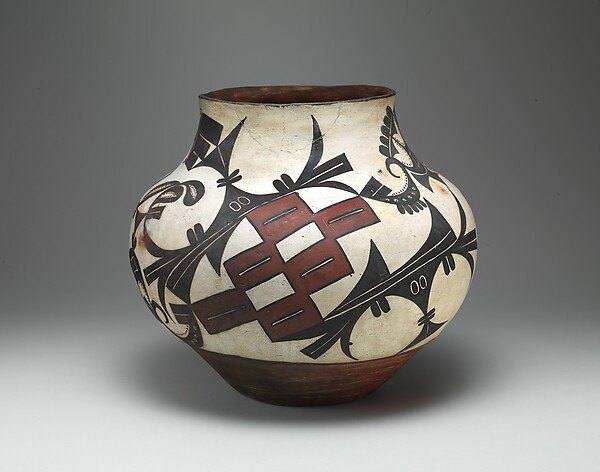
Water Jar, Acoma Pueblo The Metropolitan Museum of Art, Museum Accession, X.2.418
Museum record explicitly identifies culture as Acoma Pueblo. Ceramic water jar; does not identify a named artist or assign universal meanings to its painted motifs. Actual museum item page and API fields read, including Public Domain, culture, date, credit and image URL. 600x472 official web image downloaded unchanged and visually inspected. Object date is approximate. Web copies proportionally resized/recompressed; display backgrounds may be cropped by CSS. Full image remains proportional in the page banner.
Image, association, and reuse record reviewed 2026-10-24.
Full photographs are displayed proportionally above. A translucent background copy may be cropped by the viewport; it does not replace the complete image or its record.
The visual treatment does not change the research status, evidence, or remaining gaps recorded in this profile.
01
Haak’u and different ways of knowing historical time
Acoma’s own introduction explains its name through the idea of a place prepared and describes Haak’u as a spiritual homeland known through oral history and emergence. It separately discusses archaeological evidence and continuous occupation from at least about AD 1200. Those forms of knowledge ask different questions; an excavated deposit does not define the beginning of Acoma identity. The Pueblo’s longer historical essay also examines early Spanish descriptions, including accounts of multistory houses and abundant food. Such records reveal what visitors noticed and wanted to report. They should be read beside Acoma interpretation, rather than allowed to make an outsider’s arrival the beginning of the community’s history. A different kind of evidence comes from a 1987 tree-ring study undertaken alongside housing rehabilitation, with meetings involving Acoma homeowners and representatives. Sampled timbers indicated seventeenth-century construction and later roof repairs. The study helps reconstruct the histories of particular buildings; its limited samples and distinctions between cutting dates and incomplete rings prevent it from becoming a simple date for the origin of Acoma itself.
The 1599 assault and a colonial account of destruction
The Pueblo’s historical account describes a three-day Spanish attack, the burning of the village and provisions, the capture of men, women, and children, and subsequent colonial proceedings. A translated excerpt from Juan de Oñate’s 1599 report offers a primary record from the aggressor’s side. He acknowledges razing and burning Acoma, while presenting it as punishment and a warning to other communities after Spanish deaths. His language of royal obedience and alleged treason is a colonial justification, not this profile’s judgment of Acoma people. Reading the two accounts together makes power and authorship visible. Neither a conqueror’s report nor a short modern summary alone settles every question about casualties, sentences, or their implementation.
The Pueblo Revolt belongs to a later regional history
The 1599 assault should be distinguished from the Pueblo Revolt of 1680, more than eighty years later. The Indian Pueblo Cultural Center’s account explains the regional uprising through exploitation of labor and resources, hunger, violence, and persecution of Pueblo religious life. It presents cooperation among autonomous Pueblo communities as essential to resistance and cultural survival. This regional account provides context for reading Acoma’s colonial history; it is not a detailed reconstruction of Acoma’s particular actions in 1680 or later encounters with returning Spanish forces. The distinction also prevents a misleading story in which one battle, one leader, or one mission represents the whole history of Pueblo resistance.
The Pueblo’s landholding document shows how different legal histories occupy the same present landscape. Its inventory distinguishes the Acoma grant, executive and congressional actions, exchanges, purchases, trust holdings, and leased lands. Entries identify nineteenth- and twentieth-century transactions rather than reducing the land base to one reservation-creation event. These classifications matter: buying a ranch, holding land in trust, and leasing grazing land are different relationships. The document is a historical inventory, with dated entries and supporting records, rather than a current cadastral map. Tribal institutions also speak through their own law: Title 13 assigns responsibilities for language, education, and historic preservation, demonstrating governance over the conditions that sustain community life.
Water rights, historical loss, and proposed repair
In July 2024, Governor Randall Vicente’s written congressional testimony connected Rio San José water to Acoma farming communities, family life, and cultural continuity. He described the effects of upstream development, diversion, and groundwater pumping, alongside federal failures to protect Pueblo water uses. Historical correspondence and earlier proceedings support the Pueblo’s account of a long-running problem. His testimony advocates legislation approving a negotiated settlement and explains a trade-off between enforcing senior rights and obtaining alternative supplies. This is Acoma’s documented argument for a proposed remedy at that hearing. It should not be mistaken for evidence that the legislation was enacted, all settlement conditions were met, or new infrastructure has delivered water.
Preservation means protecting records, places, and skills
Acoma’s historic-preservation office dates its establishment to October 1999. Its public account describes collecting photographs and documents for the community, protecting archaeological resources on and beyond tribal lands, and providing guidance in preservation consultation and repatriation. At San Esteban del Rey, a condition assessment led to work involving traditional religious leadership and church caretakers, known as gaugashti. The office connects restoration to opportunities for Acoma people to learn traditional building methods. This places the mission within a larger community responsibility rather than treating the church as the whole of Acoma heritage. Title 13 supplies a complementary legal record of the preservation office and its advisory structure; an institutional description is not proof that every restoration proposal has been completed.
Language learning and community authority over materials
The H’aakume Dzeeni Language Program describes dictionary work begun in 2017, with fluent speakers editing conversational words and phrases from Acoma, McCartys, and Acomita. Its goals connect learning at home with school curricula. It expressly excludes culturally sensitive vocabulary and seeks member-controlled access to the online resource. The published language policy in Title 13 gives families and households a primary role, alongside tribal and school responsibilities, and supports instruction grounded in Acoma language. These sources document both educational work and the Pueblo’s authority over how knowledge is shared. They do not turn a public program description into permission to reproduce restricted lessons, nor do older project figures establish a current speaker count. Acoma educator Christine Pasqual Sims adds a wider policy perspective in her 2018 Senate testimony. She explains how English-centered testing, teacher credentials, and limited resources can obstruct language efforts, and argues for training and early childhood programs shaped by tribal priorities. Her examples from several communities illuminate shared policy challenges; the Cochiti and Jemez initiatives she describes remain those communities’ programs.
Pottery: individual artists within a living practice
Sky City Cultural Center’s pottery account describes fine walls, geometric work, functional vessels, and artists’ choices among construction and firing methods. Its emphasis on individual expression makes room for innovation alongside inherited practice. The Smithsonian’s biography of Lucy Martin Lewis provides a named example: she learned by watching Acoma women and experimenting, developed her own interpretations, and helped bring Acoma pottery to wider audiences. Her family continued making pottery across generations. Pairing community interpretation with an artist’s biography avoids treating every pot as an anonymous example of a timeless style. These sources support study of public artistic work; they do not authorize copying designs or seeking the locations of materials the community keeps private.
Seeds, farming, and adaptation described by Acoma people
A 2024 New Mexico PBS program includes public accounts from Acoma preservation leader Theresa Pasqual and seed keeper Aaron Lowden. Pasqual connects stewardship with care for land, plants, wildlife, and future survival. Lowden describes changing rain and snow patterns, a seed bank developed from work with young farmers, and efforts to bring Acoma seeds back from outside collections. He also discusses exchanges with other Indigenous growers and the value of varieties suited to differing conditions. His account shows adaptation through relationships, repeated planting, and seed saving rather than a single technical fix. The transcript includes speakers from other communities as well; only the Acoma speakers’ accounts are used here to describe Acoma experience.
Add a fully inspected critical edition of the 1598–1599 trial, translated Acoma testimony, and specialist historical work. Compare casualty, sentencing, and implementation claims without treating colonial proceedings as neutral evidence or repeating uncertain numerical totals.
Deepen Acoma-specific accounts of the 1680 revolt, Spanish return, seventeenth-century mission labor, and community rebuilding; the included IPCC resource supplies regional context rather than that full local history.
Trace the current status of the Rio San José settlement through later Pueblo statements and enacted instruments, and document water-delivery outcomes. A 2024 request for legislation is not evidence that it became law.
Compare the landholding inventory with current Pueblo records and primary grants, executive orders, statutes, and trust decisions. The inventory is historical and has not been converted into a present boundary map or current acreage claim.
Add direct public interviews and writings by more Acoma artists, scholars, teachers, farmers, women, and young people; expand community life beyond the mesa and beyond the examples represented here.
Seek dated language-program, school, and restoration evaluations while respecting member-controlled access and the Pueblo’s authority over cultural and linguistic materials. No Atlas community review has been recorded.
Follow the reading path
Sources & further reading
Open any title to read the original source. Annotations explain what each link can help you explore.
No Indigenous-led source is identified in this entry yet. This is a gap in this collection, and does not imply an absence of community knowledge or organization.
Read the Pueblo’s substantive introductory paragraphs on names, emergence, Haak’u, and archaeological dating. Brief but important community framing, rather than a directory-only homepage. Its dating claims are attributed and not used to rank communities by antiquity. Undated; no current demographic claim is derived from it.
Despite its title, this is a substantial Pueblo-published account of Spanish exploration, written descriptions, the conquest-era attack, prisoners, trial, and later proceedings against Oñate. Read the complete historical text. Its quoted colonial passages require attention to authorship; precise casualty and punishment totals need comparison with critical editions of the records.
Read the complete displayed translated excerpt, including Oñate’s acknowledgement of burning Acoma and his attempt to justify it. Source cited by the university is George P. Hammond and Agapito Rey, eds., Don Juan de Oñate: Colonizer of New Mexico, 1595–1628 (1953), vol. 1, pp. 480–485. This is a colonial report excerpt, not the complete letter, full trial, or an Acoma account.
August 6, 2021 public educational account by the Pueblo cultural institution. Read “Monthly Feature: Pueblo Revolt” and the Po’pay discussion for regional causes, intercommunity cooperation, and cultural survival. This is broader Pueblo context, not a detailed Acoma chronology. Books and videos recommended on the page were not counted as separately inspected sources.
Eight-page tribal document. Inspected PDF pp. 1–4, distinguishing grant, statutory, purchased, trust, and leased holdings, with dated entries extending to 2008. This is a historical inventory; its total is not asserted as the current land base. The attached primary legal material is a further reading path, not a full survey of today’s title status.
July 23, 2024, twelve pages. Read pp. 1–7 on Acoma, hydrology, earlier use, development, and historical correspondence, and p. 12 on the settlement argument. Primary tribal testimony advocating legislation; statements about federal failures are the Pueblo’s documented position. No claim here that H.R. 1304 or a successor bill became law, or that proposed water projects are complete.
Read “Our Journey,” “Preserving the Invaluable,” and “Preservation through Education.” Describes the office’s October 1999 establishment, community archives, archaeological protection, consultation, repatriation guidance, and restoration with traditional leadership. Undated; project aspirations and funding descriptions are not presented as a current completion audit.
Publication: 2019 edition; 2017 replacement text with amendment notes
Published file marked 2019 edition; internal heading says Laws 2003 (2017 Replacement), with origins and amendments noted. Read Chapter 1, especially §§13-1-1–13-1-4 on language, families, tribal and school responsibilities, and Chapter 3 on historic preservation. Primary tribal law demonstrates policy and authority; the text alone does not measure implementation or confirm the absence of later amendments.
Read the complete substantive program description, “What We Do,” objectives, goals, and community work. Describes dictionary work begun in 2017, fluent-speaker editing, school/home learning, exclusion of sensitive vocabulary, and member-access goals. Undated project counts and staffing details are not treated as current. Restricted learning material was not accessed or reproduced.
Read the complete public account on vessel uses, construction choices, individual expression, and continuity and change in artistic work. A community cultural center’s interpretation, rather than a sales listing or anonymous style guide. The embedded video was not independently reviewed, and no designs or material-collection locations are reproduced.
Read both the museum biography and Luce Artist Biography, including observation-based learning, personal style, sales, recognition, and descendants’ work. Named Acoma artist, 1902–1992 as catalogued by the museum. A useful collection-based account rather than a complete autobiography; its references to locally held knowledge do not grant permission to disclose it.
2024 broadcast with public transcript. Inspected the Acoma segments featuring Theresa Pasqual on care and stewardship and Aaron Lowden on climate changes, youth farming, seed saving, rematriation, and exchanges. This review is of the transcript, not independent listening or translation of Keres speech. Other interviewees’ experiences in the same program are not attributed to Acoma.
William J. Robinson, 1987. Read printed pp. 1–10 on meetings with Acoma homeowners and representatives, rehabilitation, methods, and results, plus p. 11’s dating-symbol key. Selected roof timbers support seventeenth-century construction and later repair; a beam date is not a founding date for Acoma. The study is preliminary and samples only parts of the village. Room-by-room owner and location details are not reproduced here.
August 22, 2018 hearing, S. Hrg. 115–367. Read Sims’s oral remarks on printed pp. 25–26 and prepared statement pp. 27–31. The Acoma educator discusses teacher training, tribal decision-making, school policy, and early childhood language learning. Her examples include several distinct communities, especially Cochiti and Jemez; those schools and their outcomes must not be relabeled as Acoma programs. Other witnesses’ statements were not reviewed as part of this source check.
These collections preserve links from supplied studies and further research leads. The collection notes explain their provenance and review status. Links already used above point to their source cards. Supporting references and unread leads are excluded from the substantive inspected-source count.
Acoma Pueblo study · 18 links
Acoma history, government, cultural preservation, and art.
Related entries may represent alternate names, constituent communities, wider groupings, or historical connections. Read the naming notes before treating entries as equivalent.
Robey’s Atlas of Indigenous North America · Compiled October 19, 2026 · Acoma Pueblo