Also find this entry through: Absentee Shawnee Tribe of Indians of Oklahoma
Absentee Shawnee histories connect Eastern Woodlands homelands, repeated displacement, and continuing community life in Oklahoma. Tribal publications, constitutional records, language resources and artworks provide different paths into the Big Jim and White Turkey communities and their shared government.
See each region’s evidence for historical or present-day scope.
Homeland / region
Oklahoma / Eastern Woodlands
Research depth
Expanded profile
Source collection
14 annotated resources · 8 Indigenous-led
Inspected sources
14 substantive works · selected content reviewed
Initial adequacy
Not assessed
Source review
October 19, 2026
Names & relationshipsAbsentee Shawnee, Eastern Shawnee and the Shawnee Tribe are distinct governments. Shared ancestry and language, and collaboration among their citizens, do not make their programs or political histories interchangeable.
An expanded introduction, with sources reviewed.This profile develops several themes through identified sources. Citations connect each section to its evidence; remaining gaps appear below. It has not been reviewed or endorsed by the community.
Backdrop photographs & credits
These photographs have individual, documented connections to this entry. Their captions and source records define the people, place, object, and period shown; no one photograph represents every community within a broader label.
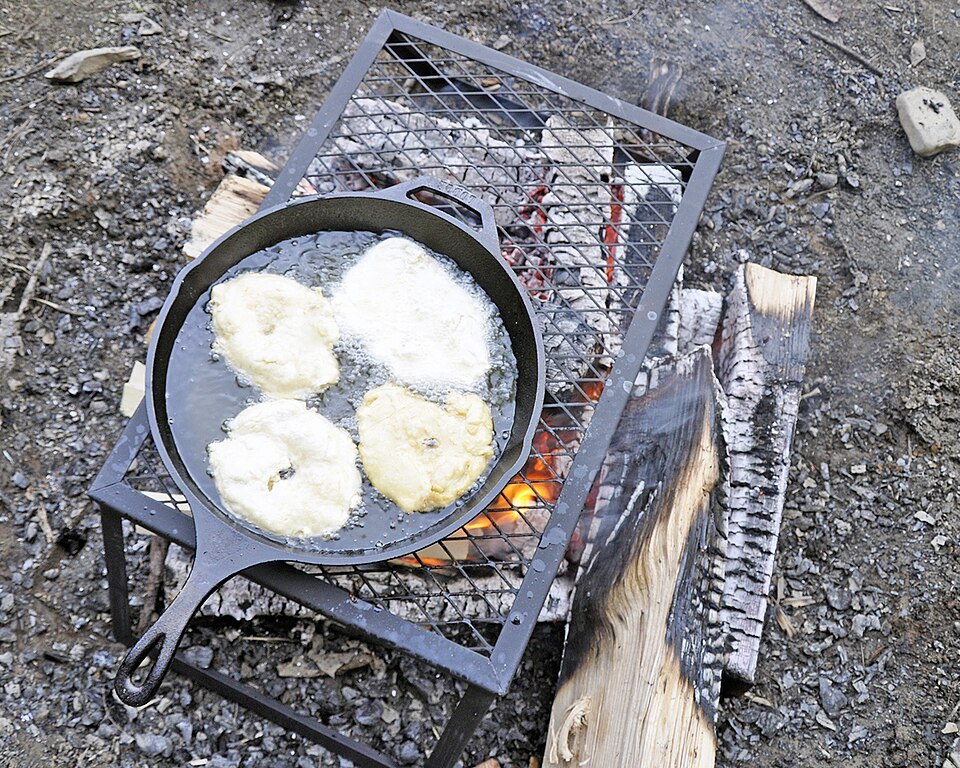
Fry bread at the Absentee Shawnee Culture Camp USDA Forest Service photo by Kelly Bridges, via Wikimedia Commons
Tribal members cooking fry bread at a public Absentee Shawnee Culture Camp event, Camp Horseshoe, Monongahela National Forest, West Virginia. Actual Commons body, original agency attribution, event caption and federal-work license read. 960px archive derivative downloaded and visually inspected; no contemporary facts inferred from the photograph. Web copies proportionally resized/recompressed; display backgrounds may be cropped by CSS. Full image remains proportional in the page banner.
Image, association, and reuse record reviewed 2026-10-24.
Full photographs are displayed proportionally above. A translucent background copy may be cropped by the viewport; it does not replace the complete image or its record.
The visual treatment does not change the research status, evidence, or remaining gaps recorded in this profile.
01
A distinct Shawnee government and community histories
Three federally recognized Shawnee governments now exist in Oklahoma: the Absentee Shawnee Tribe, Eastern Shawnee Tribe and Shawnee Tribe. The Absentee Shawnee Tribe’s account connects its people with Eastern Woodlands homelands and describes movement into Missouri and Arkansas under colonial pressure, with some communities moving onward into Indian Territory and Texas. It traces the Big Jim community to Little Axe and the White Turkey community to the Shawnee area. The constitution’s preamble names both bands. These are communities within one government; shared Shawnee ancestry and language also connect people across the three governments without making their institutions interchangeable.
Article 2 of the 1854 treaty provides especially revealing context for the Absentee distinction. It refers to Shawnee who had been separated from the treaty community and sets conditions for receiving surplus Kansas land if they returned. It distinguishes a five-year return period from a further period involving remaining land or monetary payment. The word “Absentee” thus reflects relationships to Shawnee lands and treaty arrangements in Kansas, rather than an absence of a community or government. Reading the provisions alongside community history shows how federal arrangements tried to redirect dispersed Shawnee people toward Kansas.
The June 26, 1890 agreement is a direct source for a later transformation of Absentee Shawnee landholding. Article 1 uses sweeping language relinquishing claims in the described tract to the United States. Article 2 confirms existing allotments, orders completion of others, excludes certain school and federal lands, and authorizes an agent to allot land for people who failed or refused to select it before the specified deadline. Article 3 ties an allowance of 650 allottees to financial deductions for additional allotments; Article 4 promises $65,000 for homes and improvements. White Turkey and five other named leaders signed the instrument. Its legal text records an imposed policy framework, while leaving essential questions about negotiation, dissent and family experiences for further community-centered research.
Constitutions and the distribution of governmental authority
A constitution ratified in December 1938 organized a council of adult members and a business committee under the Oklahoma Indian Welfare Act. It is a historical document, useful for tracing institutional change. The constitution ratified in June 1977, published by the Tribe with later amendments, describes a judicial branch and a legislative/executive branch, together with an independent election body. The General Council consists of members aged eighteen and older. The five elected Executive Committee offices are Governor, Lieutenant Governor, Secretary, Treasurer and Representative; the published 2019 amendment provides four-year terms. Reading the two documents together shows constitutional development rather than a government frozen at its 1938 structure.
The January 2026 tribal newspaper reports creation of a standalone Language/Culture Department, giving language work its own institutional home after earlier placement within Cultural Preservation and the 477 programs. The article recalls the Executive Committee’s December 2022 language emergency and adoption of the Pi Pa Pe Po alphabet. It describes online lessons, QR codes, after-school teaching and plans for further classes with Administration for Native Americans support. Director Scott Miller emphasizes the difference between recognizing words and carrying on a conversation, and the role of children in bringing language into family life. These are dated accounts of priorities and initiatives; they do not establish a current speaker count or prove that every planned class occurred.
Words in daily life and learning across Shawnee communities
The Tribe’s public lexicon organizes vocabulary around everyday activities: greeting someone, eating, household objects, foods, weather and the seasons. English meanings and phonetic aids make it a practical starting point for learners. A separate May 2024 Shawnee Tribe publication introduces its master-apprentice program through participants’ own accounts. Absentee Shawnee elder George “Fife” Blanchard recalls growing up with Shawnee as his first language and describes his commitment to teaching. Absentee Shawnee apprentice Daniel Citty connects learning with his children and relationships among Shawnee communities. Their accounts show how language work can connect people across governments while retaining each participant’s particular identity and experience.
The April 2024 Cultural Preservation report describes responsibilities extending beyond present Oklahoma settlements. Tribal Historic Preservation Office staff reviewed federal projects and participated in consultation concerning ancestral places, ancestors and funerary belongings. The report also describes work with Ohio History Connection and Ohio’s natural-resources department on interpretation for Great Council State Park. Tribal staff reviewed display wording and advocated use of Pi Pa Pe Po orthography. Library development and Shawnee-centered resources appear in the same report. These activities show cultural preservation as consultation, education and community service. The account records work underway at that date; a consultation should not be described as a completed repatriation.
Ernest Spybuck and the histories carried by paintings
Ernest Spybuck, also recorded as Earnest L. Spybuck, depicted community life in early twentieth-century Oklahoma. Marshall Gettys’s biography emphasizes his work as a farmer as well as a painter, and his relationship with anthropologist M. R. Harrington. Spybuck’s compositions use foreground, background and perspective to show detailed gatherings and activities. The National Museum of the American Indian’s record for Procession Before War Dance identifies him as Absentee Shawnee, dates the work to about 1908, and records Harrington’s purchase from the artist in 1910. Bringing biography and object history together helps readers ask who made an image, how it entered a collection and whose interpretation accompanies it.
Self-government in health, research, and economic life
The self-governance compact signed with the Indian Health Service in July 2017 describes tribal authority to redesign health programs and allocate resources according to community priorities, alongside continuing federal responsibilities. Its attached funding agreement documents a particular historical funding period. The Health System’s RENEW center offers a contemporary example of institution building: its public account connects pain and behavioral-health research with community advice, tribal approval and ownership of data, while describing a registry and research review board still in development. Economic institution building has its own documentary history. The archived Tribal Development Act identifies employment, revenue, enterprise development and land acquisition as governmental purposes. These sources explain authorities and aspirations; assessing their effects requires separate, dated evidence from community experience and outcomes.
Develop more community-authored family and local histories, especially experiences of the Big Jim and White Turkey communities beyond institutional summaries.
Reconstruct landholding under the 1872 legislation and 1890–1891 allotment process through tribal interpretation and primary records; do not equate rights to individual allotments with a blanket claim of communal title.
Add an Absentee Shawnee account of twentieth-century displacement around Little Axe and Lake Thunderbird, with carefully evaluated records of land acquisition and community rebuilding.
Follow up the January 2026 language initiatives with dated community reports on classes, participation and learning; no current fluent-speaker total is asserted.
Expand community perspectives on education, livelihoods, arts and stewardship, and check cultural suitability and permissions before reproducing artworks, recordings or ceremonial material.
Confirm the latest consolidated constitutional and code amendments with the Tribe when using these materials for a precise legal question; archived enactments and funding agreements have different dates and purposes.
Follow the reading path
Sources & further reading
Open any title to read the original source. Annotations explain what each link can help you explore.
No Indigenous-led source is identified in this entry yet. This is a gap in this collection, and does not imply an absence of community knowledge or organization.
Indigenous-ledAbsentee Shawnee Tribe of Indians of OklahomaSource 1
Read the tribal historical account, especially movement, the Absentee name, and Big Jim and White Turkey settlements. Undated narrative with a separately dated membership figure; that figure is not used here. Its phrase “Algonquian dialect” is a broad linguistic simplification.
May 10, 1854 treaty, published at 10 Stat. 1053 and in Kappler’s compilation. Read the preamble and Article 2, particularly provisions concerning absent Shawnee and return to Kansas. The document concerns the Kansas Shawnee treaty parties; it is not evidence that every dispersed Shawnee community consented.
June 26, 1890 agreement reproduced with congressional ratification language. Read Articles I–V and the signatories for cession, allotments, deadlines, and the promised $65,000 payment. A primary instrument of federal land policy, not a complete account of consultation, community consent, or later implementation.
Historical constitution ratified December 5, 1938, printed in 1939. Read printed pp. 1–5, including the preamble, council and committee structure, rights, and adoption certificate. This seven-page scan documents an earlier constitutional arrangement and must not be presented as the currently published constitution.
Tribal publication of the constitution ratified June 4, 1977, incorporating amendments including those dated May 10, 2019. Read pp. 1–4 for the preamble, branches, General Council and Executive Committee, and p. 14 for ratification. Historical explanatory notes are explicitly distinguished from operative constitutional text.
Read the front-page article, p. 1A, about a standalone Language/Culture Department, the December 2022 language emergency, orthography and teaching initiatives. Its fluency statement reports a 2022 assessment; neither that statement nor the announced classes establish current speaker totals or teaching outcomes. Selected article reviewed, not every item in the issue.
Inspected the public vocabulary tables, including greetings, household expressions, foods, months and weather. English meanings and phonetic aids accompany Shawnee forms. Audio columns appear, but recordings were not evaluated. A community learning resource rather than a comprehensive grammar or a replacement for instruction with speakers.
May 6, 2024 introduction to the Shawnee Tribe’s master-apprentice program. Read the program description and first-person introductions of Absentee Shawnee participants George “Fife” Blanchard and Daniel Citty. The publisher is a separate Shawnee government; its program should not be relabeled as an Absentee Shawnee government program.
Read printed pp. 3A and 5A, especially Carol Butler’s departmental report on consultation, NAGPRA, library work and Great Council State Park interpretation. The account records work underway in April 2024; consultations do not establish completed repatriations. The park’s then-planned opening is not treated as an outcome.
Marshall Gettys’s specialist biography, published in 2010 and updated in 2019. Read the account of Spybuck’s farming, schooling, relationship with anthropologist M. R. Harrington and painting style. It offers historical interpretation of an individual artist, not a single description of all Shawnee art.
Object record NMAI_27370, catalog 2/5735. Inspected attribution, circa-1908 date, materials, location and the recorded 1910 purchase from the artist. Specific collection history complements the biography. Metadata and image permissions differ; the linked record is not permission to reproduce the painting or interpret ceremonial knowledge.
Read compact pp. 1–5 and 9, the July 2017 signature page (p. 14), and the attached 2017–2020 funding agreement’s opening and service provisions (PDF pp. 17–19). Explains tribal control and continuing federal obligations. The file is a historical compact and funding package, not the current annual budget or a service-outcome evaluation.
Read the center’s mission, 2024–2026 development timeline, research priorities, community advisory structure and data-sovereignty explanation. Describes a tribally led pain and behavioral-health research initiative. The registry and Tribal Research Review Board are described as developing; intentions and governance commitments are not demonstrated clinical outcomes.
Read sections 101–102, 200–202 and the management provisions. This archived tribal enactment explains purposes including employment, revenue, enterprise development and land acquisition, and identifies Resolution L-AS-93-05. Its historical economic findings and administrative rules are not asserted as a current economic census or an up-to-date consolidated code.
These collections preserve links from supplied studies and further research leads. The collection notes explain their provenance and review status. Links already used above point to their source cards. Supporting references and unread leads are excluded from the substantive inspected-source count.
Absentee Shawnee study · 22 links
Absentee Shawnee history and contemporary community sources.
Related entries may represent alternate names, constituent communities, wider groupings, or historical connections. Read the naming notes before treating entries as equivalent.
Robey’s Atlas of Indigenous North America · Compiled October 19, 2026 · Absentee Shawnee