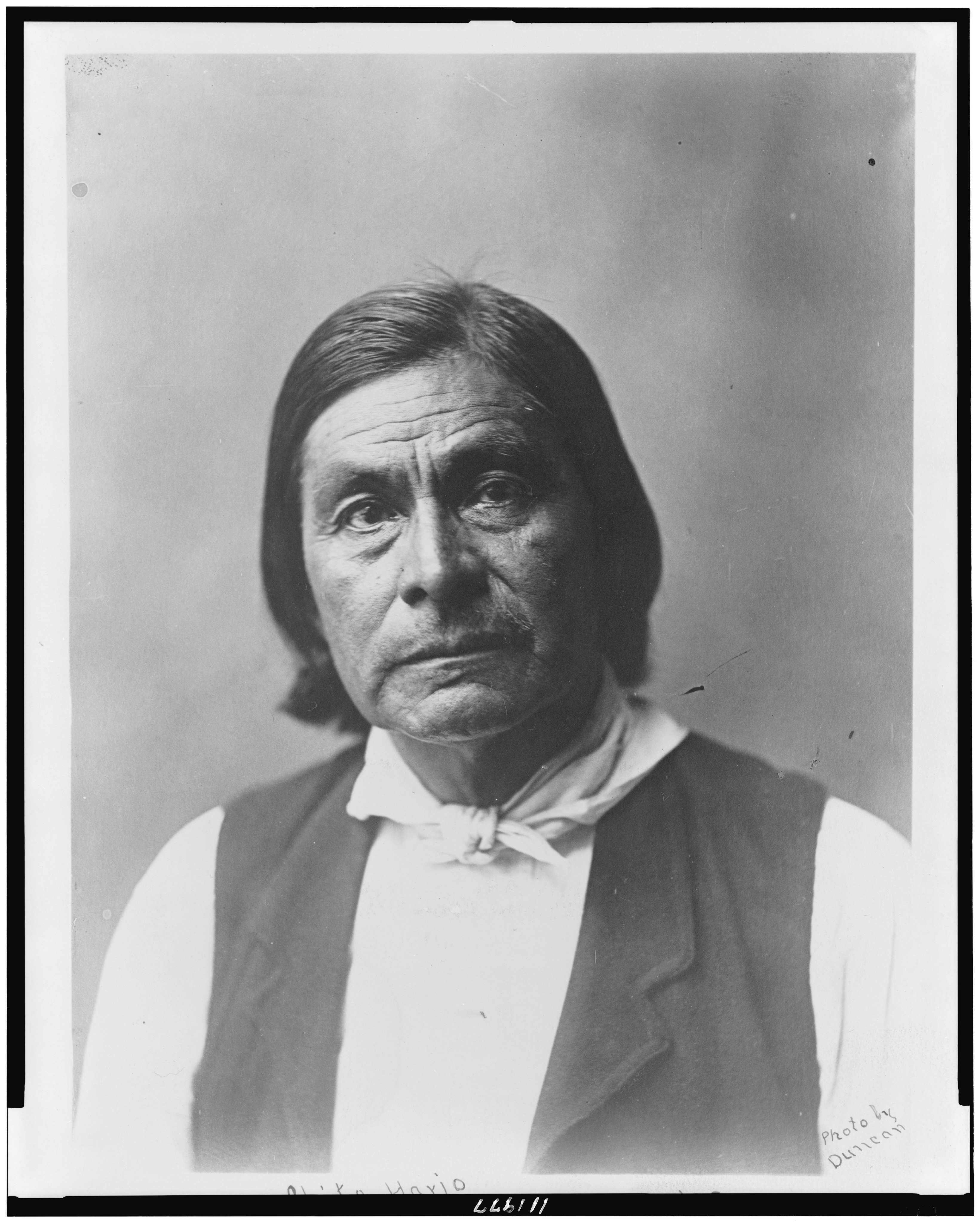
Chitto Harjo, photographed by Duncan, circa 1903Photo by Duncan, c.1903; copyright registered by Harrie D. Blake. Library of Congress, LC-USZ62-111977 (LOT 12920); Wikimedia Commons digital copy. Public domain in the United States; Commons Public Domain Mark1.0.
Also find this entry through: Abihka / Arbeka · Muscogee town history
Abihka names an important part of Muscogee town history, with ancestral connections to Alabama’s Coosa and Choccolocco valleys and continuing Arbeka community life in Oklahoma. Public Muscogee interpretation connects ancestral grounds, forced removal, and the return to those homelands. Historical records use related names at several geographical and political scales, so each source’s date and scope matter.
See each region’s evidence for historical or present-day scope.
Homeland / region
Southeast / Alabama · Oklahoma
Research depth
Expanded profile
Source collection
13 annotated resources · 4 Indigenous-led
Inspected sources
13 substantive works · selected content reviewed
Initial adequacy
Not assessed
Source review
October 27, 2026
Names & relationshipsAbihka is part of Muscogee tribal-town history. Arbeka’s public homeland marker explicitly pairs Arbeka and Abihka; historical records also describe Abihkutci, Talladega, and other related or similarly named towns. Those names require date-specific treatment. Natchez connections appear in the historical literature, but do not make all Natchez or Muscogee communities interchangeable or establish a separate modern Abihka national government.
An expanded introduction, with sources reviewed.This profile develops several themes through identified sources. Citations connect each section to its evidence; remaining gaps appear below. It has not been reviewed or endorsed by the community.
Backdrop photographs & credits
These photographs have individual, documented connections to this entry. Their captions and source records define the people, place, object, and period shown; no one photograph represents every community within a broader label.
Chitto Harjo, photographed by Duncan, circa 1903 Photo by Duncan, c.1903; copyright registered by Harrie D. Blake. Library of Congress, LC-USZ62-111977 (LOT 12920); Wikimedia Commons digital copy. Public domain in the United States; Commons Public Domain Mark1.0.
Chitto Harjo is an individually identified Muscogee historical figure with a documented Arbeka connection: Kenneth W. McIntosh's Oklahoma Historical Society biography places his birth at Arbeka on the Deep Fork River in1846. The existing Abihka profile's public marker and community-history sources explicitly pair Arbeka and Abihka. This portrait illustrates that named person's historical connection, not every Abihka town or family, universal dress, present leadership, a current separate government or territorial extent. The source credits the photograph to Duncan; no fuller photographer identity or sitter-wide cultural interpretation is inferred. The complete available Commons JPEG, including its photographic margins, was downloaded and visually inspected. Commons file history labels the 2018 replacement “LOC upscale” and records a change from 820×1024 to 3281×4096. We inspected the larger Commons file; the original print or negative and whether the replacement involved resampling or a higher-resolution source were not independently established. No source-frame crop, retouching, colorization or generated pixels were added. Directory/backdrop CSS may crop or overlay the display, with credits retained. This image review adds no substantive historical source count.
Image, association, and reuse record reviewed 2026-10-27.
Full photographs are displayed proportionally above. A translucent background copy may be cropped by the viewport; it does not replace the complete image or its record.
The visual treatment does not change the research status, evidence, or remaining gaps recorded in this profile.
01
Begin with Arbeka’s public account
At Choccolocco Park in Oxford, Alabama, a marker headed Muscogee (Creek) Nation identifies its speakers as Arbeka (Abihka). It describes the place as their ancestors’ ceremonial ground, remembers forced removal to Oklahoma, and explains that the people carried their sacred fire west. It connects place names and stories passed between generations with continuing responsibilities to the homeland. This public statement provides a community perspective that older outsiders’ town lists cannot supply. Muscogee Media’s account of the Nation’s 2022 return festival likewise identifies the park with the original Arbeka grounds. These sources establish a living ancestral relationship while leaving the detailed histories of individual towns and families to further research.
John R. Swanton’s 1922 study describes Abihka as an old Muscogee division and one of the confederacy’s foundation towns. He also records uncertainty about the name’s derivation and differences among earlier explanations. A single confident English translation would conceal that disagreement. His discussion distinguishes an Abihkutci associated with Abihka from another associated with Okfuskee and warns about similarly named towns. Benjamin Hawkins’s 1798–99 account calls a particular settlement Au-be-coo-che, while reporting that elders sometimes used Au-be-cuh more broadly for the nation. A researcher therefore needs to identify whether a document concerns a settlement, an affiliated grouping, or a wider political name before placing it on a map.
Brucie Porter’s biography of Yahatatastonake, known to British officials as The Mortar, identifies him as a representative of Abihka. It follows his efforts to negotiate trade and resist colonial encroachment amid competing British, French and Spanish interests. At the 1765 Pensacola congress, he initially questioned speaking for Upper Creek towns whose leaders were absent. This episode helps explain why an individual leader’s participation should not be treated as agreement by every town. Porter’s account is a later scholarly synthesis; the underlying diplomatic papers remain a separate research task.
A landscape of settlements, springs, and family connections
Hawkins places Au-be-coo-che on Nau-che creek, several miles from the Coosa River, and describes scattered settlement on both sides of a fertile creek valley. His account notes limestone springs and wooded slopes and credits the elder Co-tau-lau for information about older customs. It is a federal agent’s dated account, shaped by his own interests in land and agriculture. The 2023 Choccolocco archaeological report adds a different method: comparison of census, land-allotment, and family records. Its discussion links Jim Fife of pre-removal Choccolocco with Arbeka through a 1927 affidavit by his grandson Dorsey Fife. The report presents this as evidence connecting named communities across removal; its archival references remain important leads for independent checking.
Reading the mounds and the public archaeological record
The Alabama Indigenous Mound Trail describes the Choccolocco complex around Boiling Spring as a landscape with earthen and stone constructions made and changed over a long period. It distinguishes early mound-building phases from the Abihka ceremonial ground documented before removal. Its account connects stone constructions with recorded oral histories of a town lost in water. Those interpretations should retain their stated sources and uncertainties. The much longer 2023 public report explains its research methods and credits Muscogee preservation staff and elders, including Arnold Taylor of Arbeka. It offers substantial evidence alongside hypotheses that require further investigation; every interpretation is not a settled conclusion shared by all community members.
Land loss, removal, and the limits of treaty promises
The 1832 Treaty with the Creeks is essential context for the records of Choccolocco and neighboring towns. Article 1 ceded Creek lands east of the Mississippi. Article 2 provided individual land selections and a census, including arrangements for selections by members of the same town. Article 12 stated that people were free to remain or emigrate. Reading those promises beside the Arbeka marker’s memory of forced removal makes their limits visible. The treaty concerns the Creek Nation broadly; it should not be relabeled a separate Abihka treaty. Its text records negotiated provisions and United States commitments, and does not demonstrate that those commitments were honored.
Oklahoma grounds and changing historical descriptions
Swanton’s Modern Square Grounds of the Creek Indians, published in 1931, identifies an Abihka or Talladega ground near Henryetta. Its introduction dates his renewed field investigation to 1929, while its Abihka discussion also references information from Jim Star and a photograph made in 1912. Swanton revises parts of his earlier account and acknowledges that arrangements could change within a town. This is useful evidence of a named community and the history of documentation. Its title’s word modern belongs to the early twentieth century. The report should not be used as a description of present leadership, a current ceremonial schedule, or permission to reproduce sacred practices.
A Muscogee writer, the Gate Town, and resistance to allotment
In his January 31, 1902 Indian Journal essay, Muscogee writer Charles Gibson connects Arbeka’s historical warning and protective role with the name Gate Town. He identifies Chitto Harjo with Arbeka and uses that association to comment on resistance to United States policy. The Sequoyah Research Center’s edition preserves both Gibson’s writing and modern editorial notes, which readers should distinguish. Kenneth W. McIntosh’s specialist biography of Harjo provides further context: it places his birth at Arbeka and follows his opposition to allotment, political organizing, and testimony. Harjo’s experience illustrates a particular person’s struggle over land and sovereignty. It does not establish that every Arbeka person supported the same strategy.
An individual family’s path of cultural reconnection
Muscogee Media’s 2022 account follows Sten Joddi’s experience of reconnecting with cultural life. He recalled hearing that family members came from Arbeka but having few opportunities to participate as a child, and then shared a festival dance with his daughters. The article explicitly describes the festival event as a demonstration and includes different views about it. This gives readers an extended individual account of family connections, interrupted learning, and renewed participation. It should not stand in for everyone’s experience or be turned into a description of a private Arbeka ceremony. Public reporting can document a person’s own story while leaving the authority and internal life of the community distinct.
Returning to the homeland and shaping public history
The inaugural Reyicepes festival in Oxford brought Muscogee citizens, leaders, artists and local residents together in 2022. Mvskoke Media reports ancestral-trail walks, cultural activities and educational partnerships. Separate reporting by Nancy Marie Spears adds original interviews: preservation manager RaeLynn A. Butler identifies the pre-removal Arbeka site and work by city and tribal officials to protect nearby lands. National Council representative Galen Cloud contrasts his journey to Alabama with his ancestors’ forced journey west, emphasizes the importance of present visibility, and describes the continued importance of the fire carried from the homeland. These are specific, attributed interpretations of return and preservation. They do not establish a completed land transfer, title ownership or a single view held by every Arbeka person.
Seek additional Arbeka-authorized public history and review of preferred names, the town relationships summarized here, and the cultural suitability of archival descriptions.
Inspect the original Dorsey Fife affidavit, the relevant land-allotment ledgers and census pages, and the maps behind the 2023 report rather than relying solely on its archival synthesis.
Deepen the distinction between historical Abihka, Abihkutci, Abihka-in-the-west, Talladega and Choccolocco communities; similar spellings and reused names do not by themselves establish identical locations or institutions.
Expand community-specific evidence on language learning, schooling, livelihoods, women’s experiences, and life beyond the selected public reports. No present speaker, membership, or population total is asserted.
Add community-led accounts of Natchez relationships and of removal and allotment experiences; older authors’ assimilation claims and one leader’s biography do not represent every family.
Follow the Oxford educational and preservation partnerships with dated evaluations of outcomes, distinguishing plans from completed work.
October 19, 2026 baseline: Twelve inspected resources support a developed historical and community reading profile. The count is separate from research completion or community review. The community marker and 2022 return reporting now substantiate a public Arbeka–Abihka homeland connection that was missing from the earlier guide. Detailed family and institutional histories remain open. October 27, 2026: one additional inspected scholarly biography adds a cited discussion of Abihka diplomacy and representation. The thirteen-work collection remains open to further research and community review. The new Chitto Harjo photograph is a visual illustration with a documented Arbeka connection, not an extra historical source inspection.
Follow the reading path
Sources & further reading
Open any title to read the original source. Annotations explain what each link can help you explore.
No Indigenous-led source is identified in this entry yet. This is a gap in this collection, and does not imply an absence of community knowledge or organization.
Indigenous-ledMuscogee (Creek) Nation / City of Oxford; transcription hosted by the Historical Marker DatabaseSource 1
Public marker erected in 2016; read the full inscription, transcribed and photographed in 2020. Speaks in Arbeka’s first-person voice about ancestry, removal, the fire, and remembered places. The database is a third-party host; this is a public place statement, not a full genealogy or account of current government.
April 20, 2022 report, read in full. Identifies the original Arbeka grounds at Choccolocco Park and records Muscogee leaders’ interpretations of the return festival, education, and partnerships. A dated event account; future opportunities discussed in interviews are not proof of later implementation.
March 31, 2023, 166-page public PDF. Inspected preface i–v and relevant printed pp. 57–65, 69–73. Connects archival and family evidence to Choccolocco and Arbeka and identifies collaborators. Partial review, not all three technical volumes. Archaeological and linguistic hypotheses remain attributed interpretations.
Bulletin 73 (1922), printed pp. 251–254; inspected the Abihka text and a public-domain scan of pp. 252–254. Compiles earlier records and named narrators; useful for conflicting etymologies and Abihkutci distinctions. Dated interpretations and historical descriptions need comparison with community accounts. Link opens the Smithsonian record and full PDF.
First published in 1848; read printed pp. 24–25 and 41–42, especially Au-be-coo-che and Hawkins’s attribution to Co-tau-lau. Detailed settlement and landscape description by a United States Indian agent. His spellings, agricultural judgments, and descriptions of customs belong to this historical encounter and are not contemporary community guidance.
Read the full site interpretation. Explains the complex’s successive construction phases, Abihka ceremonial association, and recorded flood traditions. An accessible specialist introduction, not a detailed excavation report. Its suggested explanations for stone constructions retain uncertainty and should not become unqualified claims about a single ancient population.
Read the treaty transcript, particularly Articles 1–5 and 12–14. Primary context for land cession, family selections, census records, and promises about emigration. Covers the Creek Nation as a whole; no separate Abihka agreement is implied. Treaty commitments need comparison with what United States authorities subsequently did.
Published November 11, 1931. Read introduction pp. 1–4 and Abihka pp. 13–15, including the author’s explanation of changed information. Documents Abihka/Talladega near Henryetta through dated fieldwork. This historical publication includes culturally sensitive ceremonial detail; its availability does not authorize reproducing practices or assuming current arrangements.
Read the author biography, January 31, 1902 Indian Journal essay, and editorial footnotes. A Muscogee writer’s account connects Arbeka, warning duties, and Chitto Harjo in the allotment era. His commentary is an individual historical perspective; modern notes and historical newspaper text have different authors and should remain distinguishable.
Read the full specialist biography. Places Harjo at Arbeka and traces his opposition to allotment, organizing, testimony, and later persecution. A concise secondary account with further-reading leads; a biography does not show unanimous community opinion, and its terminology should be read in historical context.
August 8, 2022 report. Read the full article, especially Sten Joddi’s family connection to Arbeka, reconnection with his daughters, and differing views of the festival demonstration. This concerns a public event and particular interviewees; it is not a description of a private Arbeka ceremony or a uniform community position.
May 23, 2022 Native-authored reporting, with original interviews concerning Arbeka's Oxford homeland. Read the opening Muscogee discussion and closing Galen Cloud quotation; other sections concern different nations. Distinct from the Mvskoke Media festival report. This is reporting with attributed voices, not a tribal policy document or evidence of a completed property transfer.
Read the complete main article and bibliography, updated April 22, 2025. Identifies an Abihka representative and examines eighteenth-century diplomacy, especially the 1765 Pensacola congress. A later scholarly synthesis, not the original diplomatic correspondence or evidence of unanimous town consent. Its cited publications remain further-reading leads, not additional inspected works.
These collections preserve links from supplied studies and further research leads. The collection notes explain their provenance and review status. Links already used above point to their source cards. Supporting references and unread leads are excluded from the substantive inspected-source count.
Abihka study · 16 links
Abihka town history and its wider Muscogee context.
Related entries may represent alternate names, constituent communities, wider groupings, or historical connections. Read the naming notes before treating entries as equivalent.
Robey’s Atlas of Indigenous North America · Compiled October 19, 2026 · Abihka