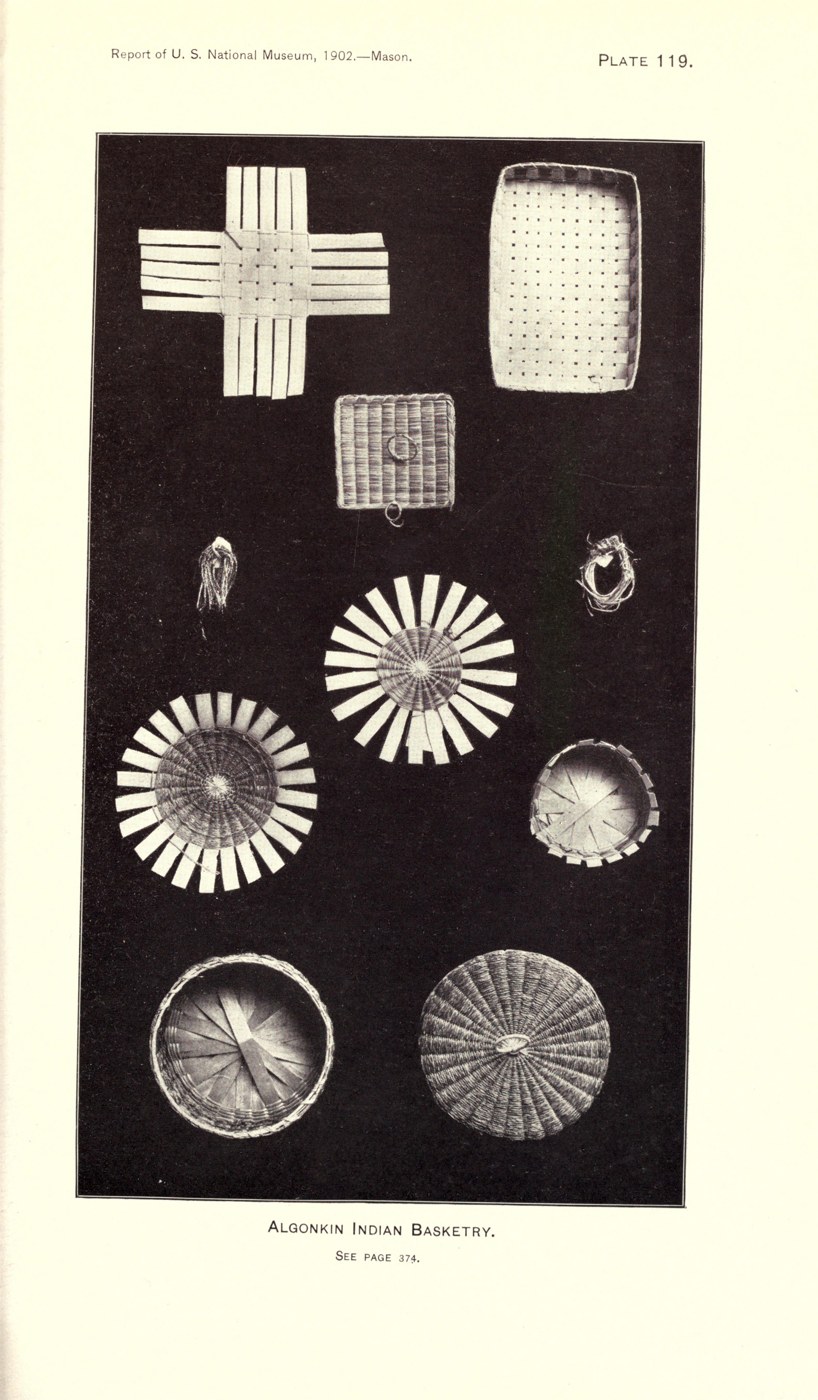
Basketry by Caroline Masta (Abenaki), published 1904Caroline Masta, basketmaker; Herbert B. Rowland, photographer. Smithsonian / U.S. National Museum, 1904; UC Libraries / Internet Archive scan.
Abenaki histories connect waterways and communities across the present Canada–United States border. This collection centers publications by Odanak, Wôlinak, and W8banaki institutions, with historical writing by Joseph Laurent and a provincial reference. It follows colonial change, basketry and forest care, language learning, community research, museum work, foodways, and governmental priorities.
See each region’s evidence for historical or present-day scope.
Homeland / region
Northeast / Québec and New England
Research depth
Expanded profile
Source collection
13 annotated resources · 12 Indigenous-led
Inspected sources
13 substantive works · selected content reviewed
Initial adequacy
Not assessed
Source review
October 19, 2026
Names & relationshipsThis profile centers Odanak, Wôlinak, and their shared W8banaki institutions. Abenaki is not interchangeable with the wider Wabanaki grouping. Historical umbrella labels, present governments, citizenship, and administrative recognition must be distinguished; this directory does not determine identity or represent a single institution as speaking for everyone using the name.
An expanded introduction, with sources reviewed.This profile develops several themes through identified sources. Citations connect each section to its evidence; remaining gaps appear below. It has not been reviewed or endorsed by the community.
Backdrop photographs & credits
These photographs have individual, documented connections to this entry. Their captions and source records define the people, place, object, and period shown; no one photograph represents every community within a broader label.
Basketry by Caroline Masta (Abenaki), published 1904 Caroline Masta, basketmaker; Herbert B. Rowland, photographer. Smithsonian / U.S. National Museum, 1904; UC Libraries / Internet Archive scan.
Actual Plate 119 and printed page 374 of Otis Tufton Mason’s Aboriginal American Basketry (Government Printing Office, 1904) were visually inspected, together with the title page. The broad plate caption says Algonkin Indian Basketry; page 374 specifically identifies the objects as Caroline Masta’s work, identifies her as Abenaki from Pierreville, Canada, working in Belmar, New Jersey, and credits Herbert B. Rowland. This supports this maker-specific Abenaki association, not a universal design for all Abenaki communities. Exact photograph date is not established. The card is a detail crop of the finished round basket at lower right (source pixels 1200,2800–1950,3540); the complete scanned plate is displayed proportionally on this page. Web copies are resized/recompressed; CSS may crop or overlay background copies. No image content is generated or retouched. The scan is the UC Libraries / Internet Archive copy, not a current Smithsonian object photograph. Current Smithsonian photos with Usage Conditions Apply were not reused. Historical evaluative language surrounding the maker identification is not adopted. This image review does not change substantive research-source counts.
Image, association, and reuse record reviewed 2026-10-25.
Full photographs are displayed proportionally above. A translucent background copy may be cropped by the viewport; it does not replace the complete image or its record.
The visual treatment does not change the research status, evidence, or remaining gaps recorded in this profile.
01
Names, communities, and the homeland beyond borders
W8banaki’s own historical account explains its preferred name through dawn and land and locates Ndakina across present-day Québec and New England. Waterways organize this geography: rivers connect communities, seasonal work, travel, and relationships with neighboring peoples. Québec’s provincial profile locates Odanak and Wôlinak near the Saint-François and Bécancour rivers on the south side of the St. Lawrence. It also acknowledges members living elsewhere in North America. The two community locations are therefore starting points for understanding a much larger homeland. Abenaki should also be distinguished from the wider Wabanaki grouping, which connects distinct nations rather than identifying a single government or language.
Colonial pressures and the continuation of land-based life
The Nation’s historical synthesis places seventeenth- and eighteenth-century epidemics, military conflict, trade, and colonial land grants within an already inhabited landscape. War drove movements toward safer settlements and missions, while families continued using routes across Ndakina. Its account follows hunting, fishing, guiding, and forestry work after the change of colonial rule in 1763, and explains how settlement and private hunting clubs restricted access. This is a history of changing opportunities and constraints rather than a simple migration that ended all southern connections. The Foodways guide brings that history into an educational account of adaptation and continuing relationships. Detailed local experiences and the interpretation of individual colonial records still require further study.
A public booklet by Louis-Vincent Laperrière-Désorcy, Sarah Robert, and Allison Bain explains archaeological work undertaken with the Nation and its museum. It describes the mission at Saint-François-de-Sales, its destruction in the 1759 attack, and rebuilding by the community. More than a list of discoveries, the booklet explains how soil layers, artifacts, radiocarbon dating, and plant and animal remains are interpreted together. Food-storage pits and refuse deposits provide evidence of fishing, hunting, cultivated crops, and the incorporation of European foods. The authors connect these findings with household work and women’s and children’s contributions. This is a study of a particular historical place, with evidence and interpretive methods readers can examine. It does not date the origins of Abenaki people or describe every family’s diet across Ndakina.
Basketry links skilled work, family travel, and forest care
Québec’s account connects ash and sweetgrass basketry with winter production and summer sales in the United States, followed by changing commercial arrangements. The May 2022 Pilaskw report adds named community perspectives: Daniel G. Nolett presented family photographs of basket booths in New England, and Suzie O’Bomsawin discussed research on harvesting, production, and sales routes. A 2022 Ndakina report carries these relationships into conservation. Members linked the future of black ash to basket makers’ livelihoods, knowledge transmission, and women’s work; environmental teams combined forest surveys with community knowledge of suitable trees. The report also records concern that a proposed species listing could restrict basket sales. That is a dated community policy position, alongside concern about the emerald ash borer, rather than a statement of current law or present forest conditions.
Joseph Laurent’s 1884 New Familiar Abenakis and English Dialogues offers an Abenaki-authored historical starting point. Its preface identifies two purposes: helping young Abenaki learn English and preserving Abenaki through written explanations. Its alphabet and pronunciation material show an author making choices for particular readers, not an outside collector simply recording a supposedly disappearing people. Those choices and the period’s terminology need context. A very different resource appears in Winter 2024 Pilaskw: Neg8nsosakilal8mow8gan, a language application using remastered recordings, everyday words, and illustrations largely made by a young woman from Wôlinak. The dated report connects inherited voices with new forms of learning. It documents an initiative and its goals without measuring present fluency or establishing that every digital feature remains available.
A museum that records living community and artistic work
The Musée des Abénakis dates its work at Odanak to 1965 and describes representation and transmission as core responsibilities. Its 2024–2025 activity report makes that mission more concrete. It records the opening of the W8banakiak permanent exhibition in June 2024, describes collecting photographs and objects from community life, and includes contemporary art, music, theatre, and film among the heritage being preserved. The report also distinguishes materials from other Indigenous nations in its collections. A work shown at an Abenaki museum is therefore not automatically Abenaki in origin. Reading the report beside the institution’s mission connects public interpretation with collecting decisions, education, and documented activities during a particular year.
Research, archaeology, and responsibilities to heritage
The Bureau du Ndakina describes its role in supporting the Odanak and Wôlinak councils through historical, archaeological, environmental, and territorial research. Its mandate connects knowledge gathering with consultation, stewardship, climate adaptation, and relationships with members. The public 2025 archaeology protocol explains what community participation should mean in work involving sites, belongings, institutions, and development. Its summary emphasizes responsibility for preserving and transmitting heritage, the integration of community knowledge, and shared decisions. The file’s cover calls it preliminary, a qualification that matters: its publication does not by itself establish adoption or implementation. These sources make the Nation’s own role in research visible rather than treating archaeology as something done only by outside experts.
Governance and priorities identified by the communities
Wôlinak’s strategic plan sets out a vision of collective well-being, cultural confidence, employment, economic autonomy, and greater control over community affairs. Its mission identifies education, health, housing, income security, employability, and territorial resources among council responsibilities. The document has a 2023–2028 cover and February 2022 internal update labels; its goals need to be read within that planning context. Odanak’s Winter 2024 newspaper adds a different dated perspective: the chief discusses future self-government, citizenship-code deliberations, sustainable revenues, and participation by members. These are community discussions and priorities. They do not establish that a proposed governmental transition has occurred or that every planned service or business has been completed.
Foodways as a path into history and contemporary learning
The Abenaki Foodways Project’s educator guide was developed with W8banaki citizens and collaborators across Ndakina. It brings farming, fishing, gathering, and care for land into the same learning framework as history and sovereignty. Its agricultural section connects crops that store well with seasonal needs, then describes present community gardens, seed sharing, and planting around public spaces. This is a useful introduction to how food, land, and teaching meet. The guide also identifies its contributors and conditions of use. Readers should follow its original lessons and distinguish a classroom synthesis from the varied experiences of individual households or a full study of every part of the homeland.
Broaden the collection through substantial, fully inspected historical scholarship, oral-history projects and public writing addressing particular places and families throughout the homeland. The current selection centers Odanak and Wôlinak rather than claiming complete regional coverage.
Compare colonial missions, military violence, settlement and land restrictions through original records and community interpretations. A broad historical synthesis cannot settle each event, local chronology or territorial claim.
Develop a carefully attributed account of contested contemporary identity and recognition claims, including the relevant nations’ positions, state records, and the perspectives and evidence of those whose claims are disputed. The May 2022 Odanak report is one primary position, not an independent adjudication.
Inspect more of Laurent’s dictionary and later language scholarship with appropriate orthographic context; seek dated evaluations of community language teaching rather than inferring results from project announcements.
Follow the black-ash work, Wôlinak planning goals, Odanak governance discussions and preliminary archaeology protocol through later community reports, distinguishing plans, adoption and demonstrated outcomes.
Add more first-person public accounts by women, young people, artists, basket makers and land users, and seek community review of scope and interpretations. The twelve-source target is separate from an adequacy assessment, a completed deep dive or community review.
Follow the reading path
Sources & further reading
Open any title to read the original source. Annotations explain what each link can help you explore.
No Indigenous-led source is identified in this entry yet. This is a gap in this collection, and does not imply an absence of community knowledge or organization.
Substantial nation-published history. Read naming, waterways, colonial rivalry, and the continuation of land-based work after 1763. Attributes its historical interpretation and gives references. Its broad historical labels and territorial claims require context; no present population figure or precise ancient ethnic identification is derived from it.
Provincial profile updated May 22, 2025. Read the community-location, basketry, and economic paragraphs. Its administrative frame covers Québec and cannot define the entire homeland. Current population and speaker figures are not used. The museum’s own record is preferred for its 1965 founding date.
Inspected printed pp. 1–2, especially the April 2022 UVM event report and named Odanak speakers’ accounts of basket sales, travel, and historical research. The issue is dated May despite its June upload path. Criticisms of Vermont recognition are the council’s attributed position, not an Atlas adjudication.
March 31, 2022 report. Inspected summary, community consultation, inventory methods, and discussion, especially printed pp. 5–6, 13–25. Combines member priorities with forest surveys. Positions about a proposed species listing are dated advocacy; neither current regulations nor present forest health is inferred. Detailed mapped locations are not reproduced.
1884 Abenaki-authored book. Inspected title pages, preface pp. 5–6, alphabet and opening pronunciation material through public-domain OCR. Laurent identifies teaching English to young Abenaki and preserving Abenaki as purposes. The complete dictionary and etymologies have not been reviewed; spelling and colonial-era terms need historical context.
Inspected printed p. 1 on governance discussion and p. 6 on Neg8nsosakilal8mow8gan. The report explains remastered recordings and community contributions to an application. Announced objectives are not a current speaker census, an independent evaluation of learning, or confirmation of present app availability.
Read the museum’s history, mission, and values. Odanak-based institution explains its work since 1965 and its responsibilities in representation and transmission. This institutional account is distinct from its dated activity report; officeholders and visitor totals are not treated as permanent facts.
Twenty-page activity report. Inspected PDF pp. 3–11: leadership accounts, collection priorities, exhibitions, and cultural activities. Records the June 21, 2024 opening of W8banakiak and distinguishes collections from other Indigenous nations. Its 2024–2025 reporting period is retained; the 2026 URL path is not presented as the activity date.
Inspected cover, authorship and summary, printed pp. ii–iv. The cover explicitly says Version préliminaire and the text carries April 2025 headings despite the later file path. Used for its stated stewardship aims and community participation, not as proof of legal adoption or full implementation. Remaining chapters await detailed review.
Read the department’s substantive mandate and description of its guardians initiative, not only the directory or linked bibliography. Explains support for Odanak and Wôlinak in research, consultation, environment and climate adaptation. Linked reports not separately inspected are not counted; staff listings are not used as lasting facts.
Publication: Cover: 2023–2028; internal update: February 2022
Seven-page council planning document. Inspected mission, vision, values and situation analysis, PDF pp. 2–4. The cover says 2023–2028 while internal update labels say February 2022; retain that distinction. Its aspirations for services, autonomy, land and participation do not establish completed projects.
Fourteen-page public guide; inspected credits and pp. 3–12 on identity, territory, history, farming and stewardship. Names community contributors and offers classroom connections. A collaborative educational interpretation with stated use conditions; lessons and images are linked in their original form. Its broad comparisons are not applied uniformly to every family.
Thirteen-page collaborative public booklet. Inspected credits and PDF pp. 3–9 on Fort Odanak history, stratigraphy, dating, food-storage pits, animal remains and cultivated plants. Explains research at one site, not a complete picture of all Abenaki foodways. No publication year is printed in the inspected opening; the 2026 upload path is not used as a firm publication date.
These collections preserve links from supplied studies and further research leads. The collection notes explain their provenance and review status. Links already used above point to their source cards. Supporting references and unread leads are excluded from the substantive inspected-source count.