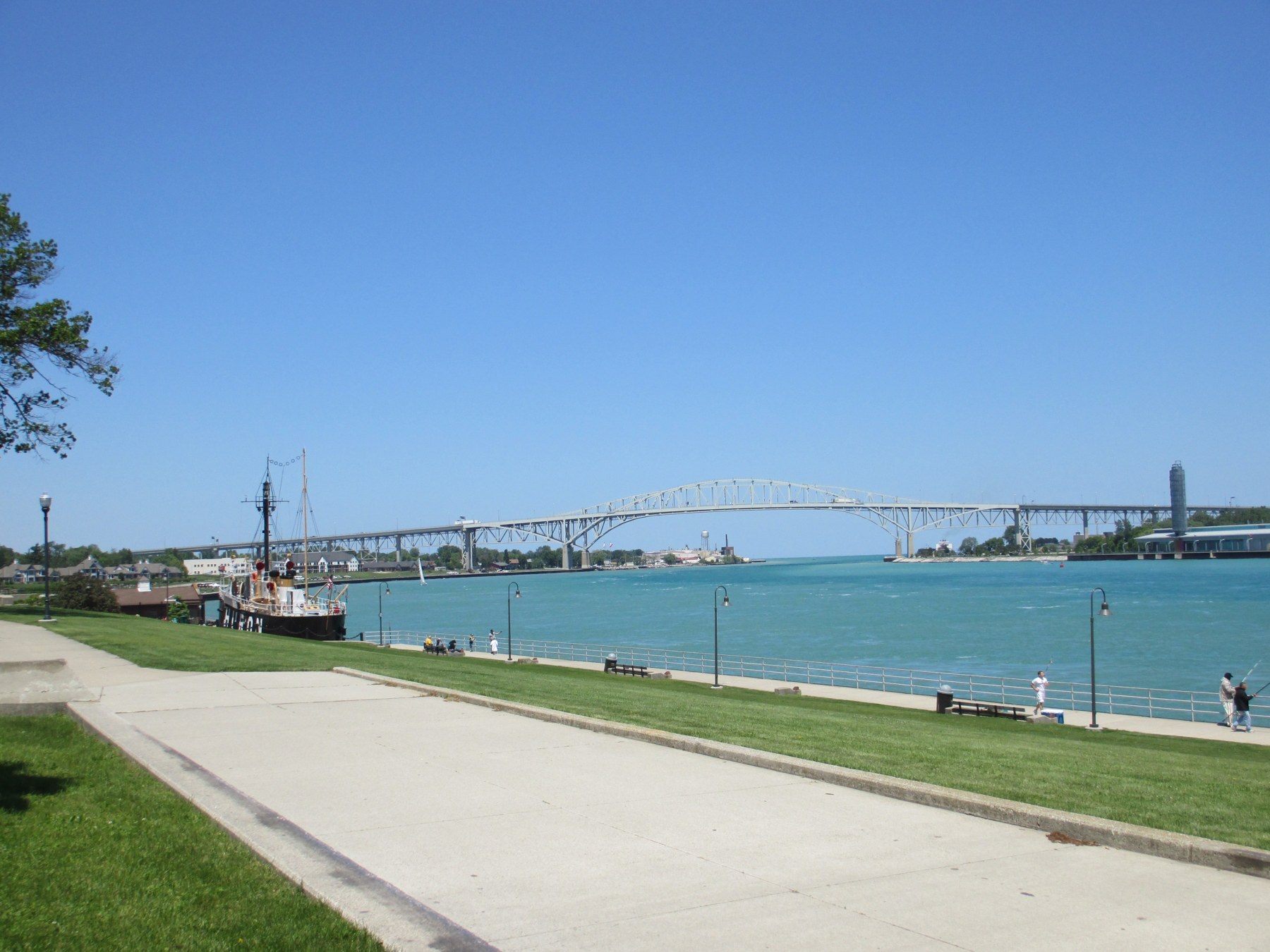
St. Clair River and Blue Water Bridge between Port Huron and Sarnia, June 2012 — regional waterway contextJim Olah (HaloJim) / Wikimedia Commons, originally Pixabay · CC0 1.0 · resized and recompressed
Aamjiwnaang’s history page, credited to David D. Plain, describes an earlier territory spanning both sides of the St. Clair waterway. A 2015 community publication documents Maajiigin Gumig’s native-plant and learning aims.
See each region’s evidence for historical or present-day scope.
Homeland / region
Ontario, Canada — listing address only
Research depth
Source guide
Source collection
2 annotated resources · 0 Indigenous-led
Inspected sources
2 substantive works · selected content reviewed
Initial adequacy
Still unfinished
Source review
October 27, 2026
Names & relationshipsListed as an Anishinabek Nation member First Nation. This is an organizational relationship; membership alone does not establish ethnicity, language, ancestry, citizenship, jurisdiction or representation of another named community.
A source guide for a deeper dive.This entry provides a brief orientation and an organized reading path. A comprehensive deep dive has not yet been completed. Follow the annotated sources and distinguish primary community accounts from outside reference material.
Still unfinished
Two directly relevant works have been read for a bounded starting guide. The selected perspectives and periods leave substantial community history and later developments unreviewed.
Assessment recorded October 27, 2026. This is separate from research completion and community review.
Read David D. Plain’s longer historical works and corroborating archival material beyond the short web account.
Review community-directed environmental research and later greenhouse reports for outcomes and changes since 2015.
Resolve the different English explanations of the name in community web publications without imposing a single gloss.
Backdrop photographs & credits
These photographs have individual, documented connections to this entry. Their captions and source records define the people, place, object, and period shown; no one photograph represents every community within a broader label.
St. Clair River and Blue Water Bridge between Port Huron and Sarnia, June 2012 — regional waterway context Jim Olah (HaloJim) / Wikimedia Commons, originally Pixabay · CC0 1.0 · resized and recompressed
Regional waterway context explicitly permitted by parent after community-specific media access failed. Exact Commons item identifies St. Clair River between Port Huron and Sarnia; original archived Pixabay item tags the same river and Michigan. Aamjiwnaang’s Environment Department explicitly locates the community on the St. Clair River within Sarnia. This photograph is not identified as Aamjiwnaang’s reserve shore or a community building. Complete available 4608×3456 source frame proportionally resized to 1800×1350 and JPEG recompressed; no pixel crop or retouching. Original source copy retained privately. CSS crops/overlays affect display only.
Image, association, and reuse record reviewed 2026-10-27.
Full photographs are displayed proportionally above. A translucent background copy may be cropped by the viewport; it does not replace the complete image or its record.
The visual treatment does not change the research status, evidence, or remaining gaps recorded in this profile.
Read a dated community publication that connects native plants, restoration and intergenerational learning.
These are selected starting points. The full annotated collection, source perspectives, inspection limits and remaining research questions follow below. A starting guide is not an exhaustive history or community endorsement.
01
A community historian’s account of changing territory
David D. Plain’s Nation-hosted account places eighteenth-century Aamjiwnaang around the waterway between Lakes Huron and Erie. It describes wars, epidemics and land transactions that reduced territory and separated communities across the international border. The account also records the revival of Aamjiwnaang as the name of the community at Sarnia. Its historical narrative offers a starting point for reading the longer histories it links.
Aamjiwnaang’s report of the September 2015 greenhouse opening describes Maajiigin Gumig as a community native-plant project. Its planned work included plant rescue and restoration, seed collection, propagation and learning across generations. The report identifies outside funders and training partners while emphasizing that the greenhouse belonged to Aamjiwnaang’s initiative. These are the project’s stated aims at opening.
Read David D. Plain’s longer historical works and corroborating archival material beyond the short web account.
Review community-directed environmental research and later greenhouse reports for outcomes and changes since 2015.
Resolve the different English explanations of the name in community web publications without imposing a single gloss.
Selected actual-content works support a bounded starting guide. Earlier source objects retain their original review dates and limits. Reused URLs, images and identity-only checks are not new global historical works. Full history and community review remain open.
Follow the reading path
Sources & further reading
Open any title to read the original source. Annotations explain what each link can help you explore.
No Indigenous-led source is identified in this entry yet. This is a gap in this collection, and does not imply an absence of community knowledge or organization.
Community-authored public historyAamjiwnaang First Nation; historical account courtesy of David D. PlainSource 1
David D. Plain’s account, hosted by Aamjiwnaang, describes an earlier cross-border territory and contraction through war, disease and land transactions. Historical figures and treaty summaries need their stated context.
Inspection: Content reviewed for the stated scope
Scope: Actual Early History and Modern History bodies (web lines 220–230) read; headings and chief chronology inspected only to bound use.
The community’s opening report describes a native-plant greenhouse and planned restoration, seed and learning activities. Its 2015 plans are read as program history, not a current service schedule.
Inspection: Content reviewed for the stated scope
Scope: Actual complete one-page PDF text: title/date, project paragraph, proposed initiatives and credited partners. Photographic collage viewed only as document context, not cleared for media reuse.